20+ years as a sales leader/trainer/coach/manager- father & husband. I simply enjoy the continual pursuit of learning to help gain the edge in all facets of business and sales success. What I learn that works, I like to share. You are invited to join in on the journey by subscribing and by sharing your comments. Thank you for visiting!
Sales leaders set goals. But they often set only one type of goal, and in doing so they set themselves up for failure. Here are different types of goals to set:
Achievement goals – These describe results that you will have when you finish the goal. Examples include: retire with a million dollars at age 65, earn a promotion by June, increase sales by 5%. Most major goals are achievement goals.
2. Action goals – These describe specific actions that you will take to accomplish achievement goals. Examples include: meet with an investment counselor, attend a workshop to learn new job skills, contact all of the prospects in the database.
3. Layered goals – These specify the same goal with different levels of priority and difficulty.
4. Rate goals – These specify actions repeatedly done over time. Examples include: Read two books per month, exercise three times per week, or write in a journal every day. Many personal growth activities can be performed as rate goals.
5. Limit goals – These set boundaries. Examples include: Spend less than $5,000 on new equipment, go to bed before 10 PM each night, take less than 45 minutes for lunch while at work. These help manage priorities.
6. Exclusion goals – These state things that you will not do. Examples include: Do not watch TV after 8 P.M., do not use a cell phone when with other people, do not eat junk foods. These help you decide in advance which activities you will avoid.
Now that you know the six types of goals begin thinking about how you can incorporate these into your short and long term plans. Doing so will put you on a path to maximum achievement!
As 2021 heads toward the finish line and preparations for 2022 begin, hopefully you’ve taken the time to clarify the roles of your sales team and sales management. It’s a valuable exercise. Once roles have been clarified now you get to assess sales team strategy and culture. Regardless of your methodology, for many organizations, half of your sales representatives currently perform below average. Fifty percent are performing below average! Think about that. For many managers it is an indisputable fact. So why even assess the team? Simply put, to sell more.
Successful selling organizations consist of three components; investment, activity and results. The first component is the investment in the sales team. The investment is measured in compensation, benefits, computers, cars, training, hiring, meetings, sales material, phones and other related expenses.
The second element is the activity of the investment. Face-to-face meetings, travel, preparation, telephone calls and administration comprise the second element. The third, and vital, component stands alone; results. How many sales were generated? Profits? Current market share?
The glue that binds the three distinct parts includes your people, culture and customers. Is there a career path for salespeople? What is your turnover rate? Who are the sales heroes? What is driving the team to achieve?
The best sales managers and sales teams recognize four productivity drivers.
Sales research-information related to market trends, target markets, customers, trends, etc.
Investment and organization-size, structure and deployment of sales team allows you to get the right people at the right place at the right time.
People-selection, training, managing, motivating, evaluation and termination.
Sales systems and processes-compensation, incentives, benefits, internal support, etc.
Tests and surveys remain the most effective way to assess salespeople. Companies rarely assess sales management instead relying on results to determine effectiveness.
A successful selling organization operates in a progressive culture. What’s a culture? That’s best answered by the following story that is illustrative in how many cultures are established.
Six apes were placed in a room with a ladder. A bunch of bananas hung from the center of the room. One ape started to climb the ladder for the fruit and the entire room was showered with cold water. This happened a few times until any ape that wandered near the ladder was beaten by other apes in fear of another cold shower. The researchers decided to stop the cold showers should any ape approach the ladder. A new ape replaced one of the original apes. The new guy, not yet accustomed to the rules, headed for the ladder and received a thorough beating as the original apes expected cold shower. He learned not to go near the ladder. Eventually every one of the original apes that received a cold shower was replaced. The beatings continued. The replacement apes were unaware why they were prohibiting others from going near the ladder. They just knew the ladder was off limits as that is how it has always been.
That’s a culture. Are there any new apes on your team following old practices without knowing why? When processes are challenged are you hearing “because that is how we’ve always done it”? Cultures evolve over time and their origins are rarely known. Does your sales team have a culture? I bet it does. Is it a good one? Sales cultures consist of three elements:
• Norms-how individuals actually behave. • Values-how individuals should behave. • Work styles-diligent, tardy, professional, thorough, detailed, casual?
Changing negative cultures represents a significant challenge but is mandatory…if you want to grow as a business. People are the agents of change and must be supported by management. Who are the heroes of your sales team? How long have they been the department hero and for what reason? Knowing these answers will help you assess your culture.
You must first formulate your vision of the sales team and evaluate all key contributing factors. Great companies communicate their vision clearly and frequently with all sales related personnel. Don’t leave anyone out that comes in contact with your sales team.
Next, you must put your vision in action by rewarding individuals for acting in concordance with your vision. This is a process not a destination but as it evolves your sales will increase and profits will soar.
This takes courage. You need to ask and answer tough questions. Dedication to a better selling team is required. Don’t give up until your vision is clarified, communicated and leads to rewarding the winners.
“Only the wisest and stupidest of men never change.”- Confucius
As a sales professional, self-doubt can be a major obstacle in achieving success. It can hold you back from making bold moves, taking risks, and making important decisions. Overcoming self-doubt is crucial to unlocking your full potential and becoming a top-performing sales professional. By believing in yourself and your abilities, you can approach prospects with confidence, handle objections with ease, and close deals like a pro. Don’t let self-doubt stand in the way of your success. Take action today and learn how to overcome self-doubt with my free e-book, “Stopping Self-Doubt.” In this guide, you’ll discover practical tips and strategies for overcoming self-doubt and unleashing your potential as a sales professional. Download your free copy today and start achieving the success you deserve!
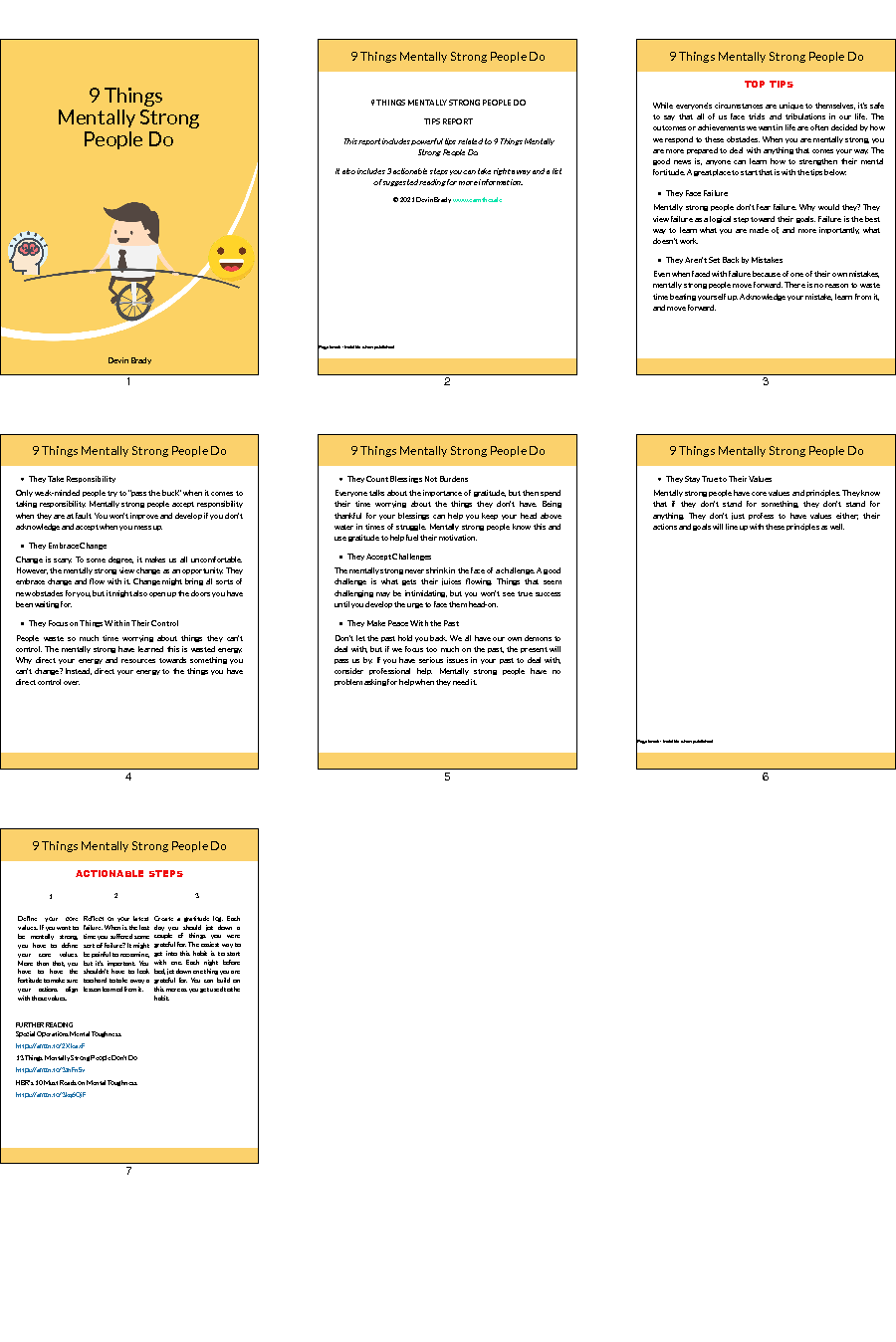
Subscribers are welcome to use the download link below and get the eReport on 9 Things Mentally Strong People Do. The eReport provides 3 actionable steps that you can use right away and a list of additional resources for suggested reading.
If you’ve been selling for a while, you’ve probably had at least one experience in which your prospect suddenly started giving you the “silent treatment.”
Anthony described this dilemma very poignantly when he called me a few weeks ago:
“I don’t know what to do when I get hit with the ‘silent treatment’ — you know, when I’ve worked with a prospect for quite a while, and we’ve had great conversations, and they’ve expressed interest in our solution — and then all of a sudden everything stops.
I try calling them back once or twice. I even send a follow-up e-mail, but nothing. They just disappear. And I figure I’ve lost the sale, and I don’t know what I did wrong, or what to do next. It makes selling feel like such a painful and arduous process.”
If this has happened to you, you may have felt anxious and confused. You may have told yourself, “It’s not as if I’m the one who did anything wrong. I put everything into the relationship. How can I rescue the sale if I can’t even get them to talk to me?”
The “Hopeium” Trap
There is a pressure-free way to reestablish communication when your prospect starts giving you the “silent treatment.” But first, it’s important to understand why the situation has happened in the first place.
Most of us who sell get caught up in “hopeium,” a comical term that means we focus our hopes and desires on making the sale. But hopeium can be a trap, because it’s impossible for you to keep in mind your most important goal: to learn your prospect’s truth.
When we fix our minds on the outcome — making the sale — we automatically begin anticipating how the process will go, and we also begin expecting that things will happen as we hope they will.
But if we’re in that mindset and our prospect suddenly breaks off communication, we feel lost, anxious, frustrated, discouraged, and confused. We become preoccupied with what went wrong.
We may even feel betrayed.
Is there any way to clear up the mystery?
Yes, by giving up your agenda and learning the truth about where you stand with your prospect –and being ok with whatever the truth may be. “But how can I learn the truth when they’re avoiding me?” you may ask. “And why do I need to let go of the sale?”
Let’s take the second question first.
If you approach your prospect while you still hope the sale will happen, you’ll introduce sales pressure into the relationship. This will push your prospect away from you and destroy any trust you have developed with them. Instead, you can eliminate sales pressure by telling them that you’re okay with their decision if they’ve decided not to move forward.
In other words, you take a step back instead of trying to chase and follow up with calls because you’re focused on getting a “yes.”
The bottom line is:
When a prospect gives you the “silent treatment,” it doesn’t mean you’ve lost the sale. It just means you don’t know the truth yet.
What you need to do is call and learn the truth.
Why is learning the truth so important?
Here are 4 important reasons:
1. You stop losing confidence in your selling ability. The “silent treatment” threatens our “hopeium.” We start blaming ourselves. We don’t know where we stand — a painful state of limbo. Our self-talk is negative and full of self-blame, and we’re on pins and needles wondering whether the sale will still come through somehow.
2. You increase your selling efficiency and decrease your stress level. Once you learn the truth about your prospect’s situation, you can either stay involved with the prospect or move on. I often say, “A ‘no’ is almost as valuable as a ‘yes.’” Why? Because it frees up your time to find prospects who are a better fit with your solution. This lets you work much more efficiently because you can quickly weed out prospects who aren’t going to buy. Knowing the prospect’s truth lets you walk away without that guilt-laden voice whispering, “If you give up, you don’t have what it takes.”
Learning your prospect’s truth translates into tangible results that equal real dollars. You’ll also put an end to the self-sabotaging stress that comes from living in “silent treatment” limbo.
3. Sales pressure pushes prospects away. When you respond to the “silent treatment” with calls and e-mails, you’re really telling them that you’re determined to move the sales process forward — which means you’re looking out for your needs, not theirs. This makes them mistrust you and run the other way.
4. The “silent treatment” — totally breaking off communication — is how prospects protect themselves from sales pressure when they don’t feel comfortable telling us their truth. The more we press, the more they run.
But the opposite is true, too. The more we relax and invite the truth, the more straightforward they’ll be with us. Prospects feel okay sharing what’s going on with them when they know we’re okay with hearing it.
How to Reopen Communication
After Anthony and I had talked about some of these issues, he said, “This all makes a lot of sense, but I’m still not sure what to say when I make that call.”
It’s simpler than you might think.
* First, simply give your prospect a call. (E-mail and voicemail are very impersonal, so use them only as last resorts if you can’t reach your prospect after several phone calls.)
* Second, take responsibility and apologize for having caused the “silent treatment”.
Here’s some language I suggested to Anthony that will make prospects feel safe enough to open up and tell you the truth about their situation:
“Hi, Jim, it’s Anthony. I just wanted, first of all, to call and apologize that we ended up not being able to connect. I feel like somewhere along the way maybe I dropped the ball, or I didn’t give you the information you needed. I’m not calling to move things forward because I’m assuming you’ve probably gone ahead with someone else, and that’s perfectly okay. I’m just checking to see if you may have some feedback as to where I can improve for next time.”
When you respond to the “silent treatment” this way, the results will probably surprise you. You may even learn that the prospect has legitimate reasons for not having gotten back to you.
You’ll also find yourself more productive and less frustrated. It’ll make a world of difference in your productivity level, your stress level, your income, and how much you enjoy what you’re doing.
Remember…
You haven’t lost the sale. You just don’t know the truth yet.








 Catalyst Consulting