Why do customers stall?

One thing I take a lot of pride in is that I was able to have some of the best years (at that point) of my sales career during the 08′-12′ Great Recession. While many of my counterparts were frozen (rightfully so- it was brutal) in how to move forward in that business environment, I was busy doubling down on my craft and subsequently finished many of those years as the #1 sales person in the organization. I don’t say that to impress you, but to impress upon you that there are opportunities to be had during this time. You just have to begin using the right strategies & stay in the right frame of mind moving forward.

Today I want to share some strategies on how to move deals through your sales cycle that may have stalled.

In consultative sales you’ve got four outcomes: a sale, a no sale, an advancement, or a continuation (another word for stall). As with any type of selling, you want as many sales as possible, limited amount of no sales (they happen), absolutely no CONTINUATIONS/STALLS, and more ADVANCEMENTS than no sales.

Some examples of continuations from a prospect: “call me next week”, “send me a quote and I’ll follow up with you”, etc. Anything where there’s a perception of a next step, but there’s no commitment or plan on what that next step may be. An advancement is where there is a solid commitment on what the next steps are, and a commitment on what you, as the sales rep, and the prospect will be doing.

What we don’t want are continuations- when you get one it’s important to be able to identify whether this is a STALL or a CONDITION to not moving forward. A condition would be any legitimate reason as to why the prospect cannot move forward- examples would be; there’s an approval process, another decision maker needs to be involved, a payment stipulation (bonus coming). It’s easy to identify stalls- if you’ve done a good job in your presentation, things line up- you’ve gained agreements along the way, and then all of sudden once a decision needs to be made, you’re given reasons that just don’t seem consistent to what’s been discussed and agreed upon.

Now-think about your projection. How much of your pipeline, or past opportunities, suffer from stalled opportunities? Opportunities- where you may believe you have a chance, but you can’t identify why they haven’t moved forward. They seemingly string you along.

If you are like most, stalled opportunities easily account for 30% and 50%. In a tough market one of the biggest returns you can reap is to reduce the impact of stalled decisions; however, to jump start a stalled sale, you must understand the cause of the stall. Here are a few common causes to investigate:

Lack of connection to a the most important issues to the prospect. Unless your solution increases savings, improves aesthetics, home value, comfort, efficiency, sound, and security, or some other looming implication, you can expect a stall. When purse strings tighten, homeowners will only spend on matters that impact them the most.

A sales rep only has reengage and ask three questions to uncover issues:

  1. Why do you want this solution?
  2. Why are those problems important to solve?
  3. Why does this matter to you?

Lack of perceived value. Most people can really only juggle five or six critical issues at a time. We all live with problems that we don’t need to solve today. However, competing priorities are constant. Can your prospect articulate the value or impact of addressing the issue? If your solution, from your prospects perspective, doesn’t have enough value to get in his top three or four, you get stalled or put on the back burner. Ask the prospect to quantify the impact of resolving the issue. Better yet, ask her how the solution will impact her personally.

Lack of differentiation. Lack of differentiation will cause the prospect to spend more time evaluating, which translates to a stall. If you are unable to differentiate on features and solving problems, you will be forced to differentiate on price.

Decision authority. Decision authority is one of the most common causes of stalled decisions. It’s important to ask yourself, ā€œHas the person you’re in contact with made this type of decisions before? When and how?ā€. Understanding their decision authority and decision making process early in the conversation will help identify whether you are dealing with a STALL or a CONDITION.

Risk. Making a decision involves risk. The prospects perception of risk can span impacts like lost budget flexibility,(do we forgo our Cruise this year??), lost time, or fear of making the wrong decision. As a prospect gets closer to making a decision, the risk becomes greater in her mind. Common tools for alleviating risk include supplying references, using reliable third-party data, and demonstrating return-on-investment analysis.

My hope is that you can take these above strategies and immediately apply them to begin helping your prospects move forward.

Thanks for stopping by and remember- the best earn the sale!
“It’s way out of our budget”- Oh no!

We’ve all had it happen before, we are in front of a prospect who has completely unrealistic price expectations. What do you do? Check out the video below for a few tips on how to address this scenario.

A potential client wants a 20 product bid. They tell you that they expect the price to be under $10,000; you know it will be considerably more than that. Now what?

Don’t be in a hurry to write off someone with an unrealistic expectation on price. If they called you, doesn’t that mean they need or want your product? Take the time to gather information before you decide they aren’t worth your time and energy. See if you can turn it into a sale.

This can be accomplished with the proper set of questions and a little patience. Start by asking the four basic questions that are needed to get to the contract. At some point, the budget will come up. Ask the question, “How did you arrive at the budget you have set?” You will get all kinds of answers, but the usual sources are other contractors, something from the media, or a hopeful wild guess on the part of the owner.

Give them the three price ranges that their job will fall into. Not one lump sum figure, not two broad figures, but three well-defined ranges based on your experience. You want them to make a decision, and that is why the wording is so important. Start with the middle range, move to the top range and finally explain what they will get in the low budget range.

Will they have sticker shock? Most likely. Will they think you and your prices are nuts? In some cases, yes. Will you get through to them that their budget is unrealistic? Maybe.

Most of it depends on how you present the information. Good questions can lead them to the conclusion you need them to reach. Blanket statements are not as effective. Remember that you have two ears and one mouth and use them in that ratio.

When you have given the three price ranges, ask the question, “Which of these three budget ranges would you like to invest in your home?” Or, “Which of these three budget ranges do you think would work best for you and your family?” There are several ways of asking this question but after you ask it, STOP! One of the biggest mistakes salespeople make is that they ask a question, and then keep on talking. Put a zipper on your lip. Button it up. Let them give their answer.

If they come back with the nonsense that they don’t know what it will cost, tell them it will be in the ranges you just discussed. Give the ranges again if necessary. They don’t like making decisions, and are trying to avoid the fact that you provided that info already.

Give your clients good information, help them adjust their budget, and make the sale. If they won’t adjust, move to the next client with a realistic price expectation.

Remember, the best earn the sale!

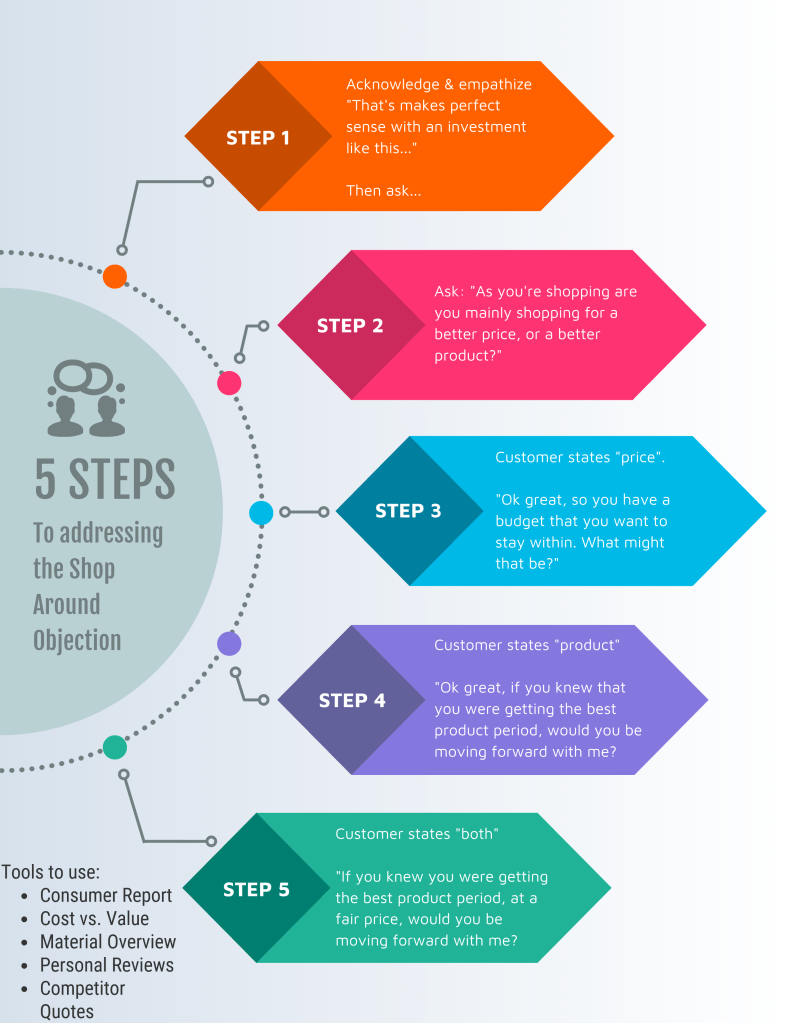
5 Steps To Addressing the Shop Around Objection

The closing stage of a sales presentation is one of the toughest- it’s fraught with emotions on both sides of the table. Customers begin to feel the tension of making a decision, and salespeople begin to battle the anticipated emotions of rejection, uncertainty, and stress.

Legendary sales trainer Brian Tracy states that whenever a customer experiences the emotions of the close “they retreat and begin to say things like, ‘let me think it over, ‘or can you email me the quote’, or ‘we need to get other quotes’, ‘I need to talk it over with someone else’, and so on.

It’s this sales resistance that necessitates a closing process. Otherwise as salespeople we begin to push for a result. The result is the process!

What’s the point of eating a bowl of ice cream: to get to the end, or savor every bite? My bet is that if you are a results driven person- you want to get to the end of that bowl as fast as possible. How about a goal of an exercise program? Unless you’re a professional athlete, the goal is to maintain a level of personal satisfaction.

Sales Coach and author of “Selling for Dummies”, Keith Rosen shares that “you don’t do a result; you execute a process, which produces the result as a natural by-product of your efforts.” To get better results you must focus on the process.

A well practiced closing process allows you to convey confidence. To address the shop around objection devote your attention to following the process and you’ll find that more of your customers will choose you rather than shop around.

When you don’t have an objection process

Sales Person vs. Sales Champion.

Coaching done wrong
Coaching done wrong

I feel extremely fortunate to have worked in sales for over 20 years now. 10 of which have been spent coaching and training sales people. In those years, I’ve noticed that both sales people and sales managers mistake the difference, and thus, the execution of sales training and sales coaching.

Sales people mistake their need for additional sales training, when in fact they need coaching. Sales managers mistakenly believe their sales people need new tricks and techniques, when they simply need help re-framing the narrative they’ve attached to an experience, which when left unattended, can turn into a limiting belief.

Do a quick Google search on books on sales coaching and you’ll get 59,000,000 results. There’s not a shortage of information on the topic. I’ve read many books on this topic and have found Keith Rosen’s work to be some of the best resources available. Below I’ve provided a quick one page of sales training vs. sales coaching.

More info on the topic don’t hesitate to check out Keith’s site here.

10 Strategies to prevent:”I lost the customer to price”

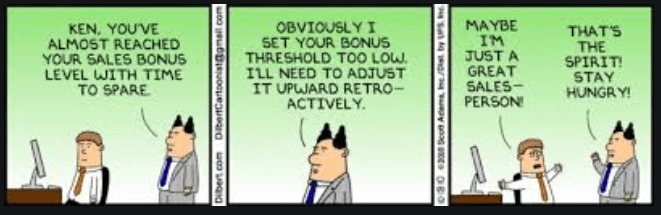
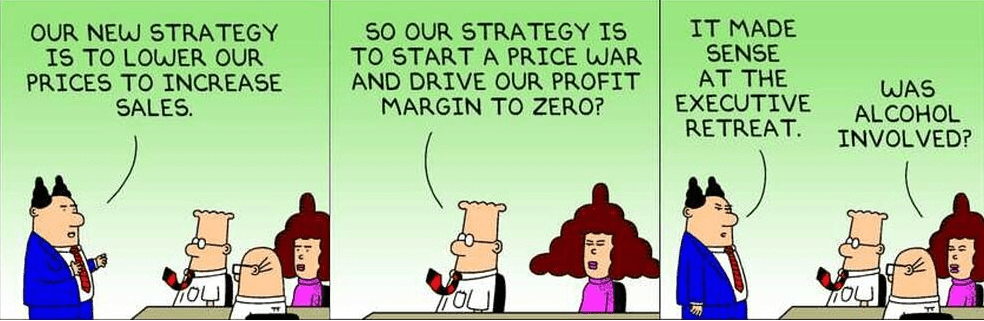
Dilbert on Price

Nothing happens until a sale is made. There are a lot of things that have to happen before a customer signs on the dotted line, but lastly, a sales rep and customer must agree on a price. At one time or another, we’ve all had our prices challenged. I’ve heard many sales people proselytize their closing abilities and tactics. The question becomes of these great closer’s is, have they protected price and margins? It doesn’t take an expert sales person to seal the deal when they’ve simply folded on price once the customer posed a pricing concern.

Avoid Price Driven Conversations

To persevere through pricing objections, your self-assurance is critical. Being confident in what you say is paramount in presenting price (Want a 1:45 second course on CONFIDENCE ?) When the customer requests a discount, respond by asking, “before we get into that, what value do you see in what I’ve presented thus far?” In reality if a customer can’t, or refuses to, answer that question, then the decision is made solely on price and I bet there are other cheaper options for your customer.

The worst thing sales people can do when a customer is looking for a price break is to give in. Jeb Blount, author and sales expert, states that customers may not have gone to sales university, but they’ve definitely gone to buyers university. Many customers know that if they give the least bit of price resistance a sales person will immediately offer price concessions. To overcome this problem, sales people need to understand, in real terms, how their prospect can benefit from your product or service- from their perspective.

A great example that I learned from Keith Rosen. If I’m taking a trip and my destination is 1,000 miles away, I have several options. I could hitchhike, which would cost me virtually nothing, but wouldn’t guarantee when I’d arrive. I could drive my car, limiting my immediate costs to the necessary gasoline, but my trip could take several days. Or, I could fly, which would probably be my highest-priced option, but would be the fastest.

You can see from my travel example that the cheapest option is not reliable, nor would it save time. In addition, most people wouldn’t want to take several days to drive to and from their destinations. Therefore, because of the time it will save, the best option is to fly, even though it’s probably the most expensive choice. Since time is of the essence for many folks, its value is worth the extra money. Cutting the price is clearly not beneficial or efficient for the customer.

Confidence Is key Everything

To hold firm on price you need to have a high level of confidence. One of the best ways to feel confident is by maintaining a full sales pipeline. When a sales person doesn’t have a full-pipeline, or lacks the ability to generate more customers, or doesn’t fully nurture past customers, they rely on each potential sale that a customer may propose. Sales people become needy, overzealous, and those emotions lead to the inability to overcome price objections.

Jeffrey Gitomer Sales Training

You’ve got to ask yourself one question…

“Do I feel lucky?” -Dirty Harry

Luck, it seems, is relied upon to carry many sales careers. A few of my favorite quotes regarding luck are:

“I’m a big believer in luck. I find that the harder I work the more I have.”

Thomas Jefferson

“Luck: where preparation meets hard work.”

Anonymous

Patrick Cohn, a sports psychologist and president of Peak Performance Sports, specializes in creating a championship mind-set in teams and individual athletes. Cohn suggests that there are four mental and emotional characteristics common to champion athletes. Erik Brady (no relation) cited work by Cohn in an article for USA Today in 2006. I believe the same characteristics are present among top performing sales professionals. In my experience one additional mental characteristic stands out that I’ve added below.

1. Composure

Composure is the ability to stay focused under pressure. The months ending soon and your one deal away from blowing past your goal and the customer throws you an unexpected curveball. Do you fold? Do you stutter? Do you forget your closing lines? Nope, not you. You’ve built the muscle of composure.

Composure is shown ultimately by not allowing one failure carry over to the next moment.

2. Competitiveness

Sales is very muck like a competitive sport. I’ve seen many sales bullpens made up of ex-jocks or professional women who want to maintain their glory days of competitive softball. Hiring managers often look for individuals who’ve played sports in the past and for one simple reason; they have a competitive spirit. If you look at a stacked ranking report and you’re listed any other than numero uno… you should feel that fire within your belly. Do you want to win-over your customers? How about beating out the competitors product?

Competitiveness is shown by the will to win.

3. Confidence

Ever shook someones hand and they didn’t give you a firm grip, or worse their hand felt like a wet noodle? What impression did that person leave with you? Not good right? That’s the same impression that a sales person lacking confidence leaves after an appointment. Customers want to feel confident in their decision to go with you and if you’re not showing it, then it’s not going to go well for you. Confidence begets more confidence in sales. Build on your smaller wins until those small wins add up to a bigger payoff. Realize that confidence can make or break record sales months.

Confidence is outwardly shown by your inner belief.

4. Determination

Be that little sales engine that could! My grandma would call this stick-to-it-iveness. She’s determined to never be wrong. Determination is the culmination of desire, focus, and grit. I’ve quit sales more times that I would like to admit, but it was my determination to overcome the challenge that propelled me through the moment. If sales were easy then everyone would and could be doing it, however it’s not for the faint of heart. Those who bowed out weren’t determined.

Determination is shown by continuously accepting the challenge and facing the task, and then the next…the next..the next.

5. Vision

Close your eyes, picture in your mind where you want to be in 5 days, 5 months…5 years. The ability to bring the future into the present- that’s vision. Does it excite you? That’s a goal. Does it scare you? That’s a challenge (see #4). If what you see doesn’t motivate you then I would argue that it’s someone else’s vision that you’re picturing in your minds eye. Vision is important because it’s the bigger picture..it’s the forest made up of the tree’s. Vision is the ultimate prize that makes the day-to-day worth it. Without it, it feels like your just treading water to say afloat.

Vision is shown by those who can go from one opportunity to the next, win or lose, and know that all experiences can move you towards your goal.

Whether luck being the result of hard work and preparation, I contend that success in sales can be attributed to the core qualities of composure, competitiveness, confidence, determination and vision. There you have it. The intangible qualities of high achievers.

“Time is a luxury we no longer have”

Stressing urgency is not about PUSHING people to do something that they don’t want to do. Instead, use urgency to PREVENT them from procrastinating on something that will ultimately benefit your customer in the long run.

Be of service to your prospect, rather than your own self-interest. I never feel pushy or obnoxious when I feel that I am working in the best interest of my customer. However, the best way to be in this position is by being a consultant. Odds are you’ve got an interested buyer who is only procrastinating.

Don’t run your customer off by using worn out closing techniques… help them to make the move they likely already want to take and bring to light the negative outcomes of procrastination. (implications) Below are some examples where I’ve used urgency phrases. While I don’t believe every objection revolves around cost, it’s the objection that I hear most often as to why salespeople have business that is not closing. Isolate any objection first to know what you are truly working withā€¦ā€Mrs. Jones- let’s take cost off the table for just a moment, if cost was not a deciding factor would you be moving forward today?ā€

ā€œMrs. Jones, in my experience I’ve found that this is one of the easiest decisions to procrastinate on and the kicker is that these problems only get worse with time and eventually cost you more money. Time really is of the essence. Because of these reasons- my professional recommendation would be for you and I to get started right away, and with our current promotion you’ve got an even better incentive to do so.ā€

ā€œMrs. Jones, I’ve worked with many customers who were facing the same decision you are now. It’s perfectly normal to feel apprehensive. We need to use what little time we have left in this promotion to agree on the remaining details so that you can take advantage of the savings, but more importantly eliminate the problems that started you on the is journey to begin with.

ā€œMr. Jones, we don’t have a second to waste. Waiting has done two things for you up to this point: increased the scope of work & increased the cost of fixing the problem. In my effort to save you time, eliminate higher cost, and address some of the problems we’ve discussed, my professional recommendation is that we get a move on it!

Give people a logical reason why they should buy now, and more people will.

For more ideas or for a list of 19+ phrases that express urgency simply type URGENT in the comments below and I’ll send you the list of phrases.

How do you finish your race?

“Effort is a commitment to seeing a task through to the end, not just until you get tired of it”

Howard Cate

At ten minutes to seven on a dark, cool evening in Mexico City in 1968, John Stephen Arkwari of Tanzania painfully hobbled into the Olympic stadium- the last to finish the marathon.

The winner had already been crowned, and the victory ceremony was long finished. So the stadium was almost empty as Arkwari, alone, his leg bloody and bandaged, struggled to circle the track to the finish line. The respected documentary filmmaker, Bud Greenspan, watched from a distance. Then, intrigued, Bud walked over to Arkwari and asked why had continued the grueling struggle to the finish line.

The young man from Tanzania answered softly, “My country did not send me nine thousand miles to start the race. They sent me nine thousand miles to finish the race.”

The Olympic Legend Who Finished in Last Place

What commitment to effort have you made to finishing your month, quarter, year, your race? Be it placing first or last, make it legendary!

Who will you be introduced to today?

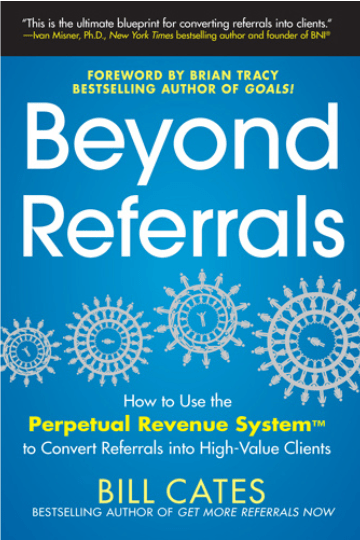
That’s how Bill Cates, author of Beyond Referrals, opened his session for our sales team. If you enjoy working with referrals in your business and you’re not familiar with Bill, I can tell you that you’re missing opportunities to earn even more referrals and introductions.

Bill is an accomplished speaker and founder of Referral Coach International. Bill worked in the referral space for over 25 years and has developed a proven system for acquiring more referrals through word of mouth, and personal introductions.

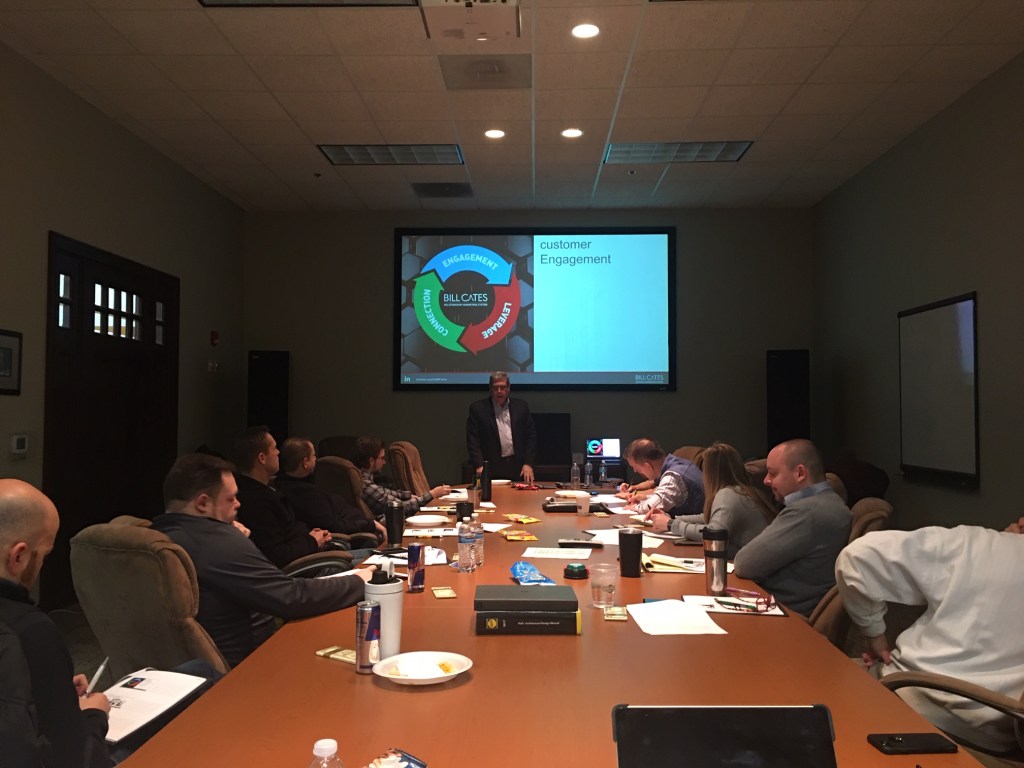
I recently hired Bill to work with my sales team to share his V.I.P.S. referral method. Bill states that when you discuss the value recognized, treat requests with importance, gain permission, and suggest names; you can collect referrals without having to beg. Our workshop contained great exercises in which we put his method into practice, and fostered collaborative discussion among the team.

Beyond Referrals contains many pearls of wisdom that goes beyond just asking for referrals and breaks down into 6 Strategies. Those strategies are broken down as follows:

  1. Adopting the Right Mindset for Growth
  2. Becoming Super Referable
  3. Asking for Introductions
  4. Securing a Solid Introduction
  5. Introductions from Referral Alliances
  6. Social Event Marketing

My favorite part of the workshop was around tapping into the power of Your Customer Focused WHY. This exercise was a fantastic reminder for our group about the great work we do, and the power of sharing our personal value.

Bill laying down a great foundation for customer referral engagement

Whether it’s an onsite workshop, or his books, I highly recommend Bill if you value referrals!

For an introduction to Bill check out the video below.

New Year-New You from Tony Robbins

One of my favorite videos to watch from time to time. A great message with important reminders about the habits & rituals that we create daily that lead to success.

We often overlook the importance of daily habits in managing ourselves and our lives. But, it’s often the small changes we make to our daily routines that enable the BIG changes in our lives and careers.

For more insights or to get my 5-Steps to identifying your daily success habits, comment below with “HABITS” and I’ll send to you for download.