


Why do we as humans frequently act in ways that we don’t actually want to? How many times have you said or done something that makes you wince when you think about it later? The fact is that your unconscious mind is in charge of most of your actions, especially those that are difficult to explain logically. Procrastination is when you know what you should do and have the capacity and desire to do it, but you don’t. Although there are several apparent grounds for procrastination, the main cause of this irrational behavior is found in your subconscious mind.
Your conscious mind’s ability to deal with life is severely constrained. The amount of conscious control you have is usually restricted to one item at a time. This is why relying on your willpower to effect long-term change seldom succeeds. What you need to do is alter your automatic behavior, which is stored in your unconscious mind, the portion of your brain that regulates all of your mind’s and body’s critical activities. Willpower can be used to combat procrastination, although it is typically only a temporary solution. Your unconscious connections, not your conscious acts, are to a considerable measure responsible for your procrastination.
Daniel Kahneman’s bestseller “Thinking Fast and Slow” claims that human decision making is subject to many follies, biases, and inherent human laziness. Daniel is also a Nobel Prize winner and is acknowledged as the father of the field of Behavioral Economics.
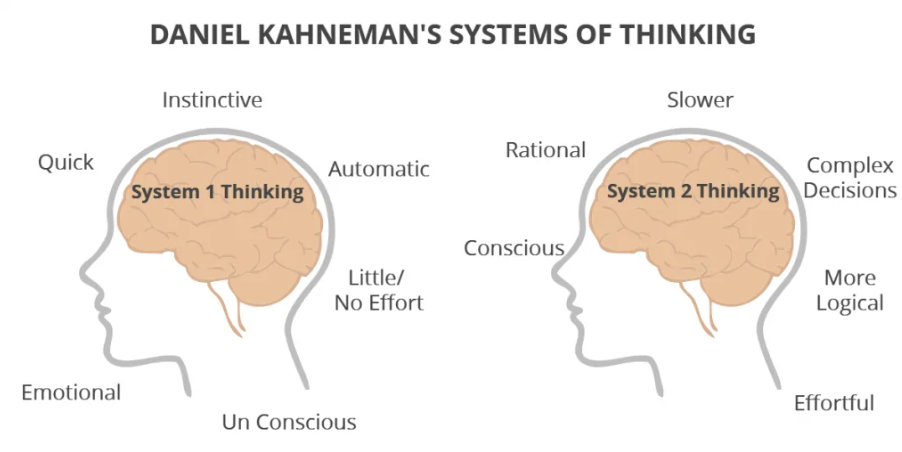
The basic idea of “Thinking fast and slow” is that we have two modes of thinking. The first mode is called System 1 (S1). This is intuitive in nature, it is emotional and acts automatically and quickly. It is based on mental rules of thumb (heuristics) and biases (cognitive). This system doesn’t involve much effort. It is often sloppy and wrong.
The second mode of thinking is System 2 (S2). This is rational thinking. In contrast to S1, this type of thinking is slow, deliberate and often requires significant effort. It doesn’t just go by intuition or gut but is more instilled in reason or logic. This thinking is often much more accurate or precise. As this type of thinking is effortful, the human brain has limited capacity for this kind of thinking.
Back to procrastination. Your System 1 thinking is created to protect you, and when fear arises, your nervous system will “kick in” to “defend you” through the subconscious. The irony is that we unknowingly train ourselves to dread some things by associating incorrect meanings with them. Nothing in life has any significance until you give it that significance. You physically “store” neurological connections to events in your nervous system so that you can act fast and efficiently the following time. Whenever anything happens to you, the way you describe the event to yourself gives it significance. Unconsciously, you’re continually trying to figure out what anything means, and at the most basic level, you’re trying to figure out if it implies pain or pleasure. This meaning is then stored in your subconscious mind, where it will later help you act (or re-act) properly. The problem is that when associations are reinforced, beliefs are formed that have a significant impact on your behavior and are frequently the source of procrastination.
Despite the fact that procrastination defies logic, it exposes a lot about your unconscious and self-imposed limitations and (in)abilities. Worry, primarily the fear that taking action would result in discomfort or a terrible experience of some type, is the leading cause of procrastination. Your unconscious mind mixes and searches its “files” to create a “link” that connects the action to an unpleasant event. This might be anything from a minor annoyance to something that is really painful. Even if you consciously desire to do something, your unconscious mind will stop you because it links the activity with pain. As humans, we instinctively seek comfort and will nearly always choose whatever seems most comfortable at the time. This is why you delay on chores that don’t feel good right now but will provide you a lot of joy in the future.
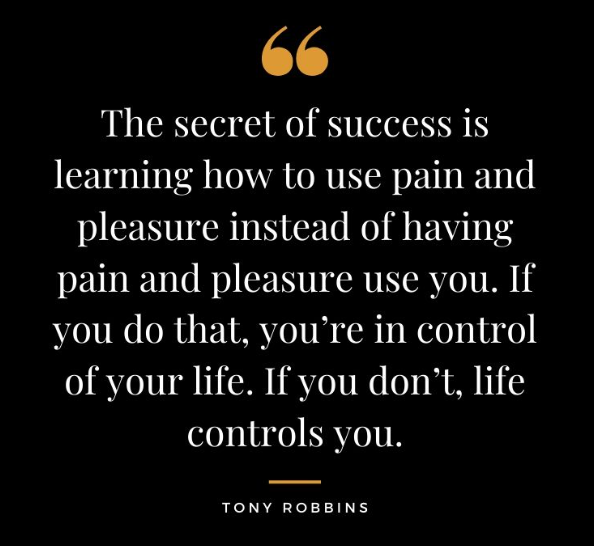
Learning (System 2) to fight against this drive for comfort is what leads to all of the essential progress for you to achieve actual success. When you consider procrastination as a gift in disguise, you may begin to exploit it and benefit from the behavioral insights it provides. Procrastination exposes your worries and, by design, provides the necessary resistance for you to expand and grow in your ability to push through your fears and build the lifestyle you truly desire. The amount of “discomfort” you can comfortably live with determines the quality of your experience. Procrastination may also shed light on the goals that you value the most, as your anxiety over postponing demonstrates that some part of you cares enough to be concerned.

It’s been stated that we shape our habits first, and then our habits shape us. This is also true of mental habits, and procrastination is frequently manifested as a regular pattern of thought. Your ideas influence and are influenced by your actions. Your behavior will “play the same song” every time, like the etched pattern on a record. Your connections with pain and pleasure play a significant role in determining what you will or will not do in your regular behavior. When your habit pattern is triggered, you create habitual thought patterns that drive you to automatically act or withdraw in specific ways.
In order to address the core cause of procrastination, you must be conscious of your associations with pain and pleasure. There are several symptomatic remedies that will not provide a long-term solution. Although willpower is required at first, the goal is to re-establish your associations with the tasks you are avoiding. If you can overcome your self-imposed anxieties and take action, you can be, do, or have anything your heart desires. Although the root of procrastination is in your subconscious mind, your conscious actions are ultimately in charge.




What type of communication is the most memorable? Of course, it’s a nice old-fashioned story! A good narrative may connect the mind and the soul in a variety of ways, including parables, fairy tales, and fables.
Storytelling is a long-standing practice that is both amusing and useful in conveying knowledge on practically any topic.
Any classroom will have teachers using stories to educate their students. When you walk into a large firm, you’ll see high-profile CEOs telling their staff anecdotes about their beliefs, opinions, and facts. Storytelling is a strong form of communication and a powerful one when selling.
Why is it important to tell stories?
It’s been revealed that we all have a want, if not a need, to tell and listen to stories.
We grow to understand one another on a much deeper level through exchanging stories with others and engaging in shared experiences. We join together as a community of persons by reaching a shared level of understanding, recognizing both our differences and our similarities.
You may use stories to express your thoughts, feelings, and experiences. By doing so, you’re verbally expressing the things you value, the traditions you follow, and the life lessons you’ve learned.
“Storytelling is our obligation to the next generation. If all we are doing is marketing, we are doing a disservice, and not only to our profession, but to our children, and their children. Give something of meaning to your audience by inspiring, engaging, and educating them with story. Stop marketing. Start storytelling.”
–Laura Holloway, Founder & Chief of The Storyteller Agency
Have you ever felt like there was nothing interesting to say? If that’s the case, you’ll be relieved to learn that you have numerous stories ready to be shared. You can build a greater connection with others by improving your storytelling skills.
How to Become an Excellent Storyteller
You can become a terrific storyteller even if you’ve never told one before! Your narrative talents will develop with a little work and practice, and as you do so others will be drawn to what you have to say.
Here are four fundamental approaches for telling outstanding stories:
1. Make sure your presence is noticeable. Whether it’s a small group of friends or a large audience, you must grab the attention of your audience. You’re halfway there if you can attract your audience! What can you use as an opener? A segment from your favorite tv series, or a clip from your favorite movie, a funny joke can be used to set the tone of your story.
• Self-assurance is important in making your presence known in a room. You’ll have a hard time capturing your audience’s attention if you lack the confidence to push outside of your comfort zone and be confident.
2. Engage and connect with your audience. It’s crucial to make an emotional connection with your audience. If you can accomplish this, you’ll pique the audience’s curiosity and your narrative won’t fall on deaf ears. This entails knowing who they are, what they want, why they’re there, and how to communicate with them. What challenges or opportunities is your audience being faced with that you can empathize?
• Interact with your audience on an equal footing. Your ego should not lead to a condescending tone of voice, nor should your shaky self-confidence make you fearful. Remove any negative views or mental negative self-talk.
• Match your tone of voice to the audience you’re conversing with. When speaking with college students vs a PTA group, phrasing should match the audience. Try to pinpoint exactly what the audience goes through on a daily basis and express that story.
3. Make eye contact with your audience, when possible. It’s too easy to stare at notes, or keep our focus on slides all while avoiding eye contact with the audience. When delivering anecdotes, professional speakers employ a simple technique; audience participation. You can pose questions, plan activities, or have someone share their experiences with you. This engages your audience because they get involved in the story.
• Use humor to engage and communicate with your audience, but don’t overdo it. It’s difficult for both the storyteller and the listener to force comedy into a story where it doesn’t fit. While humor is one of the best ways to connect with an audience, be careful that it’s relevant & topical or you risk losing the attention of the audience.
4. Share your knowledge. Your audience is looking for information. They don’t just want to learn about you; they want to learn something useful that they can apply to their own life. Structure your story such that there is a predicament as well as a solution or moral, so that the audience may relate with the story’s deeper meaning.
You can engage with your audience on an emotional level and communicate with them when you have their undivided attention. This allows you to better relate with their personal issues and keep them on the edge of their seats. It only takes a little practice!




While most sales professionals know that it takes at least five contacts to convert a prospect, the figures show that majority don’t make it past two. That should serve as a strong reminder to any salesperson who is having trouble. Of course, there are a variety of reasons why salespeople fail to follow up with prospects in order to increase their chances of making another happy customer. One of the reasons might be that they have no process in place after they discover a new prospect, they have too many difficult clients, or they are just too preoccupied with following up on too many prospects who waste their time.
However, it appears that the main issue is a lack of a prospecting process. A salesperson should have a method of communicating with their prospects that has been proven. Real estate agents, Financial advisors, and insurance providers that deliver value on a regular basis are excellent examples. It may appear to be a difficult task to remember, but any decent CRM software makes it feasible. Even without a CRM program, with today’s cell phones it’s as simple as telling Siri to set a reminder on your calendar. You may outline the steps you want a prospect to take with the help of good prospecting software. I like to use the W.I.N. method of notation structure in my CRM. List what was discussed, any insights you or the customer gain from the conversation, and based on those insights, what are the best next steps. With the help of a decent CRM software, you can keep things moving along in your pipeline and maintain your prospecting cadence.
In addition to putting in notes outlining your prospecting efforts, a prospecting cadence that has worked well for me is the 3-2-4 sequence. After every interaction I want to follow-up within three days, over the course of two weeks, I have reached out four times. This has proven to work really well for me. Naturally some prospects may need more contacts, but this is a great rule of thumb for me and following this method will put you ahead of most your competitors. After four contacts and no measurable forward progression on the prospects behalf has been taken my conversations turn more towards disqualifying the customer.
While consistent prospecting is half the battle having prospects that take up too much of our time or too many prospects who aren’t your target client is still an issue for many sales professionals. One thing that every salesperson should do is clean up their prospect list to identify just those prospects that have a lot of upside potential. You will be effective in bringing in more sales to your organization if you combine this with a strong prospecting process that you can follow.
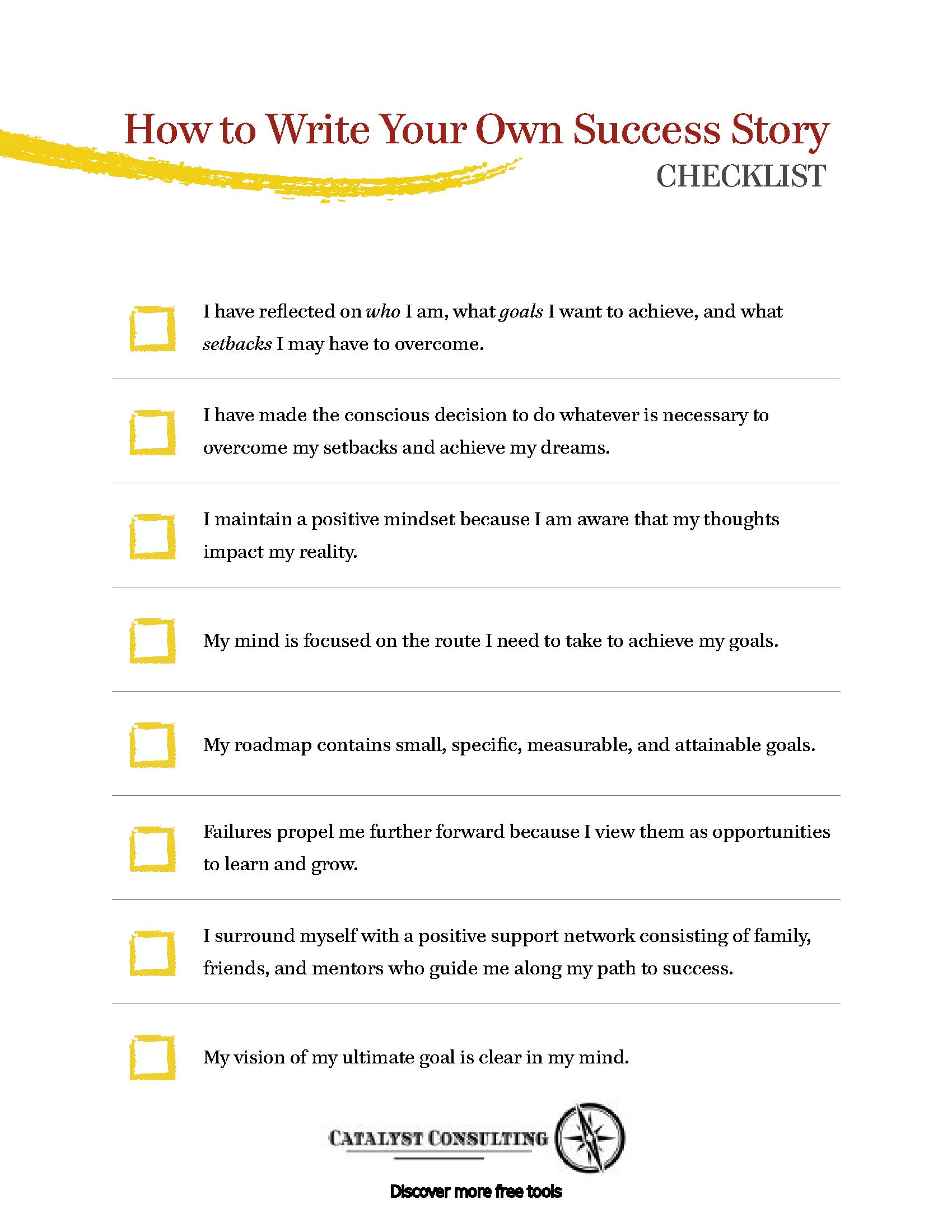
Below is a link to a slideshare titled: Ultimate Follow-Up Checklist to Boost Sales
Feel free to check it out and keep it handy next time you’re about prospect for your next dream client!




A mentor is often someone in a position who volunteers to transmit skills to up-and-coming movers and shakers in order to foster growth in their career. While taking on the mentor position is intended to benefit the mentee, it is not a one-sided experience. Being a mentor provides an incredible opportunity to improve your talents and grow as a future leader.
Learn to communicate in an open and supportive manner
Both the message sender and the message recipient must do more than simply act passively in order to communicate. You’ll become a better communicator who listens and talks with thought and regard for the other person’s comprehension as you study communication styles and how it all works.
Practice and improve your listening abilities
Mentors must pay attention to their mentees in order to understand what they require. Because listening is a skill that most people need to practice more regularly, simply needing to listen is fantastic preparation for the rest of your career. Listening entails more than simply hearing. It’s active listening with the goal of understanding, which necessitates asking questions to obtain answers.
Find out how to give constructive criticism
When mentoring someone, you must provide feedback. As a leader, you’ll be required to provide feedback to a variety of people to ensure that the influence you’re having and the outcomes you’re delivering are as good as you want them to be. However, this is a step that is frequently overlooked. When you mentor, you must do so since it is the most important aspect of the connection that you must learn to perform well. This constructive criticism will benefit you in all aspects of your leadership.
Encourages continuous improvement
While a mentor’s primary function is to guide a less experienced individual into the meat of their career, the fact is that it also helps you to learn more. It’s easy to become trapped in old habits of doing and thinking, but when a less experienced colleague asks fresh questions based on their unique perspective of the world, you’ll be forced to master new skills that will propel your career as a future leader forward.
Forms New, Strong Relationships
Even if a mentor is perceived as being significantly ahead of their mentee in their profession, the bond you develop as you help them navigate their life and job via your expertise can be extremely beneficial to you later on. Furthermore, these relationships are developed in a mutually respectful manner, which will continue over into future opportunities.
Enhances your professional reputation
It only helps you appear better if you are recognized as the person who goes out of their way to assist others and open doors for them. As a leader, you’re not concerned about someone replacing you, and you want someone to replace you someday, so you coach future leaders.
Increases self-awareness
It feels nice to help someone somewhat behind you achieve the success you achieved so far because you get to view yourself from a different perspective. The more viewpoints you can see yourself through, the more you will understand who you are and what matters to you.
Enhances your coaching abilities
Most leaders are in charge of guiding people through a problem-solving process, although they may not know it. Once you’ve mentored someone, you’ll realize that you can apply this talent at work, in your business, and even in your personal life with your family.
Finally, mentoring can assist you in becoming a better leader. With each mentee you take on, you’ll improve your people skills and become a more informed, open, and respected leader who isn’t stuck in the old ways.
EXTRA BONUS:
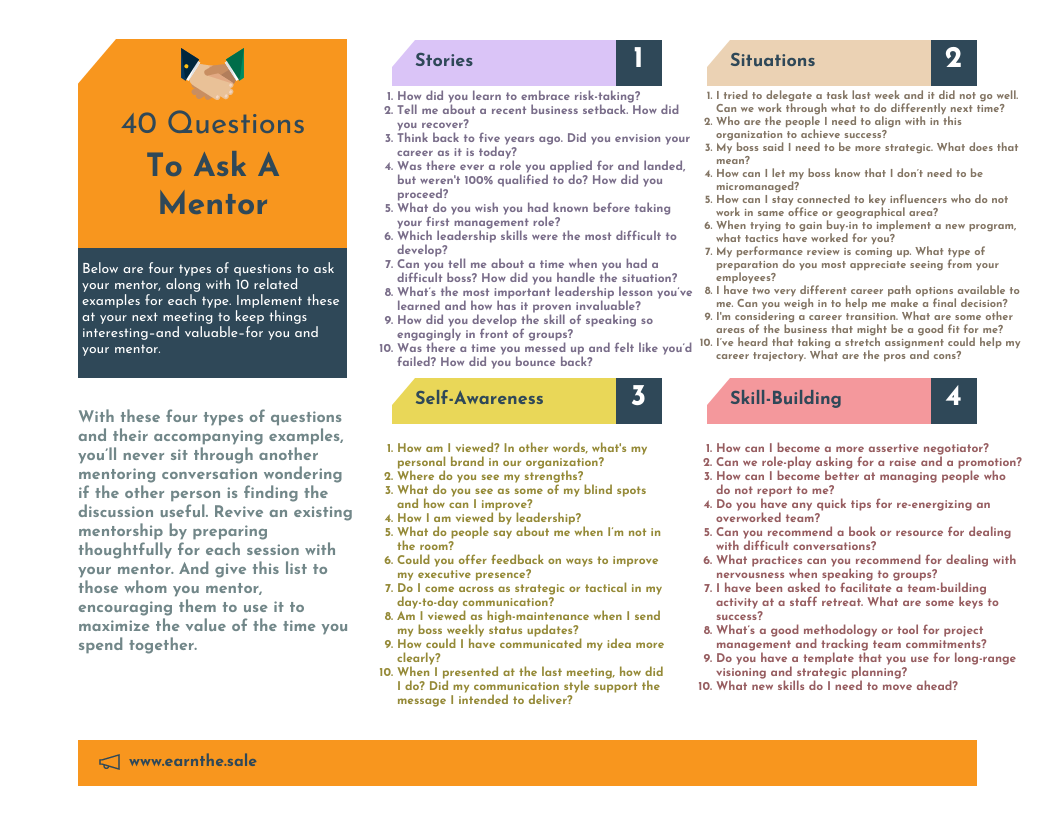
If you are currently in a mentorship but have found it difficult to facilitate a consistent dialogue then I’ve provided a list of 40 Questions to Ask A Mentor.



 Catalyst Consulting