Effective Coaching Sessions for Sales Managers & Sales Reps

Photo by Drew Beamer on Unsplash

As a sales manager, you are aware of how crucial frequent feedback is to the performance of your team. Your sales representatives could find it difficult to reach their goals and realize their full potential without constructive feedback and direction. Coaching sessions are one of the most effective ways to give this feedback.

During coaching sessions, you may sit down with your sales representatives to go over their progress and provide ideas for improvement. But not every coaching session is the same. The best coaching sessions are those that are well-organized, structured, and targeted towards the needs of the person.

In this post, we’ll look at the best methods for leading productive coaching sessions that give frequent feedback to sales managers and sales representatives. Everything will be covered, including establishing objectives, giving useful feedback, and follow-up tactics.

Making Goals

Clarify your intentions and expectations before the coaching session starts. This makes sure that you and your sales representative are on the same page and pursuing the same outcomes. When setting goals, it’s important to take the following factors into account:

  • Identifying the area(s) that needs improvement: Determine the particular area, such as closing deals, building rapport, or improving presentation skills, where the sales representative needs to improve.
  • Creating measurable milestones: Make sure the sales representative has measurable goals to strive towards. For instance, if closing deals is the area that needs development, the goal can be to raise the sales representative’s closing rate by 20% over the course of the upcoming month.
  • Creating a schedule: Create a schedule for completing the goals. Everyone is kept accountable and motivated to make progress as a result.

Providing Feedback

After you have established specific goals and timelines, the next step is to offer feedback. Feedback must be behavior or process focused, tailored to the needs of the sales representative, and constructive. Following are some pointers for giving constructive feedback:

  • Prioritize behaviors over personality: Instead of launching personal attacks, critique particular actions. Saying, “You’re not a very good listener,” for instance, can be replaced by, “I noticed that you interrupt the customer frequently during meetings. How do you suppose that comes across to the customer?”
  • Give specific examples: Use specific examples to support your critique. The sales representative can now clearly see what needs improvement. As an instance, you may state, “I noticed that you tend to use jargon during customer meetings,” while providing critique on communication skills. Let’s practice speaking in plain and understandable terms.
  • Encourage self-reflection: Use questions that motivate the salesperson to consider their actions and pinpoint their areas of weakness. What did you believe went well on the most recent sales call, for instance? What may you have done differently to provide the outcome that both you and the customer may have needed?

Follow-Up Techniques

The coaching process doesn’t end with giving feedback. You must build follow-up techniques to make sure your sales representative is moving closer to their goals. Everyone is kept accountable and driven to complete their assigned tasks as a result. Following-up techniques to think about include:

  • Schedule frequent check-ins: Set up frequent meetings to assess how well the mutually agreed upon goals are being met. Depending on the situation, this can occur weekly, biweekly, or monthly.
  • Provide ongoing support: To assist your sales representative in achieving their goals, provide ongoing assistance and direction. This can include additional training, suggesting a mentor, or resources to support their success.
  • Celebrate accomplishments: Acknowledge and celebrate achievements made along the way. Take the time to thank your sales representative for their dedication and hard work once they accomplish a target. As a result, morale and motivation are raised, which might pave the way for future success.

FAQs

Q. How frequently should coaching sessions be held?

A: Coaching sessions need to be held on a regular basis, but how often will depend on the specific needs of your sales force. Coaching sessions should ideally take place weekly or bi-weekly. This may vary on tenure of a particular sales representative, but don’t assume that your most experienced representatives do not appreciate regularly scheduled coaching sessions 

Q. What happens if a sales representative resists feedback?

A: It’s not uncommon for sales representatives to frequently exhibit resistance to feedback especially if they feel criticized or attacked. In these circumstances, it’s crucial to approach feedback in a positive and encouraging manner. Encourage the sales representative to view feedback as a chance for development and progress.

Q: Are remote coaching sessions possible?

A: Using video conferencing software or other online communication platforms, coaching sessions may be held remotely. To make sure that remote coaching sessions are successful, it’s important to establish clear guidelines and expectations.

Effective coaching sessions are an essential component of any successful sales team. By setting clear goals, providing actionable feedback, and establishing follow-up strategies, sales managers can help their sales reps achieve their full potential. Remember, coaching sessions should be a collaborative effort, with both the sales manager and the sales rep working together towards a common objective. As is the case with many sales managers who’ve performed well as sales reps, these feedback sessions can often become one-way solution providing sessions. These sessions turn into selling your sales reps on your techniques, and become less effective over time. After all, you want your sale reps empowered to come up with their own solutions that will pave the way for their long-term success. A sales reps inability to be resourceful when creating solutions may be a sign that they are not a good fit for the role, or may need further training to deliver better outcomes. With regular coaching sessions, you can improve performance, increase productivity, and drive sales growth for your organization.

Here are 30 Coaching Questions to use in your next session: 

  1. What do you feel went well during your last sales call? 
  2. How can you continue to build on that insight? 
  3. Can you tell me about a time when you were able to close a difficult sale?
  4. What part of that experience do feel is repeatable? 
  5. How do you typically open a sales call?
  6. What has worked well? What did not work well and should focus on eliminating? 
  7. What are some of the biggest challenges you’re facing in your sales role right now?
  8. When was the last time you faced a similar challenge and how did you move passed it? 
  9. Can you walk me through your process for gaining agreement with a customer?
  10. What do you think sets you apart from other sales reps on the team?
  11. What have you learned form other team members? 
  12. How do you stay motivated during times when sales are slow? 
  13. Can you give me an example of a successful presentation you’ve made in the past?
  14. What do you feel you could improve on in terms of your sales technique?
  15. How do you typically handle objections during a sales call?
  16. What could you improve on? 
  17. Can you walk me through your follow-up process after a sales call?
  18. What do you feel are some of the most important qualities for a successful sales rep?
  19. What are some the qualities of an successful one?
  20. Which are you exhibiting? 
  21. How do you measure success in your role?
  22. What are you settling on, rather than overcoming and pushing through? 
  23. What do you think are some of the biggest challenges facing our industry right now?
  24. How do you stay up to date on trends and changes that customers are faced with?
  25. Can you give me an example of a time when you were able to successfully upsell a customer?
  26. How do you approach building relationships early in the conversation?
  27. What do you think are some of the most important behaviors for a sales rep to have?
  28. How do you prioritize your sales activities throughout the day?
  29. Can you tell me about a time when you were able to turn around a difficult sales situation?
  30. What do you need from a coach to move you closer towards you goals? 

Book Review: The War of Art, by Steven Pressfield

“Resistance is the most toxic force on the planet. It is the root of more unhappiness than poverty, and disease. To yield to Resistance deforms our spirit. It stunts us and makes us less than we are and were born to be.”

“The War of Art”, by Steven Pressfield, is a book that every artist, writer, musician, or creative person should read. It is a compelling manifesto that explores the nature of creativity and the resistance that often hinders us from achieving our full potential.

Pressfield’s book is divided into three parts, each with its own set of insights and wisdom.

Part one, “Resistance: Defining the Enemy”, is a powerful call to action that forces readers to confront the obstacles that prevent us from creating, such as procrastination, self-doubt, and fear.

Part two, “Combating Resistance: Turning Pro”, is a guide to overcoming these obstacles and becoming a professional in our chosen field.

Finally, part three, “Beyond Resistance: The Higher Realm”, explores the spiritual dimension of creativity and the connection between art and the divine.

The book’s tone is straightforward and no-nonsense, with Pressfield’s voice serving as a firm but supportive guide. I found his writing style to be engaging and accessible, with anecdotes and examples that illustrate his points and make the book feel like a conversation with a wise mentor.

One of the main themes of the book is the importance of discipline and perseverance in the creative process. Pressfield argues that to achieve greatness, we must show up every day and do the work, regardless of how we feel or what obstacles we face. He also stresses the importance of taking risks and embracing failure as a necessary part of the creative journey.

Another key theme is the idea that creativity is a spiritual endeavor, and that by tapping into our innermost selves, we can create work that is not only meaningful but transformative. Pressfield encourages readers to trust their intuition and to view their work as a calling rather than a job.

Overall, “The War of Art” is a book that has inspired me to take my own creative work more seriously and to confront the resistance that arises when pushing beyond the status-quo. It has given me actionable ideas and tools that I can use to overcome self-doubt and fear, and it has reminded me that creativity is not just a hobby but a vital part of who I am and who I can continue to become as new challenges come.

“The War of Art” is a must-read for anyone who has ever struggled to create or who has felt that their creative work is not living up to its full potential. It is a book that will inspire, challenge, and ultimately transform.

Here are my five main takeaways from the book:

  1. Resistance is the enemy of creativity, and we must learn to recognize and overcome it.
  2. Discipline and perseverance are essential to achieving greatness in our creative work.
  3. Taking risks and embracing failure are necessary parts of the creative journey.
  4. Creativity is a spiritual endeavor, and by tapping into our innermost selves, we can create work that is transformative.
  5. Trusting our intuition and viewing our work as a calling rather than a job can help us find meaning and purpose in our creative endeavors.

While “The War of Art” is primarily focused on the creative process, its principles can be applied to sales professionals and sales managers as well. Here are some ways the book is very relevant to sales:

  1. Resistance in sales: Just like in the creative process, sales professionals also face resistance in their work. This can manifest as fear of rejection, procrastination, or self-doubt. By understanding the nature of resistance and learning to overcome it, sales professionals can become more effective and successful in their work.
  2. Discipline and perseverance: Sales is a competitive field, and achieving success requires discipline and perseverance. Sales professionals must be willing to put in the hard work and show up every day, even when faced with rejection or setbacks.
  3. Taking risks: Sales professionals are often required to take risks, whether it’s trying out a new sales technique or reaching out to a potential client who may seem out of reach. By embracing the possibility of failure and taking calculated risks, sales professionals can expand their reach and achieve greater success.
  4. Resourcefulness in sales: While sales may not seem like a creative field at first glance, creativity can be an important asset for sales professionals. By thinking outside the box and coming up with innovative solutions to clients’ problems, sales professionals can differentiate themselves from their competitors and build lasting relationships with clients.
  5. Trusting intuition: Sales professionals often rely on their intuition to make quick decisions and build rapport with clients. “The War of Art” emphasizes the importance of trusting our inner voice and intuition, which can be a valuable tool for sales professionals.

Overall, “The War of Art” can provide valuable insights and strategies for sales professionals looking to improve their performance and achieve greater success in their work.

The Sales Managers Guide for the Quietly Quitting Sales Force

Photo by Magnet.me on Unsplash

You are responsible for leading your team to success as a sales manager. You seek to ensure that your team members are motivated, successful, and, above all, continually striving towards improvement. But what happens when members of your team begin quitting without ever saying a word? This is a problem that many sales managers are facing in todays (post-covid) environment – the quietly quitting sales force. When salespeople quietly leave, it can be challenging to identify the reasons behind their departure and address the issues that led to it. This guide is designed to help sales managers navigate the issue of a quietly quitting sales force.

Identifying the Quietly Quitting Sales Force

The first step in addressing the issue of a quietly quitting sales force is identifying the signs that your team members are unhappy and may be considering leaving. Here are some common signs to look out for:

  • A decline in productivity or work quality
  • A rise in absenteeism or tardiness is observed.
  • A lack of engagement during team meetings or one-on-one meetings.
  • A sudden shift in work-related behavior or attitude
  • A decline in sales performance or missed targets
  • A lack of interest in professional development or training
  • A rise in conflicts with team members or superiors

If you observe any of these symptoms, it is crucial that you address them promptly. Don’t wait for your team members to quit before taking action.

Preventing the Quietly Quitting Sales Force

The best way to address a sales force that is quietly quitting is to prevent it from occurring in the first place. Here are some strategies for maintaining the engagement and motivation of your team members:

  • Create a positive workplace: Ensure that the members of your team feel valued and appreciated. Celebrate their successes and provide regular feedback.
  • Offer development opportunities: Offer your team members opportunities to acquire new skills and build their effectiveness. This may help them feel more invested in their work by helping them to increase their ability to influence. 
  • Provide regular feedback: Regular feedback can help your team members improve their performance and feel more engaged with their work.
  • Offer competitive compensation and benefits packages to ensure that your team members feel valued. Many team members do not equate higher-pay to a greater sense of happiness, but more often do want the ability to affect their income with merit based raises or bonuses. 
  • Value work-life balance: Encourage your team members to take breaks and prioritize their well-being by setting goals around this value. This can help prevent burnout and increase job satisfaction.

By implementing these strategies, you can help prevent the quietly quitting sales force and keep your team members motivated and engaged.

Addressing the Quietly Quitting Sales Force

If you detect signs of a quietly quitting sales force, it is crucial to address the situation immediately. Here are some strategies for addressing the issue:

  • Have open and honest conversations: Schedule one-on-one conversations with your team members to discuss any concerns they may have. Listen to their feedback and work together to find solutions.
  • If team members decide to depart, conduct exit interviews to collect feedback and identify areas for improvement.
  • Provide training and support: Provide training and support to team members who may be struggling with their work or experiencing feelings of being overburdened.
  • Take action based on feedback: Improve your management style, company culture, and policies and procedures based on the feedback you receive from your team members.
  • Celebrate success: Celebrate successes while recognizing the hard work of your team members. This can help boost morale and prevent resignations in the future.

By taking action to address the quietly quitting sales force, you can prevent further turnover and ensure the success of your sales team.

FAQs 

1. How can I determine if my sales team is quietly quitting?

  • Look for signs of decreased productivity, increased absenteeism, lack of engagement in meetings, and a sudden change in behavior or attitude towards work.

2. What can I do to prevent the quietly quitting sales force? 

  • Creating a positive work environment, offering career development opportunities, providing regular feedback, offering competitive compensation, and encouraging work-life balance can help prevent the quietly quitting sales force.

3. How can I address the quietly quitting sales force?

  • Having open and honest conversations with your team members, conducting exit interviews, providing training and support, taking action on feedback, and celebrating successes can help address the quietly quitting sales force.

4. Why is addressing the quietly quitting sales force important?

  • Addressing the quietly quitting sales force is important because it can prevent further turnover and ensure the success of your sales team. Additionally, addressing the underlying issues that led to the resignation can improve company culture and increase employee morale.

The quietly quitting sales force is a problem that sales managers cannot afford to ignore. Identifying the signs of a quietly quitting sales force, preventing turnover, and addressing the issue when it arises are critical steps to ensuring the success of your sales team. By creating a positive work environment, offering career development opportunities, providing regular feedback, offering competitive compensation, encouraging work-life balance, having open and honest conversations, conducting exit interviews, providing training and support, taking action on feedback, and celebrating successes, you can prevent the quietly quitting sales force and keep your team members motivated and engaged. As a sales manager, it’s your responsibility to ensure the success of your sales team. Use this guide to help prevent and address the quietly quitting sales force and keep your team members on the path to success.

Coaching Beyond the Metrics

My approach to coaching, which I use in my role as a sales manager who works with top salespeople, is based on three essential pillars: caring, focus, and listening. In this article, I will share, what I believe to be, the significance of these pillars and offer some suggestions for how sales coaches might make good use of them to assist their sales reps in achieving the goals they have set.

Pillar #1: a sincere concern for the individual

While Stephen Stills sang it first, it is a common refrain in sales to, “love the one your with”. This is a great reminder when working with customers, but what about when it comes to working with your salespeople? How often have you sat with a manager only to be stuck in a whirlwind of someone who’s multitasking?  To be an effective coach, you must first demonstrate a profound concern for the individual you are working with and that begins with scheduling uninterrupted time with your reps. If you want to be a good coach, you need to sincerely care about the people you’re mentoring and the progress they make.  You have to work to build a connection with them that is founded on trust, respect, and empathy. You must be willing to devote both time and effort into comprehending their (what’s perceived) one-of-a-kind circumstance. If the person you are coaching has the impression that you care about them on a personal level, they will be more receptive to the advice you give and more likely to put it into practice. 

Listed below are some examples of questions that might be asked when delivering on this pillar:

  • What do you perceive to be your most significant obstacles at the moment, and how may I assist you in overcoming them?
  • What is it that drives you to succeed, and how can I help you work toward attaining the objectives that you have set for yourself?
  • What are some of your personal as well as professional objectives, and how may I assist you in accomplishing those objectives?

Questions to gain commitment on future activities:

  • In order to get past your difficulties, what actions are you prepared to take?
  • In order to accomplish what you have set out to do, how can you best utilize your strengths?
  • What are some concrete steps you can take this week to go closer to achieving the objectives you’ve set for yourself?

Pillar #2: the ability to concentrate on the goals of another person

If you want to be a good coach, you have to put the needs and goals of your reps ahead of your own. It is your responsibility to assist them in recognizing and achieving their objectives. After 15 years of coaching sales professionals it is no surprise to me when a sales rep comes to a coaching session without defined goals and objectives. I’m talking about the things that are beyond quota, minimums, and income expectations. Too often we get caught up doing what we are doing today because it is the same thing we did yesterday. To really challenge your reps you need to have excellent listening skills and be able to ask probing questions that assist them in gaining clarity, insight, and perspective. You have a duty to help them in exploring a variety of possibilities and solutions, and you must also encourage them to take accountability of their actions and choices. You know you are doing this well if the conversation becomes uncomfortable. If achieving goals were easy they aren’t really goals and this requires you to stretch someone beyond what they may believe they are capable of doing. 

Listed below are some examples of questions that might be asked when you are delivering on this pillar:

  • What are some goals that you wish to accomplish in the next six to twelve months, and why is accomplishing these goals important to you?
  • What are your greatest areas of strength and where do you feel you need the most growth, and how can you best utilize those areas to reach the objectives you have set for yourself?
  • What are some possible problems or roadblocks that you could run across, and how can you get beyond them?

Questions to gain commitment on future activities:

  • What specific actions are you going to take, and by when, in order to get closer to the achievement of your goals?
  • How can you make the most of your resources and network to move toward your objectives?
  • In order to keep moving forward with your goals, what kind of assistance or responsibility do you require from me?

Pillar #3: a willingness to actively listen and dive deeper

Active listening is essential to effective coaching, as is providing your rep with encouragement to investigate their own thoughts, feelings, and beliefs. Too often I see both reps and managers listen with the goal to respond rather than to understand. The irony of these situations is that, as managers, don’t we want our sales people to listen to understand the customer rather than to product dump? Of course! This is our opportunity to display this skillset. It is necessary for you to ask open-ended questions that will assist your reps in revealing their values, ambitions, and priorities. You also need to be willing to confront their assumptions and beliefs and assist them in overcoming any self-doubt or limiting ideas that may be holding them back from reaching their full potential.

Listed below are some examples of questions that might be asked regarding this pillar:

  • What are some of your biggest worries or doubts, and how do you plan to get through them?
  • Which of the following views or narratives would you take into consideration that would serve you better?
  • What is the primary motive or reason behind your goals, and how can you best align them with the things that are most important to you?

Questions to gain commitment on future activities:

  • How can you evaluate your growth and improve based on the lessons you’ve gained from your experiences?
  • What kinds of assistance or resources do you require so that you can keep expanding and improving?
  • What are some measurable goals that you aim to reach, and how will you know when you’ve achieved them when you get there?

In a nutshell, in order to be a good coach, you need to have a profound sense of care, focus on the needs and agenda of your reps, engage in active listening, and encourage your reps to think critically. The use of these three pillars allows coaches/managers to not only form good connections with your reps but also to assist them in achieving their goals, as well as to empower them to continue developing and becoming more successful.

Source: HBR.org

How Mentoring Can Help You Develop Your Leadership Skills

A mentor is often someone in a position who volunteers to transmit skills to up-and-coming movers and shakers in order to foster growth in their career. While taking on the mentor position is intended to benefit the mentee, it is not a one-sided experience. Being a mentor provides an incredible opportunity to improve your talents and grow as a future leader.

Learn to communicate in an open and supportive manner

Both the message sender and the message recipient must do more than simply act passively in order to communicate. You’ll become a better communicator who listens and talks with thought and regard for the other person’s comprehension as you study communication styles and how it all works.

Practice and improve your listening abilities

Mentors must pay attention to their mentees in order to understand what they require. Because listening is a skill that most people need to practice more regularly, simply needing to listen is fantastic preparation for the rest of your career. Listening entails more than simply hearing. It’s active listening with the goal of understanding, which necessitates asking questions to obtain answers.

Find out how to give constructive criticism

When mentoring someone, you must provide feedback. As a leader, you’ll be required to provide feedback to a variety of people to ensure that the influence you’re having and the outcomes you’re delivering are as good as you want them to be. However, this is a step that is frequently overlooked. When you mentor, you must do so since it is the most important aspect of the connection that you must learn to perform well. This constructive criticism will benefit you in all aspects of your leadership. 

Encourages continuous improvement

While a mentor’s primary function is to guide a less experienced individual into the meat of their career, the fact is that it also helps you to learn more. It’s easy to become trapped in old habits of doing and thinking, but when a less experienced colleague asks fresh questions based on their unique perspective of the world, you’ll be forced to master new skills that will propel your career as a future leader forward.

Forms New, Strong Relationships

Even if a mentor is perceived as being significantly ahead of their mentee in their profession, the bond you develop as you help them navigate their life and job via your expertise can be extremely beneficial to you later on. Furthermore, these relationships are developed in a mutually respectful manner, which will continue over into future opportunities.

Enhances your professional reputation

It only helps you appear better if you are recognized as the person who goes out of their way to assist others and open doors for them. As a leader, you’re not concerned about someone replacing you, and you want someone to replace you someday, so you coach future leaders.

Increases self-awareness

It feels nice to help someone somewhat behind you achieve the success you achieved so far because you get to view yourself from a different perspective. The more viewpoints you can see yourself through, the more you will understand who you are and what matters to you.

Enhances your coaching abilities

Most leaders are in charge of guiding people through a problem-solving process, although they may not know it. Once you’ve mentored someone, you’ll realize that you can apply this talent at work, in your business, and even in your personal life with your family.

Finally, mentoring can assist you in becoming a better leader. With each mentee you take on, you’ll improve your people skills and become a more informed, open, and respected leader who isn’t stuck in the old ways.

EXTRA BONUS:

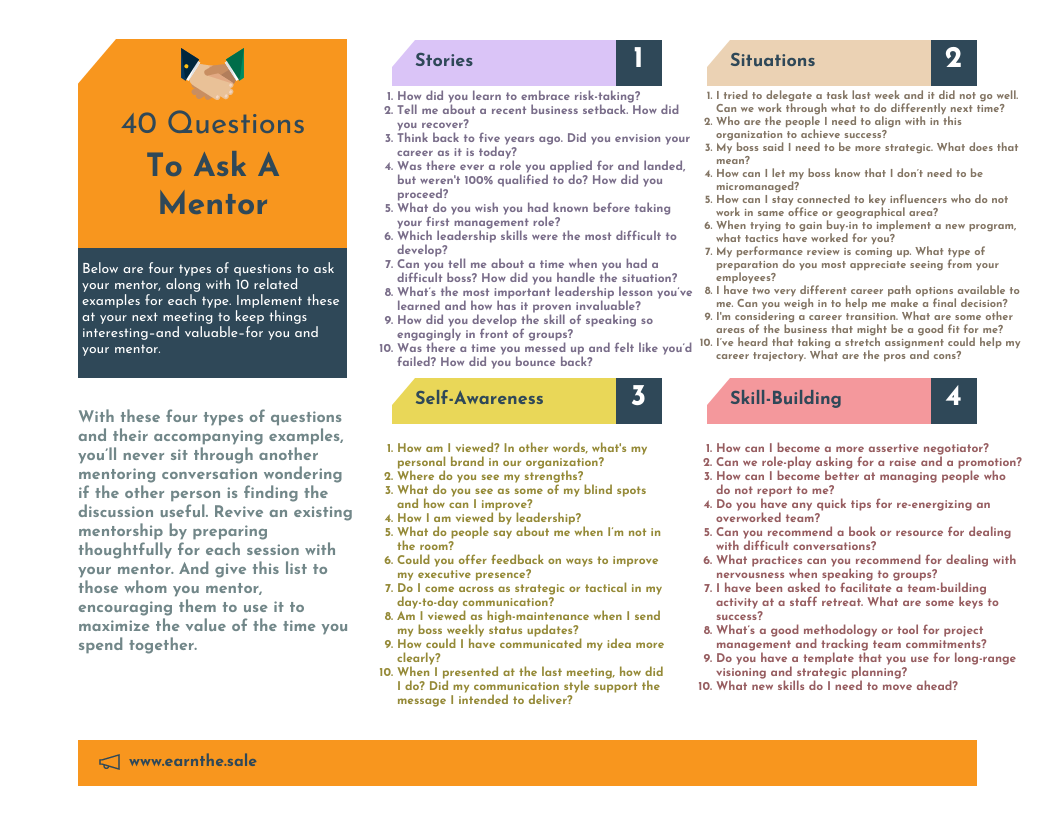
If you are currently in a mentorship but have found it difficult to facilitate a consistent dialogue then I’ve provided a list of 40 Questions to Ask A Mentor.

How To Push Through When You Feel Like Quitting

There are times in our career when we want to throw our hands in the air and shout, “I quit.” If working on something is affecting your mental health in a negative way, then it’s time to give up. Quitting, resetting, and rethinking what you’re doing are all acceptable options. Then go on with a new strategy. When you want to quit, but there isn’t a big reason why you should, look at the main reasons to keep going. 

Understanding why you must break through the wall is a rather straightforward process………. It is referred to as the “Big Why?” You’re more likely to give up if your why isn’t clearly defined. The simple act of sitting down and writing out all the reasons you shouldn’t give up might often be all you need to keep you going. Consider whether you are doing it for yourself, and why you deserve it. If you’re a parent, you might look back on your youth with a sense of wanting to create something better for your children than you experienced growing up. You believe your family deserves better, and going the extra mile is more than worth it to you since you care so much about them. If you haven’t heard of Simon Sinek, he’s most notably known for his TedTalk titled; How Great Leaders Inspire Action. The focus on his talk was around the importance of answering the “Why” question and what is now known as The Golden Circle. Below is a video from Sinek where he describes how he came to this realization, and how the WHY movement has grown.

You’ll need to keep reminding yourself that there are going to be a lot of obstacles in the way. Sit down, clear your mind and contemplate the obstacles before you. Ask yourself if they are truly obstacles preventing you from moving forward or if your imagination is exaggerating their magnitude. We often embellish an event by adding in negative self-talk and actions that did not take place. For example, a negative self-image perceives the act of feedback as criticism rather than coaching. Our minds are capable of creating fears, but sometimes those fears are filled with pain when they don’t have to be.

Replaying breakthrough moments in your imagination might help you avoid picturing hurdles in your mind. Fake obstacles will have a hard time taking root in the wake of such positive reflection. Breakthroughs occur to everyone at some point in their careers. It might be anything as basic as suffering through two years of an entry-level position before suddenly finding purpose in this experience as a stepping stone to a promotion. You may have spent years attempting to be the best salesperson in your company, only to come in second place. After that, you took your frustration and channeled it into action, putting in the time and calls necessary to get to the top. The thrill of achieving such a significant goal and receiving such recognition was priceless.

When someone says they have no recollection of a time when they were a winner, then make one. If you give it enough focus, your brain can’t discern the difference between a real occurrence and one you’ve made up. In Psychology this process is known as the Pygmalion Effect. Think back to a time when someone believed in you, and in doing so gave you the self-belief to push through. Describe how you “rose to the occasion” when confronted with a serious obstacle and smashed through it. Put your heart and soul into it, and imagine yourself leaping up and down and yelling, “I did it!”. In your mind’s eye, you’ll be able to see this scene in motion. This happens all the time in sports. Basketball’s finest free-throw shooters have a mental picture in their heads that encourages them to make their shots. After bouncing the ball around a few times before shooting it, they see and feel themselves on the line, ready to go. In this mental replay, there are no rim bouncers.

Stop and take a breather when you’re feeling overwhelmed. What may initially feel like a need to quit is simply a need to take a break . Take a deep breath, then turn off your phone and disconnect from email, social media, and constant notifications. For me getting outside and connecting with nature helps me reset. The only thing that matters is whether or not you are moving and smiling at the same time. Don’t worry about why you decided to rest for a few days. A mental and physical break is the only solution. Once you feel a sense of rejuvenation begin the process of refocusing on what you want and why you want it, then take huge action to get there.

5 Strategies to Overcoming Set-Backs

Photo by the blowup on Unsplash

Everyone despises failure, but what most people don’t know is that failure is an essential part of the succeeding process. Anyone who has ever achieved success has also experienced several failures. So, what is the best way to overcome failure?

Here are five strategies for overcoming adversity.

1. Make Use of Your Mistakes and Failures to Improve Your Performance.

What method did you use to learn to ride a bike? The short answer is that you fell off a hundred times. After every error or failure, try to extract as much information as possible from it in order to be better prepared for the next time.

Action Step: Make a list of the top five things you took away from your most recent error or setback and write them down.

2. Don’t Spend Too Much Time Thinking About It.

Now that you’ve gained some insight from your mistake, it’s time to move on. Don’t get caught up in the past. When you are gazing backwards, it is impossible to know where you are headed. Furthermore, concentrating on your previous failures will keep you trapped in your current situation.

Action Step: Go through everything you’ve written in Key 1 and make notes (The 5 Things You Learned).

3. Don’t be afraid to give it another go.

Make sure you don’t let the fear of failing again prevent you from achieving your greatest potential or achieving your goals. You don’t give up after one or two set-backs, just like you didn’t give up after one or two falls while learning to ride a bike.

Action Step: Apply what you’ve learned and give it another shot now that you’re more prepared.

4. Surround yourself with people who are upbeat and optimistic.

No matter what it is that you are attempting to do, it is important to surround yourself with successful individuals who have accomplished what you desire. One of the most effective methods to overcome failure is to learn from the experiences of others who have faced similar challenges. This will not only inspire you, but it will also serve as proof that it is possible.

Finding a mentor or group of individuals and surrounding yourself with them as soon as possible is a great action step.

5. Recognizing that failure is a necessary part of the learning process.

Failure and mistakes aren’t enjoyable, but they are necessary for us to learn how to be excellent at whatever it is that we are attempting. “There are no secrets to achieving success in life. It is the consequence of careful planning, hard labor, and the ability to learn from mistakes.”

Action Step: Think back to a moment when you were successful at anything. Then consider how many times you failed or made mistakes on your way to achieving your goal.

Now that you have the 5 Keys to Overcoming Failure, it’s time to put your knowledge into action. You have a spark of greatness ready to ignite deep within your being. Make no compromises in your pursuit of your full potential because of anyone or anything.

Below you’ll find a link to an E-Book on Famous Failures. History provides us with quite a few notable failures. Names that you are sure to recognize. These individuals are great examples of how set-backs led to insights that fueled their success. Enjoy~

3 Effective Sales Strategies That Motivate Customers to Buy

Photo by Sebastian Herrmann on Unsplash

Remember what it was like courting your spouse? It’s likely that you didn’t propose on your very first date! A two-way interaction develops before reaching the church doors. Much like dating, in selling, if you want the fulfillment of a life-long customer, you can’t rush it.

It takes time and effort to get to know your customer. While every customer is unique in personality, likes and dislikes, there are some constants that sellers may leverage. Give them what they want, and they’ll become devoted, lifelong clients.

1. Forget Selling… Focus on Buying

One of my favorite selling mantra’s is from Jeffrey Gitomer in which he states; no one likes to be sold, but everyone loves to buy! People want to imagine they make all their purchases based on their own brilliant ideas and savvy purchasing. No one likes a pushy salesperson. A salesperson who “HELPS” their customer find the best deal is a hero.

When a customer enters into conversations with you, they are probably already planning to buy something. You don’t have to sell them. You may relax and just assist them in making the greatest buy decision.

Focus on the customer’s needs. Consider… what rewards would she seek? What is his budget? Remember that you are there to help, not to persuade. By doing so the stress is gone!

2. Buy A “Sure Bet”

There are always risks associated with buying, or at least an opportunity cost. The higher the price, the greater the perceived risk! Yes, a customer is seeking a product that meets his wants and needs. Always remember that internally the customers is asking themselves, “Is it worth it?”.

It’s a valid question. The world is full of scams where you spend money on junk that doesn’t last and can’t be maintained. Or a previous salesperson has overpromised on what their service or product could provide. A few hard lessons make people weary of impulse purchases. They want something reliable.

A “no risk” guarantee helps negate many customer fears. They may relax knowing that if the goods do not live up to expectations, they won’t be stuck paying for a dud. If you’re in a business where providing a money-back guarantee isn’t realistic, then explain that you’re in the business of making it right and that is what they are paying for in choosing you.

Customer testimonials also show “potential” customers that you truly work towards customer satisfaction. No one can say it better than a happy customer, but don’t overuse them. Choose precise and detailed testimonials, and provide as much about the consumer as you can to bolster their credibility. Do you have a customer that initially had a bad experience, but you turned it around? Don’t hesitate to ask them to detail their experience in a testimonial.

3. Assure Them It’s A Simple Process

Review your sales process and evaluate if it’s too complex. Yes, your stressed-out clients can experience buyer’s fatigue. One of my favorite examples of simplifying the buying process is the convenience store Quik-Trip. A few years ago they embarked on a multi-store remodeling initiative to where now every Quik-Trip you enter is exactly the same. I know precisely where my favorite protein bar is whether I’m in Oklahoma, or Kansas. Make sure you process is customer friendly, not company compliance friendly.

Any darn fool can make something complex; it takes a genius to make something simple. — Albert Einstein 

When developing your selling strategy, don’t forget to highlight your product or services convenience. Value isn’t everything. With a little knowledge, you may easily attract your dream customer. Keep these three strategies in mind as you work to increase your business and client base, and watch your revenues skyrocket.

A Foolproof Formula for Showing Your Boss You Have Potential

Whether you want to move up the corporate ladder to management or be chosen to lead new initiatives, demonstrating your potential to your boss is critical. Naturally, excelling at your present work is a good place to start, but advancement requires more. In fact, your supervisor is most likely analyzing you right now. According to a Harvard poll, 98 percent of organizations have some type of mechanism in place to identify top achievers, who make up around 3 to 5% of the workforce. Meanwhile, staying in those upper echelons is nearly as difficult as getting there. According to the same poll, up to 20% of these emerging stars disappear off the list each year. Start immediately to realize your ambitions. Check out these pointers to help you remain on track at every level of your career.

Displaying Your Potential Early in Your Career

Focus on fitting in and building connections while you’re new to the workplace. That preparation will lay a solid foundation for you over time.

1. Produce results. Keep track of your achievements and keep a record of them. Develop a reputation for going above and beyond and finishing tasks on schedule. Proactively I dentify problems for which you may have a solution. Naturally it would be great if your solutions were adopted, but that’s not always the goal. Sharing your voice and taking part in the solution is just as important in providing one. 

2. Back up your manager. Make an effort to make your manager look good. What goes around, comes around. You’ll have your moment to bask in the feeling of making an impact, in the meantime focus the attention upward. Check your managers priorities to determine where you can focus your efforts.

3. Focus on learning. Keep the big picture in mind as you find out all you can about your company and your industry. Ask lots of questions, be observant, and read the latest news.

4. Request feedback. You should also learn about yourself, or at leas how you’re being perceived. Invite people to express their opinions on your work. Accept constructive criticism and acknowledge your coworkers for their input.

5. Take action! You must put your learning into practice in order for them to make a difference. Analyze information to see how it may be used in real life. When you pick a coworker’s brain or attend a conference, make a list of takeaways, and then choose one that you can take immediate action on.

6. As Kendrick Lamar would put it; Be Humble!  Allow your actions to do the talking. Contribute to the team and be willing to share credit.

Displaying Your Potential Later in Your Career

Your skill as a seasoned professional is often taken for granted. Intangibles such as leadership and vision are now more likely to be valued.

1. Create a niche for yourself. Prepare to relinquish certain obligations in order to focus on your talents. Find out what you’re excellent at and what you enjoy doing. Later in your career is a great time to leverage your strengths that may not have been quite as developed earlier. 

2. Act as a role model for others. Now is the time to return the favor. Consider the attributes you appreciate in your role models and tailor them to your own personal style. Make an effort to reach out to new recruits and provide supportive comments to your coworkers.

3. Inspire others. Encourage people to achieve their goals. Allow your colleagues to learn and improve by providing them the opportunity model you. 

4. Take on the role of an mentor. When working with customers or other members of the team, your behavior reflects on your company. Make sure you understand the mission statement so you can apply the values that perpetuate the teams success.

5. Take risks. You can act like an entrepreneur even if someone else owns the company. Take sensible risks that will allow you to stretch your skills and enhance your company’s position. Start off small and learn from experience so you can fine tune your judgement over time.

Demonstrating your potential to your manager will help in your advancement and recognition. Early in your career, increasing your effectiveness is a great way to set yourself up for success. You may rely on your business acumen and strong ties to help you succeed as a leader later on.