Mastering the Art of Perception: Understanding Contrast Bias in Sales and Sales Management”

Contrast bias is a cognitive bias in which our perception of something is influenced by a previous experience or exposure to a contrasting stimulus. This bias can lead to an exaggerated difference in our perception of two similar things due to the direct comparison between them.

Simple Example of the Contrast Effect

In sales and sales management, contrast bias can have significant implications. For example, when a salesperson presents a high-priced product after showing a series of even more expensive options, the customer may perceive the high-priced product as a good deal in comparison, even if it is still expensive in absolute terms. Conversely, if the salesperson presents the same high-priced product after showing a series of lower-priced options, the customer may perceive it as excessively expensive, despite its actual value. This demonstrates how the perception of value is heavily influenced by the context in which it is presented.

In sales management, contrast bias can affect performance evaluations. For instance, if a sales manager evaluates a salesperson who has been consistently meeting moderate targets after observing another salesperson exceed exceptionally high targets, they may perceive the first salesperson’s performance as subpar, despite it being objectively satisfactory in a different context. This can lead to unfair assessments and demotivation among the sales team.

To mitigate contrast bias in sales, salespeople can strategically present products in a consistent context to avoid exaggerated perceptions of value. Sales managers can reduce the impact of contrast bias by evaluating each salesperson’s performance based on individual targets and industry standards rather than direct comparisons with colleagues. By understanding and addressing contrast bias, sales professionals and managers can make more objective decisions and improve overall performance.


Here are 10 questions to help identify where the contrast effect may be present in your day-to-day. The contrast bias is not inherently bad or good. However, identifying where this bias may be contributing to both positive and negative outcomes can be important to achieving the results you want.

  1. Have you ever felt that a product was a great deal only after seeing a series of more expensive options?
  2. When making purchasing decisions, do you find that your perception of a product’s value is heavily influenced by the context in which it is presented?
  3. In a sales environment, have you noticed instances where a product appeared more or less appealing due to the way it was presented in comparison to other products?
  4. When evaluating performance in a professional setting, do you tend to compare individuals directly to one another, potentially leading to unfair assessments?
  5. Have you ever observed situations where a colleague’s performance was perceived as subpar, even though it met industry standards, simply because it was compared to exceptionally high achievements?
  6. Do you find that your perception of a product’s cost or value changes depending on the sequence in which it is presented alongside other options?
  7. Have you experienced situations where a salesperson’s performance evaluation seemed influenced by the performance of their peers rather than their individual achievements?
  8. When considering different options, do you feel that your perception of each option’s qualities is influenced by the qualities of the others?
  9. In a sales context, have you observed instances where a customer’s perception of a product’s value dramatically changed after seeing alternative options?
  10. When evaluating performance or making purchasing decisions, do you consciously consider how the context or comparisons may be influencing your perception of value or achievement?

Ready to take your sales game to the next level? ๐Ÿš€

Don’t miss out on more tips, insights, and strategies to boost your sales and sales leadership skills! Subscribe today and join a community of sales enthusiasts like yourself!

๐Ÿ“ฉ Stay up-to-date with the latest blog posts, packed with practical advice and real-world examples that will help you close more deals and inspire your sales team. ๐Ÿ’ช

๐Ÿ”— Want more valuable content? Check out the library of articles for a treasure trove of sales wisdom just waiting to be discovered. From prospecting techniques to negotiation tactics, I’ve got you covered!

๐Ÿ‘ If you found this article helpful, give it a thumbs up and share it with your network. Help spread the word and empower others to achieve sales excellence!

Remember, success in sales starts with knowledge and continuous learning. Don’t miss outโ€”subscribe, explore, and share today!

๐Ÿ“ข Come along the journey! Subscribe now, explore more, and share the knowledge! ๐ŸŒŸ

Navigating the Price Game: Mastering the Art of Negotiation with Buyers

When it comes to negotiations, buyers often try to push for lower prices to maximize their own gains. As a seller, it’s important to be aware of the tactics buyers use and to develop effective strategies to navigate these situations. In this article, I will explore the five most common ways buyers negotiate lower prices and provide insights on how to respond as a seller. Whether you are in sales or simply interested in understanding the dynamics of negotiation, this article will equip you with valuable knowledge to achieve win-win outcomes.

A LOST (when effectively negotiated) deal is often better than a BAD deal

1. One Last Request: Appealing to the Seller’s Desire for Closure

Buyers often employ the “one last request” tactic to secure a final concession from the seller. This tactic occurs at the end of a negotiation when the buyer requests one additional change to seal the deal. The effectiveness of this tactic lies in the seller’s eagerness to close the sale and their willingness to make a final concession in exchange for the buyer’s signature.

To effectively counter this tactic, sellers should remain diligent in evaluating the value of the requested change and considering whether it aligns with their pricing and objectives. It is essential to communicate the rationale behind your decision and signal that you understand the buyer’s request without compromising the overall value proposition.

2. Flinch Test: Challenging the Seller’s Initial Price

The “Flinch Test” tactic involves buyers insisting that the seller’s price is too high and demanding a better offer. This tactic is often used regardless of the circumstances and aims to evoke a concession from the seller solely based on a price reduction.

As a seller, it is crucial to resist the temptation to immediately concede to price demands. Instead, focus on highlighting the unique value your product or service offers and the reasons behind your pricing. Demonstrate the differentiation and benefits that set your offering apart from competitors. By emphasizing the value proposition, you can shift the negotiation away from pure price discussions and towards mutually beneficial outcomes.

3. Split the Difference: Appealing to Fairness

Buyers may suggest “splitting the difference” as a negotiation technique, portraying it as a reasonable compromise. However, sellers must be cautious, as meeting in the middle may not always result in a fair outcome for both parties.

To navigate this tactic, sellers should focus on rationalizing their pricing based on the value provided. Engage in open discussions with the buyer to understand their concerns and identify alternative concessions that align with the overall value proposition. By showing a willingness to collaborate while safeguarding your pricing, you can establish a partnership based on transparency and shared benefits.

Sellers want to be seen as reasonable. They want to create a partnership. When buyers say, “Why donโ€™t we meet in the middle?โ€ there’s an emotional appeal of showing good faith by splitting the difference.

Mike Schultz, Rain Group

4. Anchoring: Establishing a Low Budget Threshold

The “anchoring” tactic involves buyers sharing a low budget early in the negotiation to set the stage for further bargaining at a reduced price. By presenting a low anchor, buyers aim to influence sellers to provide lower estimates and increase their chances of securing a better deal.

Sellers must be aware of anchoring effects and the cognitive bias associated with the first offer in a negotiation. It’s crucial to understand the buyer’s budget and pricing expectations while highlighting the unique value your product or service brings. By framing the conversation around the value derived from your offering, you can counteract the anchoring effect and build a foundation for discussions based on the benefits your solution provides.

5. Meeting with Your Competitor Today: Leveraging Time Pressure

Buyers often use time-pressure tactics, such as presenting an offer within a tight timeframe or hinting at engaging with a competitor. These tactics aim to create a sense of urgency and scarcity, pushing sellers to make concessions quickly.

To counter time-pressure tactics, sellers should remain composed and analyze the situation objectively. Evaluate the buyer’s timeline and ensure you have a clear understanding of the value your product or service brings to the table. Demonstrate confidence in your offering and focus on the long-term benefits rather than succumbing solely to short-term pressures. By communicating the value and emphasizing the partnership potential, you can mitigate the effects of time-pressure tactics and maintain control over the negotiation process.

The Bottom Line

Negotiations are a crucial part of the consultative sales process, and understanding the tactics buyers employ can significantly impact your ability to secure favorable outcomes. By familiarizing yourself with the five most common ways buyers negotiate lower prices and developing effective responses, you can position yourself as a strategic partner who emphasizes value creation and mutual benefits.

Remember, negotiations should always strive for win-win outcomes where both parties feel satisfied with the agreement reached. By employing strategies that focus on highlighting the value of your offering and fostering open communication

FAQs:

Q1: How can sellers effectively respond to the “One Last Request” tactic?

In response to the “One Last Thing” tactic, sellers can employ Chris Voss’s technique of labeling, introduced in his book, “Never Split the Difference: Negotiating as if Your Life Depended on It”. Labeling involves acknowledging the buyer’s request and labeling it as legitimate while reframing it to gain perspective.

For example, respond with, “I understand that this is important to you, and I can see why you’d want this. Let’s take a step back and explore how this change aligns with the overall value we’re providing.”

Q2: What strategies can sellers employ to counter the “flinch test” tactic?

In dealing with the “Flinch Test” tactic, sellers can apply Chris Voss’s technique of mirroring. Mirroring entails repeating the buyer’s words or the last few key words to encourage further elaboration and create a collaborative atmosphere. By saying, “So you’re looking for a better price?”, sellers gather more information and show a willingness to understand the buyer’s perspective. This allows for a more thoughtful response rather than immediately conceding to price demands.

Q3: Are there situations where buyers’ negotiation tactics can be beneficial for sellers?

Yes, there are instances where buyers’ negotiation tactics can be advantageous for sellers. Chris Voss explains the importance of utilizing and adopting a mindset of “tactical empathy”. Through active listening, sellers can uncover the underlying motivations and concerns driving the buyer’s negotiation tactics. By understanding these factors, sellers can adapt their approach to address the true needs of the buyer and arrive at a mutually beneficial outcome.

Q4: How can sellers effectively respond to time pressures buyers use by leveraging competitive research?

An accusation audit, a technique introduced by Chris Voss, can be a powerful tool in negotiations. Instead of shying away from potential criticisms or concerns, the accusation audit allows sellers to address them head-on.

For example:

Buyer: “Iโ€™m meeting with your competitor this afternoon, and Iโ€™m sure they can do better. Is that the best you can do?”

Seller: “It sounds like you believe our price is too high and that we may not be offering enough value for the investment. I can understand why you might think that, as there are many options on the market. However, I’d like the opportunity to highlight the unique benefits and superior quality/service we provide.”

By leading with a statement that acknowledges the buyer’s concern or accusation, the seller demonstrates empathy and shows a willingness to address potential reservations. This can lead to a more open and constructive dialogue, allowing both parties to explore ways to create value and find a mutually beneficial solution.


Ready to take your sales game to the next level?๐Ÿš€

Don’t miss out on exclusive tips, insights, and strategies to boost your sales and sales leadership skills! Hit the subscribe button and join a community of sales enthusiasts like yourself!

๐Ÿ“ฉ Stay up-to-date with the latest blog posts, packed with practical advice and real-world examples that will help you close more deals and inspire your sales team.

๐Ÿ”— Want more valuable content? Check out the library of articles for a treasure trove of sales wisdom just waiting to be discovered. From prospecting techniques to negotiation tactics, I’ve got you covered!

๐Ÿ‘ If you found this article helpful, give it a thumbs up and share it with your network. Help spread the word and empower others to achieve sales excellence!

Remember, success in sales starts with knowledge and continuous learning. Don’t miss outโ€”subscribe, explore, and share today!


Subscriber Bonus:

If you want more tips & techniques for negotiating, then subscribe & leave a comment on this post. Iโ€™ll email you my new E-Book as a bonus: Negotiate Like a Proโ€ฆAnd Get What You Want More Often

Recession Proof Sales Techniques for Selling Home Improvements to Homeowners

Selling home improvements can be a lucrative business, but it can also be challenging, especially during times of economic uncertainty. With many homeowners tightening their belts and cutting back on expenses, it can be difficult to convince some to invest in home renovations. However, with the right sales techniques, you can still close deals and grow your business even during a recession.

Here, I’ll share some of the top recession-proof sales techniques for selling home improvements to homeowners. From building trust to offering financing options, we’ll cover everything you need to know to close more deals and thrive in a challenging market.

Building Trust

One of the most important things you can do as a salesperson is to build trust with your potential customers. Homeowners want to work with someone they can trust to do a good job and not take advantage of them. In a recession many businesses will be cutting costs in an effort to lower prices and in doing so quality can suffer. In a race to the lowest price, homeowners are willing to pay more for companies they can trust. Here are some ways to build trust with your customers:

  • Be honest and transparent: Don’t make false promises or exaggerate the benefits of your services. Be transparent about pricing and what your services include.
  • Provide references and testimonials: Show your potential customers that you have a track record of satisfied customers. Provide references and testimonials from previous clients to demonstrate your expertise and reliability. Many homeowners are aware of how easily some testimonials can be misrepresented (testimonials from family members, friends, employees, etc) so be sure to leverage other sources of credibility such as Better Business Bureau ratings, and other third party ratings.
  • Offer guarantees: Offer a satisfaction guarantee or warranty to show your customers that you stand behind your work.

By building trust with your customers, you’ll be more likely to close deals and earn repeat business.

Offering Financing Options

During a recession, many homeowners may be hesitant to spend money on home improvements, even if they’re necessary. Offering financing options can help make your services more accessible and affordable. This is another area where some business will see financing as an expense and look for cost-savings by either limiting financing options or eliminating them. Here are some financing options you can offer:

  • Payment plans: Offer payment plans that allow customers to pay for your product or services over time instead of all at once.
  • Home equity loans: Help your customers secure home equity loans to finance their home improvements.
  • Credit cards: Accept credit cards to make paying for your services more convenient for your customers.

By offering financing options, you can make your services more accessible to a wider range of customers and increase your chances of closing deals.

Creating a Sense of Urgency

Creating a sense of urgency can be a powerful sales technique, especially during a recession when customers may be more hesitant to spend money. Here are some ways to create a sense of urgency:

  • Limited-time offers: Offer limited-time discounts or promotions to encourage your customers to act quickly.
  • Emphasize the benefits: Highlight the benefits of your services and how they can improve your customers’ quality of life. Remind them of the potential costs of delaying or not investing in home improvements.
  • Show your availability: Let your customers know that your schedule is filling up quickly and that they may miss out on the opportunity to work with you if they don’t act soon.

By creating a sense of urgency, you can encourage your customers to act quickly and increase your chances of closing deals.

Overcoming Objections

Homeowners may have objections to investing in home improvements, especially during a recession. Here are some common objections and how to overcome them:

“It’s too expensive”: Offer financing options or emphasize the long-term benefits of the investment. For products or services that have a strong return on investment, whether through greater resale value or energy-savings, long-term financing options let these homeowners offset the initial costs through a low cost of ownership.

“I don’t have time”: Emphasize the convenience and time-saving benefits of your services. You can also work with the customer to create a timeline that works for them.

“I’m not sure it’s necessary”: Emphasize the potential cost savings and energy efficiency that come with home improvements. You can also provide references or testimonials from previous customers who have seen the benefits of your services.

By addressing objections and providing solutions, you can help your customers overcome their reservations and close more deals.

Upselling and Cross-Selling

Upselling and cross-selling can be effective sales techniques for increasing the value of each sale. Here are some tips for upselling and cross-selling:

Offer complementary services: If a customer is interested in one service, offer a related service that complements it. For example, if they’re interested in a window replacement, offer to also update their entry door as well.

Suggest upgrades: If a customer is considering a certain product or service, suggest an upgraded version that offers more features or benefits.

Large project discounts: Offer discounts for jobs that keep crews busy and reduces downtime to encourage customers to invest in larger projects.

By upselling and cross-selling, you can increase the value of each sale and grow your business.

Selling home improvements during a recession can be challenging, but it’s not impossible. By building trust, offering financing options, creating a sense of urgency, overcoming objections, and upselling and cross-selling, you can increase your chances of closing deals and growing your business. Remember to be honest, transparent, and customer-focused throughout the sales process, and you’ll be well on your way to recession-proof success.

Don’t Take Selling Personal

Photo byย Ryan Snaadtย onย Unsplash

Selling may be one of the most lucrative and exciting careers in the world when you’re closing sales and hitting your sales targets. However, if sales are down and prospects aren’t returning your calls, you may begin to doubt yourself and take it personally. So, let’s look at what it takes to stay motivated in order to bring in additional clients.

In order to get more clients and expand your business, follow these three steps.

1. Identifying and cultivating new customers.

2. Investing more time and effort into existing customers to increase referrals and business.

3. Making contact with higher-level decision-makers in order to gain larger deals. 

As a sales professional, we recognize the significance of reaching these goals. Why, then, do so many sales professionals struggle to get over the first hurdle? It appears that, as much as we want to succeed in sales, we also want to avoid rejection while calling on prospects and customers.

Let’s take a look at how rejection affects sales performance. Fear of rejection and failure might make you lose your excitement, confidence, and initiative. When you are rejected, it can be damaging to your ego. You may get disillusioned, upset, and defensive if you take the negativity personally.

We may take rejection personally for three reasons. Each of them is linked to one of the three goals. They are as follows:

Frequency: Studies have shown that reaching decision makers takes at least five attempts or more. You may be irritated, disheartened, and uncertain of yourself if you’ve been calling prospects all week and they haven’t responded. It’s difficult not to take it personally and believe you’ve done something wrong.

Emotional Involvement: You’ve had a long-term business relationship with a client. You put a lot of effort into building the relationship. You want to ask for referral business from them, but you’re terrified of putting them on the spot or getting a negative response. You’re worried that this may harm the connection you’ve fought so hard to build.

Perceived Importance: You may choose to call on prospects with whom you are most familiar. You may be hesitant to contact decision makers higher up the ladder in a company because you believe you lack the experience and confidence to engage with a seasoned senior executive. If you believe you have nothing in common with a company’s CEO, you are unlikely to contact him or her.

If we believe that in order to feel good about our work, we must be accepted by others, we will be vulnerable to failure and rejection. Because self-esteem is built on ones own sense of self-worth, successful sales professionals see failure as a chance to learn and improve. They feel that failure may teach them more than success, and that every mistake is an opportunity to learn and grow. This is why successful sales professionals are generally in a positive mind-set, whether they achieve or fail, whether they are liked or rejected.

So, what’s the secret to coping with rejection in a constructive way? It can be summed up in five terms… “Don’t take anything too seriously.” Shit happens Things take place. People get overworked. Customers are possibly having a rough day. The economy rises and falls. You have a decision to make. You may either take it personally and use it as an excuse for failure, or you can concentrate on the four things you have control over: your beliefs, attitude, emotions, and performance. Take care of those four things, and the rest will fall into place.

Change your thoughts to “My customer is extremely satisfied with my service and is eager to suggest me to others with similar challenges!” the next time you have a limiting thought like “I can’t ask for referrals because I don’t want my client to think I’m too pushy!” Shifting your thoughts is the first step toward changing your beliefs, but it’s not the end of the process. Begin by stating it out loud to yourself and then sharing it with others. It will become more real for you if you do so.

ASSIGNMENT:

Choose one of the three objectives in which you’d want to make a breakthrough:

1. Identifying and cultivating new clients.

2. Investing extra time in customers in order to earn referrals or new business.

3. Obtaining larger orders or contacting higher-level decision makers.

  • Cut a 3″ x 5″ index card in half. On one side of the card, put down all of your negative thoughts regarding achieving that goal. Don’t be afraid to speak your mind.
  • Reverse the negative thinking and write good thoughts on the other side of each index card. This is the first step toward changing a negative belief.
  • Begin by speaking the new affirmation aloud to yourself and sharing it with others to practice changing that thought.

Make a list of action items to take, and take one step toward achieving the goal today!

Sell for Change!

Photo byย Ross Findonย onย Unsplash

Selling is all about getting buy-in for people and businesses to change, and change is always inherently risky. When given an option, most individuals will invariably opt for the status quo. People, and especially businesses, are creatures of habit, and changing their habits necessitates breaking old ones and forming new ones. Selling is challenging because it requires you to battle against human nature by influencing others to change (and you thought it would be simple!).

When you think about it, a lot of the opposition you’ll face in sales (objections, delays) is a result of risk. Most people will resist change if they consider the danger of changing is greater than the risk of staying the same. It’s tough to build the momentum needed to encourage people to change because of the old concept that “it’s better to live with the devil you know than the devil you don’t know.” It is a formidable force with which we shall all have to contend.

So, how can we reduce risk, or at least reduce the impression of threat, so that more customers are willing to take the risks necessary to experience the positive future result?

 Two essential tactics spring to mind:

1. Identifying and thoroughly understanding your prospects’ problems will encourage them to believe that you are less likely to sell them a solution that will not work because of your understanding. Asking questions that allow you to fully comprehend their circumstances will help to reduce their fear of risk.

2. Assisting them in seeing that the current “discomfort” (consequences, circumstances of remaining the same) will be mitigated by their willingness to go through the “discomfort” of change. Helping them in overcoming the apparent risk once more.

The first technique requires our ability to ask excellent “information seeking” questions.

Questions such as:

  • Could you tell me more about the issues you’re having?
  • How long have you been having these issues?
  • What steps have you taken to address them?
  • How did that work out for you?
  • What influence or repercussions do they have on you and your firm, specifically?
  • Are the issues costing you or your firm money?
  • What will happen if you don’t take care of them?

As you gain knowledge, you develop the notion that using the insight you’ve obtained, you’ll be more likely to make a solid recommendation…thus minimizing risk (you may also find this is a good strategy that helps to differentiate you from your competition).

The second method necessitates the use of “consequence” questions.

Questions such as:

  • What happens if nothing is done about it?
  • Do you think you’ll be able to live with this?
  • How would you feel if you weren’t able to tackle the problems?
  • Is there anyone else who is impacted by these issues?
  • Is it possible that you don’t need to be concerned?

These questions assist the prospect in realizing that failing to solve the problem may be a greater risk than the risk of change. They’re frequently the questions you’ll need to generate change momentum.

Your ability to ask both of these type of inquiries will aid you and your prospect in recognizing and limiting the risks associated with making a change. One of the secrets to being effective in sales is to reduce risk!

My Top 5 Recommended Books on Selling

Photo by Shiromani Kant

Mark Twain once said, “The man who does not read good books has no advantage over the man who cannot read.”

Here are short links for you to find on Amazon:

  1. Objections: The Ultimate Guide for Mastering the Art and Science of Getting Past No Jeb Blount does an excellent job of outlining the mental process of addressing objections rather than rejection. This is my favorite book on closing and isn’t your typical anectdotal approach to objections that you find in sales.
  2. Triggers: Creating Behavior That Lasts-Becoming the Person You Want to Be While this isn’t technically a “sales” book, being truly effective in sales is about engaging in the right behaviors consistently. While there are many books that will tell you exactly what sales behaviors to do- none of them get to the psychology of root behaviors. Goldsmith does an excellent job of understanding the psychology behind the behaviors we choose to engage in (sales or not).
  3. Escaping the Price Driven Sale: How World Class Sellers Create Extraordinary Profit Anyone who knows me knows that I am a BIG fan of SPIN Selling. When your value is determined by your ability to be consultative, there is simply no better sales methodology than SPIN, in my opinion. Escaping the Price Driven Sale is a great companion to SPIN Selling and further deepens the understanding of the SPIN methodology.
  4. Emotional Intelligence for Sales Success: Connect with Customers and Get Results Talk to anyone who works in sales and they will undoubtedly tell you that it’s an emotional rollercoaster of a profession. Enter; Emotional Intelligence. If you don’t have it- your success, if any, will be shortlived. If you don’t have it, and you find success, you’ll never become a great leader- you’ll be pigeon holed. Just get it and be grateful that you made the investment in yourself.
  5. The Sales Bible: The Ultimate Sales Resource I simply enjoy Jeffrey’s approach to all things sales. It’s short and to the point. He over delivers on what he promises and his approaches simply work. The amount of complimentary resources he provides on his website through this book is worth 10x’s what he charges for the book. You’ll be referencing this for years to come and should be a staple on your shelf.

As with any list it’s hard to narrow down to just five, and some would be debatable depending on the stage of your sales career. I consider these to be foundational to the profession of sales. I could create lists upon lists should we get into the various facets of sales; presenting, speaking, communicating, building value, prospecting, asking for referrals, so on, and so on. Hey- there’s my next few lists ideas ๐Ÿ™‚

What books are staples on your “sales” shelf?

On Goodreads? Let’s connect there!

4 Steps to Negotiating When You’re Intimidated By Rejection

If youโ€™re terrified of getting the door slammed in your face, negotiation must be difficult for you! Just the thought that your efforts could be met with rejection might be enough to discourage you. If you are new to sales confronting rejection will become a common occurrence.

So where do you go from here? How do you get past rejection even if your first attempt fails? Getting past rejection may not happen overnight, but it’s certainly possible. In fact, what you really need is a few easy-to-apply steps to successful negotiation. Getting tips that keep you focused on your mission can ensure that you persevere. As you begin to make these easy steps part of your daily habits there are more advanced techniques in addressing and reducing rejection.

Check out these great ideas for scoring the upper hand with negotiations:

(1) Believe in your product or services. By far, this is the most important element of successful negotiation. While this may sound like an obvious point, the reality is there are many sales professionals that do not believe in their product or service. The lack of belief makes rejection almost an expectations, rather than an anomaly. In some cases it is not that sales professionals lack belief in their offering, they do not fully understand the problems that their service or product solves. You absolutely need to believe in your product in order to sell it!

When you’re confident, it shows in your eyes and body language. People are quicker to pay attention when they realize you stand 100% behind your negotiation point.

If you’re not sold on your product and the problems you are able to solve, chances are the other person may fail to take you seriously.

Standing behind your product gives you the bargaining ability to win over your potential customer.

(2) Prepare your case. Now that you've bought into your product, it's time to plan your approach. Decide how to express your case for the best possible results. Write out your high-level points and how those points tie-back to the needs of your customer. Think about what possible reasons the customer may object to. Give thought to both logical and emotional reasons. 

Is there any backup information you need to help support your case? Prepare it in advance.

Know your case inside out. If you're selling something that you know somebody wants, be able to negotiate and tell them why they want it!

Try to have a "yes" for every possible "no" the other party may pose.

(3) Embrace your human equality. At the end of the day, you’re just as good as anybody else. Avoid allowing your feelings of inadequacy to convince you to shy away from negotiation.

Remember that rejection doesnโ€™t make you a failure. It simply gives you the opportunity to fine tune your approach. After all, experience is the best teacher!

Avoid contemplating that the other person may not want to negotiate with you. Think positively! Youโ€™re just as equal as the other person. Tell yourself that everybody wants to hear what you have to say.

You’re very deserving of the opportunity to negotiate your point. Seize it and make the most of it!

(4) Consider the worst that could happen. Take a moment and really consider the possible outcomes. What’s the worst that could come out of your attempts at negotiation? Just how life-crushing do you think the rejection could be?

If you’re honest with yourself, you’ll realize that you’re probably making it seem worse than it is.

The worst thing you can hear is “no.” And so what if you do? What possible damage can that word do to you? Absolutely none! Selling makes for a very interesting career for individuals who cannot learn how to deal with the word “no”.

Being rejected doesnโ€™t make you any less worthy. In fact, consider that the other party is missing out on what you have to offer!

Rejection is a natural, ever-occurring part of life. You can expect to face rejection from time to time because not everybody sees eye to eye. But that’s what makes life so interesting!

Can you imagine how boring life would be if nothing you did was ever met with rejection? It would limit creativity and imagination. So do your part to keep constantly evolving. Be bold and ready to take on whatever is thrown at you!

Why do customers stall?

One thing I take a lot of pride in is that I was able to have some of the best years (at that point) of my sales career during the 08′-12′ Great Recession. While many of my counterparts were frozen (rightfully so- it was brutal) in how to move forward in that business environment, I was busy doubling down on my craft and subsequently finished many of those years as the #1 sales person in the organization. I don’t say that to impress you, but to impress upon you that there are opportunities to be had during this time. You just have to begin using the right strategies & stay in the right frame of mind moving forward.

Today I want to share some strategies on how to move deals through your sales cycle that may have stalled.

In consultative sales you’ve got four outcomes: a sale, a no sale, an advancement, or a continuation (another word for stall). As with any type of selling, you want as many sales as possible, limited amount of no sales (they happen), absolutely no CONTINUATIONS/STALLS, and more ADVANCEMENTS than no sales.

Some examples of continuations from a prospect: “call me next week”, “send me a quote and I’ll follow up with you”, etc. Anything where there’s a perception of a next step, but there’s no commitment or plan on what that next step may be. An advancement is where there is a solid commitment on what the next steps are, and a commitment on what you, as the sales rep, and the prospect will be doing.

What we don’t want are continuations- when you get one it’s important to be able to identify whether this is a STALL or a CONDITION to not moving forward. A condition would be any legitimate reason as to why the prospect cannot move forward- examples would be; there’s an approval process, another decision maker needs to be involved, a payment stipulation (bonus coming). It’s easy to identify stalls- if you’ve done a good job in your presentation, things line up- you’ve gained agreements along the way, and then all of sudden once a decision needs to be made, you’re given reasons that just don’t seem consistent to what’s been discussed and agreed upon.

Now-think about your projection. How much of your pipeline, or past opportunities, suffer from stalled opportunities? Opportunities- where you may believe you have a chance, but you can’t identify why they haven’t moved forward. They seemingly string you along.

If you are like most, stalled opportunities easily account for 30% and 50%. In a tough market one of the biggest returns you can reap is to reduce the impact of stalled decisions; however, to jump start a stalled sale, you must understand the cause of the stall. Here are a few common causes to investigate:

Lack of connection to a the most important issues to the prospect. Unless your solution increases savings, improves aesthetics, home value, comfort, efficiency, sound, and security, or some other looming implication, you can expect a stall. When purse strings tighten, homeowners will only spend on matters that impact them the most.

A sales rep only has reengage and ask three questions to uncover issues:

  1. Why do you want this solution?
  2. Why are those problems important to solve?
  3. Why does this matter to you?

Lack of perceived value. Most people can really only juggle five or six critical issues at a time. We all live with problems that we donโ€™t need to solve today. However, competing priorities are constant. Can your prospect articulate the value or impact of addressing the issue? If your solution, from your prospects perspective, doesnโ€™t have enough value to get in his top three or four, you get stalled or put on the back burner. Ask the prospect to quantify the impact of resolving the issue. Better yet, ask her how the solution will impact her personally.

Lack of differentiation. Lack of differentiation will cause the prospect to spend more time evaluating, which translates to a stall. If you are unable to differentiate on features and solving problems, you will be forced to differentiate on price.

Decision authority. Decision authority is one of the most common causes of stalled decisions. Itโ€™s important to ask yourself, โ€œHas the person youโ€™re in contact with made this type of decisions before? When and how?โ€. Understanding their decision authority and decision making process early in the conversation will help identify whether you are dealing with a STALL or a CONDITION.

Risk. Making a decision involves risk. The prospects perception of risk can span impacts like lost budget flexibility,(do we forgo our Cruise this year??), lost time, or fear of making the wrong decision. As a prospect gets closer to making a decision, the risk becomes greater in her mind. Common tools for alleviating risk include supplying references, using reliable third-party data, and demonstrating return-on-investment analysis.

My hope is that you can take these above strategies and immediately apply them to begin helping your prospects move forward.

Thanks for stopping by and remember- the best earn the sale!

“It’s way out of our budget”- Oh no!

We’ve all had it happen before, we are in front of a prospect who has completely unrealistic price expectations. What do you do? Check out the video below for a few tips on how to address this scenario.

A potential client wants a 20 product bid. They tell you that they expect the price to be under $10,000; you know it will be considerably more than that. Now what?

Don’t be in a hurry to write off someone with an unrealistic expectation on price. If they called you, doesn’t that mean they need or want your product? Take the time to gather information before you decide they aren’t worth your time and energy. See if you can turn it into a sale.

This can be accomplished with the proper set of questions and a little patience. Start by asking the four basic questions that are needed to get to the contract. At some point, the budget will come up. Ask the question, “How did you arrive at the budget you have set?” You will get all kinds of answers, but the usual sources are other contractors, something from the media, or a hopeful wild guess on the part of the owner.

Give them the three price ranges that their job will fall into. Not one lump sum figure, not two broad figures, but three well-defined ranges based on your experience. You want them to make a decision, and that is why the wording is so important. Start with the middle range, move to the top range and finally explain what they will get in the low budget range.

Will they have sticker shock? Most likely. Will they think you and your prices are nuts? In some cases, yes. Will you get through to them that their budget is unrealistic? Maybe.

Most of it depends on how you present the information. Good questions can lead them to the conclusion you need them to reach. Blanket statements are not as effective. Remember that you have two ears and one mouth and use them in that ratio.

When you have given the three price ranges, ask the question, “Which of these three budget ranges would you like to invest in your home?” Or, “Which of these three budget ranges do you think would work best for you and your family?” There are several ways of asking this question but after you ask it, STOP! One of the biggest mistakes salespeople make is that they ask a question, and then keep on talking. Put a zipper on your lip. Button it up. Let them give their answer.

If they come back with the nonsense that they don’t know what it will cost, tell them it will be in the ranges you just discussed. Give the ranges again if necessary. They don’t like making decisions, and are trying to avoid the fact that you provided that info already.

Give your clients good information, help them adjust their budget, and make the sale. If they won’t adjust, move to the next client with a realistic price expectation.

Remember, the best earn the sale!

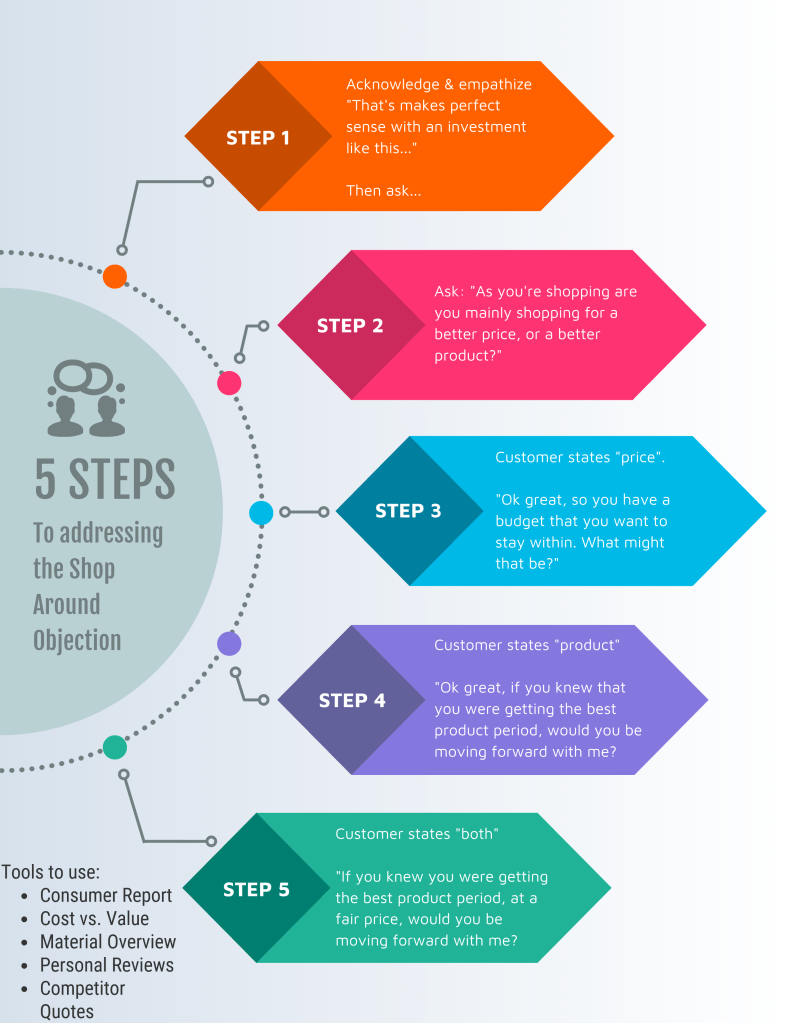
5 Steps To Addressing the Shop Around Objection

The closing stage of a sales presentation is one of the toughest- it’s fraught with emotions on both sides of the table. Customers begin to feel the tension of making a decision, and salespeople begin to battle the anticipated emotions of rejection, uncertainty, and stress.

Legendary sales trainer Brian Tracy states that whenever a customer experiences the emotions of the close “they retreat and begin to say things like, ‘let me think it over, ‘or can you email me the quote’, or ‘we need to get other quotes’, ‘I need to talk it over with someone else’, and so on.

It’s this sales resistance that necessitates a closing process. Otherwise as salespeople we begin to push for a result. The result is the process!

What’s the point of eating a bowl of ice cream: to get to the end, or savor every bite? My bet is that if you are a results driven person- you want to get to the end of that bowl as fast as possible. How about a goal of an exercise program? Unless you’re a professional athlete, the goal is to maintain a level of personal satisfaction.

Sales Coach and author of “Selling for Dummies”, Keith Rosen shares that “you don’t do a result; you execute a process, which produces the result as a natural by-product of your efforts.” To get better results you must focus on the process.

A well practiced closing process allows you to convey confidence. To address the shop around objection devote your attention to following the process and you’ll find that more of your customers will choose you rather than shop around.

When you don’t have an objection process