
A mentor is often someone in a position who volunteers to transmit skills to up-and-coming movers and shakers in order to foster growth in their career. While taking on the mentor position is intended to benefit the mentee, it is not a one-sided experience. Being a mentor provides an incredible opportunity to improve your talents and grow as a future leader.
Learn to communicate in an open and supportive manner
Both the message sender and the message recipient must do more than simply act passively in order to communicate. You’ll become a better communicator who listens and talks with thought and regard for the other person’s comprehension as you study communication styles and how it all works.
Practice and improve your listening abilities
Mentors must pay attention to their mentees in order to understand what they require. Because listening is a skill that most people need to practice more regularly, simply needing to listen is fantastic preparation for the rest of your career. Listening entails more than simply hearing. It’s active listening with the goal of understanding, which necessitates asking questions to obtain answers.
Find out how to give constructive criticism
When mentoring someone, you must provide feedback. As a leader, you’ll be required to provide feedback to a variety of people to ensure that the influence you’re having and the outcomes you’re delivering are as good as you want them to be. However, this is a step that is frequently overlooked. When you mentor, you must do so since it is the most important aspect of the connection that you must learn to perform well. This constructive criticism will benefit you in all aspects of your leadership.
Encourages continuous improvement
While a mentor’s primary function is to guide a less experienced individual into the meat of their career, the fact is that it also helps you to learn more. It’s easy to become trapped in old habits of doing and thinking, but when a less experienced colleague asks fresh questions based on their unique perspective of the world, you’ll be forced to master new skills that will propel your career as a future leader forward.
Forms New, Strong Relationships
Even if a mentor is perceived as being significantly ahead of their mentee in their profession, the bond you develop as you help them navigate their life and job via your expertise can be extremely beneficial to you later on. Furthermore, these relationships are developed in a mutually respectful manner, which will continue over into future opportunities.
Enhances your professional reputation
It only helps you appear better if you are recognized as the person who goes out of their way to assist others and open doors for them. As a leader, you’re not concerned about someone replacing you, and you want someone to replace you someday, so you coach future leaders.
Increases self-awareness
It feels nice to help someone somewhat behind you achieve the success you achieved so far because you get to view yourself from a different perspective. The more viewpoints you can see yourself through, the more you will understand who you are and what matters to you.
Enhances your coaching abilities
Most leaders are in charge of guiding people through a problem-solving process, although they may not know it. Once you’ve mentored someone, you’ll realize that you can apply this talent at work, in your business, and even in your personal life with your family.
Finally, mentoring can assist you in becoming a better leader. With each mentee you take on, you’ll improve your people skills and become a more informed, open, and respected leader who isn’t stuck in the old ways.
EXTRA BONUS:
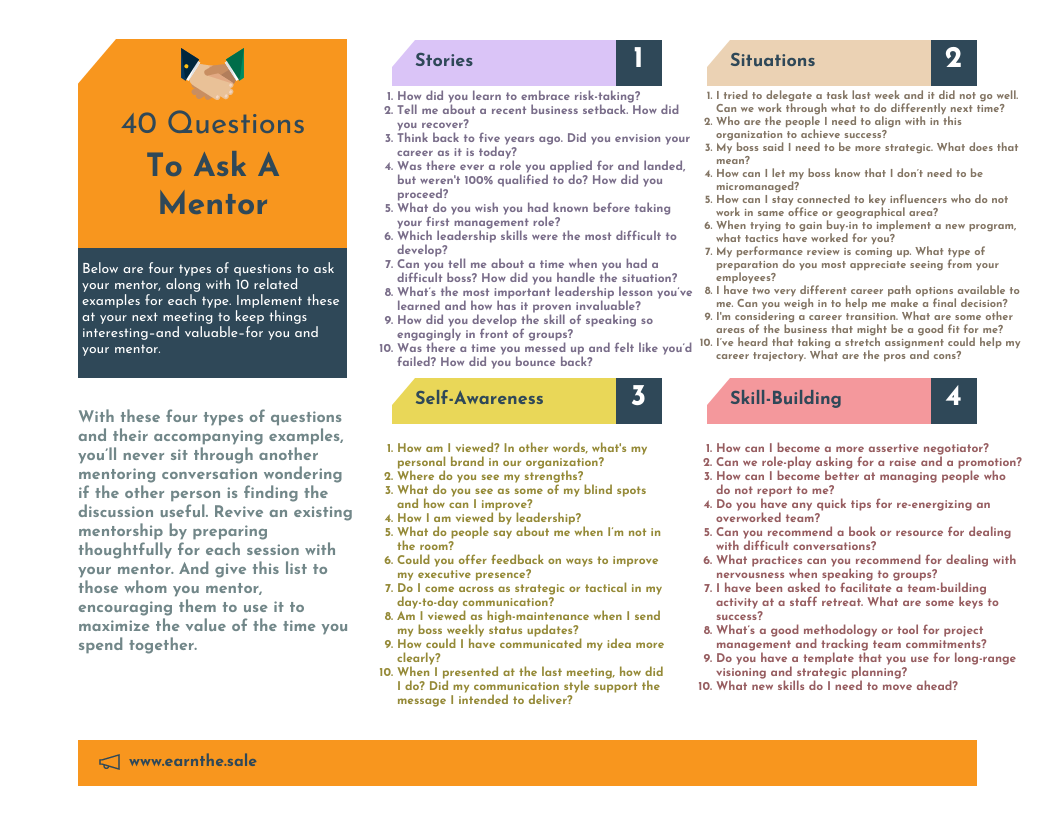
If you are currently in a mentorship but have found it difficult to facilitate a consistent dialogue then I’ve provided a list of 40 Questions to Ask A Mentor.


























 Catalyst Consulting