Triggers: Creating Behavior That Lasts-Becoming the Person You Want to Be While this isn’t technically a “sales” book, being truly effective in sales is about engaging in the right behaviors consistently. While there are many books that will tell you exactly what sales behaviors to do- none of them get to the psychology of root behaviors. Goldsmith does an excellent job of understanding the psychology behind the behaviors we choose to engage in (sales or not).
Escaping the Price Driven Sale: How World Class Sellers Create Extraordinary Profit Anyone who knows me knows that I am a BIG fan of SPIN Selling. When your value is determined by your ability to be consultative, there is simply no better sales methodology than SPIN, in my opinion. Escaping the Price Driven Sale is a great companion to SPIN Selling and further deepens the understanding of the SPIN methodology.
Emotional Intelligence for Sales Success: Connect with Customers and Get Results Talk to anyone who works in sales and they will undoubtedly tell you that it’s an emotional rollercoaster of a profession. Enter; Emotional Intelligence. If you don’t have it- your success, if any, will be shortlived. If you don’t have it, and you find success, you’ll never become a great leader- you’ll be pigeon holed. Just get it and be grateful that you made the investment in yourself.
The Sales Bible: The Ultimate Sales Resource I simply enjoy Jeffrey’s approach to all things sales. It’s short and to the point. He over delivers on what he promises and his approaches simply work. The amount of complimentary resources he provides on his website through this book is worth 10x’s what he charges for the book. You’ll be referencing this for years to come and should be a staple on your shelf.
As with any list it’s hard to narrow down to just five, and some would be debatable depending on the stage of your sales career. I consider these to be foundational to the profession of sales. I could create lists upon lists should we get into the various facets of sales; presenting, speaking, communicating, building value, prospecting, asking for referrals, so on, and so on. Hey- there’s my next few lists ideas 🙂
Sales leaders set goals. But they often set only one type of goal, and in doing so they set themselves up for failure. Here are different types of goals to set:
Achievement goals – These describe results that you will have when you finish the goal. Examples include: retire with a million dollars at age 65, earn a promotion by June, increase sales by 5%. Most major goals are achievement goals.
2. Action goals – These describe specific actions that you will take to accomplish achievement goals. Examples include: meet with an investment counselor, attend a workshop to learn new job skills, contact all of the prospects in the database.
3. Layered goals – These specify the same goal with different levels of priority and difficulty.
4. Rate goals – These specify actions repeatedly done over time. Examples include: Read two books per month, exercise three times per week, or write in a journal every day. Many personal growth activities can be performed as rate goals.
5. Limit goals – These set boundaries. Examples include: Spend less than $5,000 on new equipment, go to bed before 10 PM each night, take less than 45 minutes for lunch while at work. These help manage priorities.
6. Exclusion goals – These state things that you will not do. Examples include: Do not watch TV after 8 P.M., do not use a cell phone when with other people, do not eat junk foods. These help you decide in advance which activities you will avoid.
Now that you know the six types of goals begin thinking about how you can incorporate these into your short and long term plans. Doing so will put you on a path to maximum achievement!
As a sales professional, self-doubt can be a major obstacle in achieving success. It can hold you back from making bold moves, taking risks, and making important decisions. Overcoming self-doubt is crucial to unlocking your full potential and becoming a top-performing sales professional. By believing in yourself and your abilities, you can approach prospects with confidence, handle objections with ease, and close deals like a pro. Don’t let self-doubt stand in the way of your success. Take action today and learn how to overcome self-doubt with my free e-book, “Stopping Self-Doubt.” In this guide, you’ll discover practical tips and strategies for overcoming self-doubt and unleashing your potential as a sales professional. Download your free copy today and start achieving the success you deserve!
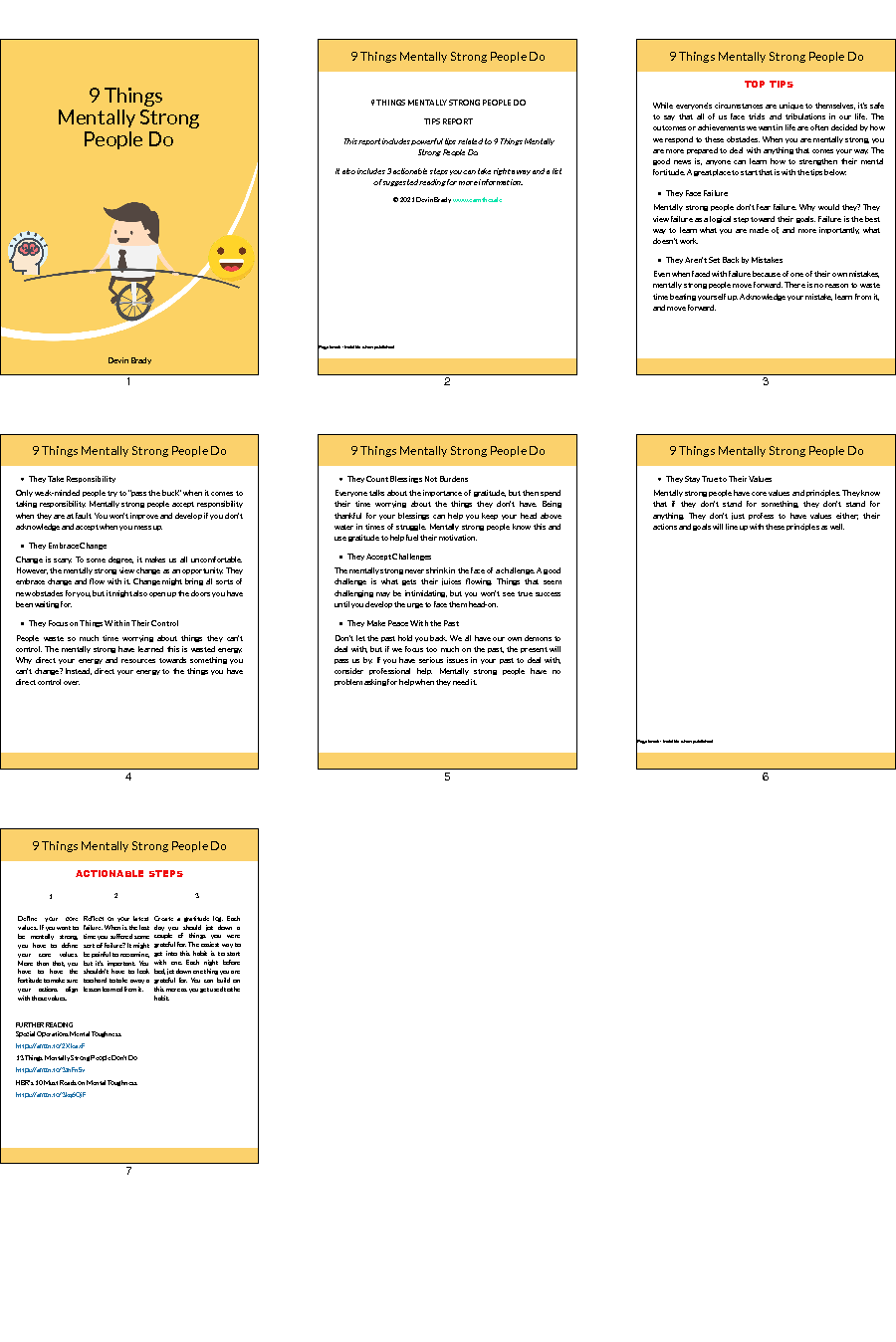
Subscribers are welcome to use the download link below and get the eReport on 9 Things Mentally Strong People Do. The eReport provides 3 actionable steps that you can use right away and a list of additional resources for suggested reading.
If you’ve been selling for a while, you’ve probably had at least one experience in which your prospect suddenly started giving you the “silent treatment.”
Anthony described this dilemma very poignantly when he called me a few weeks ago:
“I don’t know what to do when I get hit with the ‘silent treatment’ — you know, when I’ve worked with a prospect for quite a while, and we’ve had great conversations, and they’ve expressed interest in our solution — and then all of a sudden everything stops.
I try calling them back once or twice. I even send a follow-up e-mail, but nothing. They just disappear. And I figure I’ve lost the sale, and I don’t know what I did wrong, or what to do next. It makes selling feel like such a painful and arduous process.”
If this has happened to you, you may have felt anxious and confused. You may have told yourself, “It’s not as if I’m the one who did anything wrong. I put everything into the relationship. How can I rescue the sale if I can’t even get them to talk to me?”
The “Hopeium” Trap
There is a pressure-free way to reestablish communication when your prospect starts giving you the “silent treatment.” But first, it’s important to understand why the situation has happened in the first place.
Most of us who sell get caught up in “hopeium,” a comical term that means we focus our hopes and desires on making the sale. But hopeium can be a trap, because it’s impossible for you to keep in mind your most important goal: to learn your prospect’s truth.
When we fix our minds on the outcome — making the sale — we automatically begin anticipating how the process will go, and we also begin expecting that things will happen as we hope they will.
But if we’re in that mindset and our prospect suddenly breaks off communication, we feel lost, anxious, frustrated, discouraged, and confused. We become preoccupied with what went wrong.
We may even feel betrayed.
Is there any way to clear up the mystery?
Yes, by giving up your agenda and learning the truth about where you stand with your prospect –and being ok with whatever the truth may be. “But how can I learn the truth when they’re avoiding me?” you may ask. “And why do I need to let go of the sale?”
Let’s take the second question first.
If you approach your prospect while you still hope the sale will happen, you’ll introduce sales pressure into the relationship. This will push your prospect away from you and destroy any trust you have developed with them. Instead, you can eliminate sales pressure by telling them that you’re okay with their decision if they’ve decided not to move forward.
In other words, you take a step back instead of trying to chase and follow up with calls because you’re focused on getting a “yes.”
The bottom line is:
When a prospect gives you the “silent treatment,” it doesn’t mean you’ve lost the sale. It just means you don’t know the truth yet.
What you need to do is call and learn the truth.
Why is learning the truth so important?
Here are 4 important reasons:
1. You stop losing confidence in your selling ability. The “silent treatment” threatens our “hopeium.” We start blaming ourselves. We don’t know where we stand — a painful state of limbo. Our self-talk is negative and full of self-blame, and we’re on pins and needles wondering whether the sale will still come through somehow.
2. You increase your selling efficiency and decrease your stress level. Once you learn the truth about your prospect’s situation, you can either stay involved with the prospect or move on. I often say, “A ‘no’ is almost as valuable as a ‘yes.’” Why? Because it frees up your time to find prospects who are a better fit with your solution. This lets you work much more efficiently because you can quickly weed out prospects who aren’t going to buy. Knowing the prospect’s truth lets you walk away without that guilt-laden voice whispering, “If you give up, you don’t have what it takes.”
Learning your prospect’s truth translates into tangible results that equal real dollars. You’ll also put an end to the self-sabotaging stress that comes from living in “silent treatment” limbo.
3. Sales pressure pushes prospects away. When you respond to the “silent treatment” with calls and e-mails, you’re really telling them that you’re determined to move the sales process forward — which means you’re looking out for your needs, not theirs. This makes them mistrust you and run the other way.
4. The “silent treatment” — totally breaking off communication — is how prospects protect themselves from sales pressure when they don’t feel comfortable telling us their truth. The more we press, the more they run.
But the opposite is true, too. The more we relax and invite the truth, the more straightforward they’ll be with us. Prospects feel okay sharing what’s going on with them when they know we’re okay with hearing it.
How to Reopen Communication
After Anthony and I had talked about some of these issues, he said, “This all makes a lot of sense, but I’m still not sure what to say when I make that call.”
It’s simpler than you might think.
* First, simply give your prospect a call. (E-mail and voicemail are very impersonal, so use them only as last resorts if you can’t reach your prospect after several phone calls.)
* Second, take responsibility and apologize for having caused the “silent treatment”.
Here’s some language I suggested to Anthony that will make prospects feel safe enough to open up and tell you the truth about their situation:
“Hi, Jim, it’s Anthony. I just wanted, first of all, to call and apologize that we ended up not being able to connect. I feel like somewhere along the way maybe I dropped the ball, or I didn’t give you the information you needed. I’m not calling to move things forward because I’m assuming you’ve probably gone ahead with someone else, and that’s perfectly okay. I’m just checking to see if you may have some feedback as to where I can improve for next time.”
When you respond to the “silent treatment” this way, the results will probably surprise you. You may even learn that the prospect has legitimate reasons for not having gotten back to you.
You’ll also find yourself more productive and less frustrated. It’ll make a world of difference in your productivity level, your stress level, your income, and how much you enjoy what you’re doing.
Remember…
You haven’t lost the sale. You just don’t know the truth yet.
Success starts with mindset. Different mindsets give different outcomes. A poor mindset leads to poor results. A positive mindset leads to success. While your experience, education, and skills can matter a lot, your mindset can make all the difference. In no other profession is this this more evident than in the profession of selling. Can you have a poor mindset as an accountant and the books still balance, yes.
Luckily, anyone can develop a mindset primed for sales success . It’s certainly easier and less time consuming than mastering a complex skill!
Create a mindset that creates success! Include these components in your mindset:
1. Gratitude. Be grateful of what you have and have already accomplished. Be happy for the success of others. If you can’t feel happy for others when they are successful, your own success will be limited. I have seen both ends of the spectrum in sales where individuals felt that the company or the world owed them something and took for granted the resources they had available, and thus they never built any momentum to experience joy and success. Others who became successful through their results, and developed an attitude of superiority. They too felt the world owed them something due to their performance and thus began taking things for granted. Whatever spectrum one may find themselves on, an attitude of gratitude is a must for a sustained experience of joy and happiness.
2. Evaluation of risk and reward. Successful salespeople are masters at evaluating risk and reward. Unsuccessful salespeople, or salespeople that have plateaued, either refuse to take any risks or take on far too much risk for the potential reward. Neither is a successful way to approach life. While balance is key, risk avoidance is a sure path to a deteriorating career in sales.
3. Focus on emotional and physical health. Sacrificing your health for success isn’t true success. What do you really gain if you achieve your goals but sacrifice your physical or emotional health in the process? I have witnessed many people join the sales profession in the last twenty years that did so because their “chosen” profession didn’t work out. Selling can be an emotional roller-coaster in the beginning. A weak foundation in your emotional and physical well-being only makes it more difficult on you.
4. Abundance. Believe that there is enough to go around. A scarcity mindset can lead to ethical issues. One of the most fun aspects of sales is the competition, but only when it’s fun and productive. Ultimately you will want to build your skills and competency where you’ll only be competing with yourself. Reaching that point in your sales career opens up unlimited possibilities. Along the way you’ll maintain a more positive attitude when you believe your dreams are possible. What do you believe is possible for you to achieve?
5. Keeping mistakes and failure in the proper context. Failure is guaranteed to happen more often than not. Learn from your mistakes and failures and try again. When mistakes are internalized as failure that action can become a limiting belief. All initial failures are learning opportunities. Repeated failures are choices.
6. Growth. Placing a priority on growth is a necessary part of success. Carol Dweck, the author ofMindset: The New Psychology of Success, has done some pioneering work in the field of motivation. Dweck, in her book, outlines the implications of what she terms a “fixed mindset” versus one of a “growth mindset”. I highly recommend her TedTalk for a quick primer on her work. You can find the link here. You can’t achieve anything new without growing in some way. It might be your skills, attitude, discipline, or courage that need to grow. Rest assured, something needs to grow if you’re currently stuck.
7. A willingness to be uncomfortable. Growth isn’t pleasant. There will be discomfort as you develop yourself, fail, and make mistakes. As you take risks, deploy new tactics, engage in new habits, and strive to reach things previously unknown to you- you will undoubtedly become uncomfortable along the way. Even success can be uncomfortable. How uncomfortable are you willing to be to become successful in sales?
The willingness to be uncomfortable is the limiting success factor for most salespeople.
8. A positive attitude. How much are you willing to do if you’re certain you’ll be successful? A lot. How much are you willing to do if you don’t have high expectations? A lot less. Give yourself and your abilities the benefit of the doubt. As you approach areas of your career that are unknown the discomfort and/or failures can easily turn into fear. Remember this acronym for fear as it might serve you well.
False
Evidence
Appearing
Real
Notice how you think and how you talk to yourself. Is it positive or negative? What impact do you think that has on you? Most of the fears that develop are due to a negative anticipation of a specific event. It’s rarely a result of what is actually happening in the moment.
9.Planning.Success for each salesperson is a precise goal. I’ve seen salespeople spend more time planning their NFL Fantasy Lineup than they do on their professional goals. You’re not going to what you want on accident. If you do, it wasn’t really a goal to begin with. Without a destination in mind and a plan for getting there, you’re relying too much on luck to reasonably expect success.
10. A great mentor. A mentor that has achieved the success you desire knows where your head needs to be. There is a lack of good mentors in the workforce today. It’s unfortunate and an avenue that many companies need to be more intentional about. So, when you spot someone who’s willing to spend time with you, don’t take it for granted. They don’t come around very often. In a mentor, he/she knows what’s important and what’s just noise. Your mindset will be more accurate and effective if guided by a qualified mentor.
Think about your current mindset and compare that to the results you’re currently experiencing in your life. Can you see the connection?
If you feel that you have the skills you need to be successful in selling, but still come up short, it might be time to take a look at your mindset. Anyone can choose their mindset. There are no prerequisites for having a great mindset. You can just choose. Put your mind into a positive state that aids in your success and those around you.
Self-Reflection Questions:
What do I think about during the day? Are those thoughts likely to lead to actions that will bring success?
What was the primary cause of my last failure? What can I learn from it?
What steps do I need to take today to reach my goals?
How can some people be so persuasive while others can’t seem to convince anyone to do anything? Persuasion is part art and part science. Some people are born with the charisma that the rest of us lack. But anyone can become more persuasive with the right approach. Anyone that can read or write can influence others effectively. Many people may correlate the skills of persuasion to sales, however this skillset is used across many professions, and often useful in our daily lives.
What would it mean to your professional and personal life if you could reliably influence others? Few skills are as wide-ranging in their benefits.
Persuade others to your way of thinking:
1. Create a connection with those you wish to influence. Whether you’re trying to influence one person or a thousand, it’s important to create rapport. The level of trust and connection you can establish will directly affect your ability to influence others. Don’t neglect the importance of adapting your rapport to varying personality styles. At first it will be easiest to establish a connect with those that are most like ourselves, however this will limit your influence. This is an important first step. There are many ways to establish a connection.
Show what you have in common.
Mirror the other person’s body language.
Be honest and genuine.
Show others that you can be trusted.
2. Be convincing. I’ll be honest, early in my career I had someone say to me on a call, “you’re persistent, but not at all persuasive”. At that time I thought if I just out-worked everyone else I would accomplish my goals. There was more to it. At first you may feel small and insecure, but presenting yourself that way won’t convince anyone that you are worth following. There are several ways we show a lack of conviction, such as body language, using qualifiers like “I think, probably, maybe and possibly,” and lack of eye contact.
Stand tall, look them in the eye, and present your opinion like it’s an obvious fact. Your confidence is key. If you’re communicating over the phone, put a mirror in front of you and smile as if the communication were in person.
3. Use reciprocity to your advantage. Studies show that you’re much more likely to return a favor after someone does something for you. That’s why the people that knock on your door and try to sell you pest control give you a pen or a magnet. They know that you’ll be more likely to purchase from them.
Do something for the person you’re trying to persuade. You might buy them lunch, drive them to the airport, or let them borrow a cup of sugar. Do something for them before you attempt to persuade them. Your odds of success will go up dramatically.
4. Consider their interests. Even the most noble of people wonder what’s in it for them. Make it clear what they’ll be receiving out of the deal. Your neighbor might not want to sign off on your idea of building a fence between your respective properties. However, he might change his mind if you can show him the benefits he’ll enjoy.
You might point out that your dog will stay out of his yard and stop dropping presents.
It might help the resale value of his house.
It might cut down on the weeds in your yard spreading to his.
It will increase his level of privacy.
5. Be a good listener. The other party matters a lot. We tend to only consider ourselves when we’re trying to be influential, but this is a grave mistake. Open your ears and close your mouth. Be curious about the person you are speaking to. When you understand the needs of the other person, you’ll know how to influence them.
6. Establish yourself as an authority. If you’ve spent time with the Dalai Lama and wrote three books on meditation, your opinions on meditation are more likely to be respected. That is a bit extreme obviously, but leverage your knowledge and experience on a topic to establish authority. Simply dressing in a suit would convey authority in the right setting.
Persuasion is a highly researched field. There are numerous resources if you wish to learn more and there a few books that I would recommend on the topic. The ability to influence others is useful both in and outside of work. Invest some time in practicing this valuable skill. You’ll be glad you did!
In the fine art of finesse, you get much better results when others perceive you as being assertive rather than selfish. Either way, you’re letting others know what you want or need, so why is there such a difference?
Assertiveness is a positive quality that makes others feel good about helping you get what you want. On the other hand, selfishness pushes others away. It makes them want to keep you from getting your way!
Let’s look at some examples:
Selfish
When you appear selfish, it looks like you’re concerned only with yourself and your advantage to the exclusion of the feelings, wants, and needs of others. Your focus is completely on you. This might trigger others to feel negatively toward you.
You could come off as demanding or even rude when you’re behaving selfishly.
Selfish Examples
John said, “I’m in need of a decision now and I don’t want to wait two more hours to learn what it may be. Let’s go to the point right now!”
Susan loudly demanded the salesperson send her a revised contract because the terms weren’t clear enough for her.
Jane insisted that she be first to get into the que for receiving her product when she was late placing her order. “My timeline is now all screwed up”
Assertive
When you’re assertive, you appear self-assured, confident, declarative, definite, emphatic, and positive about what you want.
You might not like the way something has taken place, but you’re able to stand up for yourself and appropriately say what you require. You have no malice toward others and you’re not feeling frustrated.
You’re simply asking for or stating what you want to happen with confidence and courtesy.
Assertive Examples
Jim said, “There’s no rush in requiring a final decision and I know we’ll need to wait a few more hours. I’m going to work on a few of the other details in the meantime. What day & time would be best to take delivery?”
Gloria was subtle as she noted to the salesperson and spoke quietly. “I’d like to understand what I’m signing. Could you please outline these terms & how they apply to me? I’d really appreciate it.”
Julie was concerned about a few of the home projects she’s lined up. She said to Michelle, who took her order, “Since I have a few projects that I’m coordinating, could I get updates as to any delays so that I can be proactive in addressing how it may impact my other projects?”
What would your natural reactions be to these requests? Considering the feelings of others can make all the difference – regardless of what you’re asking for.
Your Own Feelings When Being Selfish or Assertive
You can determine whether you’re acting selfish or assertive, depending on how you’re feeling when you make a request:
Selfish
When you’re reacting in a selfish way, you’ll often find yourself experiencing negative feelings. You can’t figure out why others don’t see that you’re unhappy or not getting the attention you deserve. Why don’t they understand?
You may feel frustrated or short-tempered.
You want your way. You want what you want when you want it. And you want it now!
Assertive
On the other hand, when you’re assertive, you likely don’t have negative feelings. You’ve thought about what’s going on and realized your needs weren’t being met so you stepped forward to state them succinctly and without negativity.
You have no negative or hidden agenda to “get back” at someone or loudly demand what you believe you should have.
You feel you can calmly state what it is you’re after. It’s clear and understandable. You just want to resolve the situation.
Use these points to determine whether you’re behaving selfishly or assertively. Strive to use assertiveness to help you accomplish your goals and you’ll find that you get where you want to be much quicker.
What’s your goal for achievement on a professional level? Is it a promotion to a high level manager, vice-president, or even CEO? Getting selected for that dream position would completely make your day, wouldn’t it? The job market has never been better for leveraging your skills to get the promotion you want.
How can you put yourself into a position to be chosen to fill that coveted role? You’re likely doubtful about whether you have all the qualities that upper management is looking for, but honestly speaking, you probably already do!
What you’re perhaps missing is the know-how to get your abilities and skillsets noticed so you get chosen for the promotion.
Five Surefire Ways To Get That Job Promotion
In order to be selected over the best competition in your office, make these actions priorities:
1. Excel at current job. Ok, that’s an obvious one. In any organization, employers look at a prospect’s current competencies to determine suitability for a promotion. If you have what it takes now, you’ll probably have what it takes in the new position. Some roles however, the skills that make you a great individual contributor are vastly different than the skills that will make you successful in a role with more responsibility. So, your game plan is simply:
Perform your current tasks to the best of your ability.
Stand out among your peers who are on the same level as you.
Show versatility and drive by performing an unassigned task from time to time.
2. Achieve recognition. Some may feel that being recognized among peers puts an uncomfortable spotlight their work, but that may be a justification for simply not putting in the extra effort. Doing well at your current job is great, but being recognized is how you’ll really stand out. That’s not to say that your aim is always to be recognized, but it’s certainly not going to hurt leading up to the company’s decision about a promotion!
3. Achieve efficiency. If you’re going for a promotion, you’ll be receiving increased responsibilities. What that means for you is that you’ll have to be able to achieve more in the same amount of time. That’s where efficiency comes in, and if you display it now in your current job, that’s a plus on your record. Efficiency is not a superpower. Ask yourself if there’s a way that you can leverage technology, company resources, or people to accomplish more with the time that you have.
Start thinking about how you can accomplish the same tasks with the same quality, but more efficiently.
4. Adhere to company policies. By showing your support of company policies, you’ll show your employer that you have the maturity and responsibility to handle a more senior position. It’s time to start thinking like a leader, and not a follower.
5. Learn about the job. While upper management is doing its own assessment of potential candidates for the promotion, it would be a great idea for you to do what you can to learn more about the job you’re shooting for.
Ask others in that department or in a similar capacity about what it’s like being at that level.
Do research online to gain an understanding of the responsibilities you’ll probably have in your new position.
Spend some time talking to the person who’s currently in that position to find out what the challenges are and try to figure out how you would approach them.
Only you can secure the professional future you want. The decision you make to stand up and be counted is yours and yours alone. Embrace the opportunity to shine and go for it; your future self just may thank you for it!







 Catalyst Consulting