Helping Others Achieve Career Success

One of the most rewarding experiences for many people is helping someone else succeed. You can do this in many ways. Among the best is finding a way to help someone with his or her career. A fulfilling career can produce a lifetime of joy and, with some effort, you can help others experience that joy.

 When you help others achieve career success, you give them a priceless gift. There are many ways for you to help others advance their career in a way that allows them to reach their full potential.

Careers Are More Than Just Jobs

When you have a job, it’s often temporary. It might be something less than what you’re qualified for, or something you’re doing just so you can get by for the moment. When you have a career, it’s either something you went to school for, or have invested a considerable amount of time in and it is something you plan on doing for the rest of your life. Getting help to get that career started can make all the difference.

There are plenty of things that you can do to help others get their careers off the ground. Besides hiring them or giving them financial support, there are other ways to contribute to someone launching a new career. Consider the following options:

  1. Be a mentor for good work habits and perseverance. If the company does not have a formal mentorship program, volunteer for a less formal one.
  2. Teach others how to develop their skill set. The best way to learn is when you have to teach someone else. While this teaching is focused on building others up, it’s often the teacher that may benefit the most.
  3. Encourage others to volunteer in meetings, departmental projects, and/or social committees. This will help broaden their exposure to others in the company and build cross-collaborative relationships.

Those who see the job they do every day as part of a bigger career picture often get farther in their career and ultimately experience a greater sense of fulfillment. Instead of staying where they are, they always work to move forward with their professional lives. They might be interested in financial success, but they also want to do something with their lives that leaves their mark of contribution for those that follow.

Encouragement is Very Important to Success

 There are certainly stories of people who were successful without positive, encouraging words from others. But most of the successful people in their careers got there because they were told they had value. People in their lives encouraged them and told them how much they were capable of. By internalizing that information, they started believing it and putting it to good use.

With that in mind, ensure you encourage the people you work with. If you want others to see success in their careers, it helps if you let them know you believe in them. Sometimes all a person really needs is to know that his/her work matters and that he/she can make a difference. Having people that believe in you and your ability to deliver is very important.

Keep encouraging people to move forward with their career goals. Some of them may be lofty, but there’s nothing wrong with that. They need to know that they’re capable of more than what they’re doing now. When people see that they can accomplish more, they expand their thinking and rededicate themselves to their goals. You can be a part of their success story through your encouragement and support.

Learn to be a Valued Team Player and Reap the Benefits

Have you ever struggled to “click” with your co-workers? Whether you see the differences as a matter of age, stage in life, or philosophy, those gaps surely make it more of a challenge to work together to achieve a common goal. 

Of course, it’s important to be recognized for your individual achievements. However, wouldn’t it be nice to also receive kudos for your great teamwork skills, despite your differences?

The good news is you have the power to become that valued team player! And even better, your career will benefit immensely from your team skills.

Apply these ideas and you’ll be a star on your team:

1. Be friendly to every co-worker. Sounds simple, but not easy in practice. A great piece of advice that I was given in early in my management career was to “be curious” about every person on your team. Even if you have completely different interests than a co-worker, you never know what can happen if you show sincere interest in them.

2. Ask work-related questions. When you’re unsure of factors related to a work project, approach a co-worker working on the same job and to try to clarify your questions. In some organizations it is very easy to fall into work silos. Reaching out to others who may be in a different department may provide a different perspective on shared issues or problems.

  • Reaching out to others shows your willingness to accept information from co-workers in order to do your best work. 
  • Plus, this behavior demonstrates your respect for your co-workers and their input.

3. Celebrate even the smallest successes. When a co-worker completes part of a project or resolves a minor issue, make it a point to comment on it. Show you notice the contributions of your co-workers through your words. Your comment on their achievement may be the only one they get. In some organizations and management structures you know you haven’t done anything wrong when your manager hasn’t spoken to you in days or weeks. While that is unfortunate, it tends to be true.

4. Show openness about your work plan. Prior to proceeding with your work on a project, tell involved co-workers what you plan to do. Creating culture involves repeatedly casting a vision regarding the work that you do.

  • When you speak to your co-workers about the direction you’re heading in the work you’re doing, it promotes open communication and shows you’re using a team approach.

5. Use “we” when talking with co-workers. When you use “we,” it pulls all of you together to work for a common cause. 

  • When you and your co-workers feel a part of something greater than yourselves, you’ll be amazed at the things you can achieve together.

6. Notice behaviors of your co-workers. Do they offer to help you once in a while? Are some of them willing to put in extra effort when it’s needed? When they do, let them know you notice.

7. Reciprocate. When a co-worker chips in to help or finishes a task to assist you in completing a project, remember to return the favor. Help them out when they need a boost with their big project.

8. Avoid pointing out the errors of your co-workers. Calling attention to the mistakes of others is rarely the way to go. It certainly won’t earn you any brownie points with anyone. 

  • It may sound cliché, but everyone makes mistakes and you likely won’t want someone bringing up your faux pas to the group, so don’t do it to others. 
  • Take the attitude that you’ll instead try to learn from the mistakes of others.

9. Be generous. Of course, it would be nice if you received special recognition for whatever you contributed to someone else’s project, but it may not happen all the time. 

  • If you approach a job with the idea that, above all, you want to be an effective team player, you’ll be recognized for your stellar individual skills at some point.

Being a team player will help open doors for you over your career. Plus, you’ll probably make some friends and learn something of great value in the process. When you can demonstrate you fully understand the importance of contributing to the team, you’ll eventually win the game.

How to Improve Communication with Your Boss

Good communication allows many situations to run smoothly. However, there are certain relationships that deserve extra attention, such as the relationship you have with your boss. You and your boss have drastically different roles, and when each of you fulfills these roles with a hard working and understanding attitude, you’ll both feel fulfilled.

Get To Know Your Boss

As in all personal and professional relationships, it’s important to understand how others communicate. 

Everyone has their own set of likes and dislikes, and everyone has their own unique personality types and communication styles. Once you understand their preferences, you can adjust your style and methods of communication to best suit their needs.

It is important to take note of communication patterns. Does your boss email after hours? Does your boss email on weekends? Does he/she prefer face-to-face meetings? Does he/she prefer end-of-week summaries? The trouble with a lot of communication today is the perception that it has happened. By identifying patterns early in the relationship you can have an open conversation about what the expectations are around how and when to communicate.

Understand Your Relationship

It’s important to develop a good business relationship with your boss. Find out what he expects and what his/her goals for the business are, that way you can both be working toward the same goal.

The following tips can help you further improve your communication with your boss:

1. Avoid being too friendly. It’s important to be friendly, but only to a certain extent. You’re not true friends with your boss. While it may seem like a good idea at first, it can lead to some uncomfortable situations. Your boss might have trouble giving you negative feedback, or your co-workers may develop jealousy. Too often this is a lesson learned after the fact.

2. Schedule meetings with your boss. Managing up is just as important as managing down. Proactively scheduling regular meeting with your boss gives you an opportunity to manage up. Your boss may or may not be scheduling regular meetings with you. Regardless of this, take the initiative to schedule time with your boss if you feel the need. Your boss will know that you’re serious about developing your business relationship and that you really care about your job and the company.

3. Problem solving. Find out if you can help your manager with any problems that need attention. What are the burning imperatives? While you don’t want to step on any toes, your boss will surely appreciate you taking the initiative. Doing so will really give you the chance to stand out. 

4Maintain patience. The title “Supervisor” is misleading in that there is no super vision powers innate to the role. The pandemic has brought many challenges and situations where there were no answers or easy solutions. Perhaps you would’ve done things differently than your boss or you strongly feel that one of his/her decisions won’t turn out right. Develop the wisdom to know if you should keep your mouth shut and go with the flow, or if you should politely speak up. 

5. Shift your perspective. You can improve your communication with your boss and feel less frustrated just by putting yourself in their shoes. Imagine what everything is like for them; they likely have more burdens and pressures on their shoulders than you realized. The hardest aspect of being a manager are the problems that are prevented hardly ever get recognized, it is the problems that could not have been prevented that get the attention.

Be Prepared

Even if you’re not quite sure what to say all the time, as long as you are prepared and honest in your communication, your boss will surely notice. So if you have to reflect and write down your thoughts ahead of time, so be it. That level of preparation will benefit you in the long run. As the saying goes, it is better to be silent and thought a fool than to speak up and remove all doubt. If you are a more deliberate speaker do not hesitate to take the appropriate time to come up with a well thought-out response to a particular situation.

With any relationship, good communication skills are a huge benefit. Strive to work on strengthening these skills every day and it will help your career to flourish. In the end, your positive attitude and willingness to understand others will help you forge stronger, more permanent bonds.

7 Signs You’re Working Towards Your Potential:

For those who desire to experience a greater sense of enjoyment in their work, it’s necessary to concentrate on what you want and keep working towards it. Those who fall short of their potential and those who exceed their potential have one thing in common, they both experience times where it’s a struggle to stay focused on their goals.  

Is it a constant struggle to give 100% in everything you do? Here’s how those who exceed their potential stay motivated.  

7 Signs you’re on the path to your potential:

1. You make every moment count. You recognize that if you’re spending your time doing something, you might as well be learning as much as you can. You stay connected to the task at hand. Immersing yourself in each activity to make the most of it. 

  • Think about a task at work that you dislike, such as completing reports. Even though these reports may be boring and time-consuming, you understand that it’s important to do a good job and put forth maximum effort. Proving to yourself and others that you can excel at even the most mundane task.
  • You direct your energies toward living in the moment not mulling things of the past.

2. You regularly think about the difference between being average versus excellent. You reflect on the difference between performing a mediocre job as opposed to an outstanding job. You know which way of working makes you feel more confident about your performance? You may not hit it every time, but you strive for excellence in everything you do.

3. You begin with the end in mind. Commonly you ask yourself, “If I try as hard as I can, what might happen?” According to Stephen Covey, beginning with the end of your project in mind is a wonderfully proactive way to set yourself up for success. You realize that identifying the “end” you seek puts you ahead of the pack. Then, you design a specific step-by-step plan in order to achieve it.

4. You’re positive. You know that positive thoughts will make you feel more content and increase your chance of success. 

  • You take time to consider the alternative: is it possible to work toward your potential if your thoughts are riddled with negativity? 
  • You choose positive thinking over cynicism to achieve your highest heights.

5. You’re optimistic when approaching a task. You know that if you ever think, “I hate doing these monthly reports because they take forever,” then the report will probably indeed take a long time to complete. 

  • When you have a pessimistic attitude, you know that is often what you will live up to. 
  • Instead, you choose optimism and put forth your best efforts. Then maybe that task won’t be so bad after all. 

6. You set smaller objectives toward accomplishing larger goals. To avoid getting overwhelmed you creating short-term objectives. For example, if you want to earn a college degree, but it seems overwhelming, just start by taking one class at a time. 

  • You think about the process. Referring back to the example of a college degree, you start by taking one course, then completing a semester of classes, and then finishing each year of college until you earn your degree.
  • You know that by setting small, manageable objectives, you’ll be on a positive path toward your goals and you’ll be able to see your forward progress along the way. 

7. You celebrate your successes. By acknowledging your efforts, you’re inspired to achieve even higher levels. The more you accomplish the more success you will experience.

You make the most of your experience by working toward your fullest potential. Who do you know that may be encouraged by learning these signs? When you begin helping others exceed their potential, you know that yours is endless!

Does the Pandemic Have You Job Planning?

Due to the pandemic many individuals have found themselves looking for work, or they may be taking this opportunity to reevaluate a chosen career path. The best way to determine a job worth pursuing is by doing a job skills assessment. A self-assessment will allow you to explore your personality type, find out what you’re good at, and determine your values.

Here’s a list of questions that may be a part of a self-assessment:

  • Do you tend to be introverted or extroverted?
  • Do you generally remain calm, or do you get nervous easily?
  • How organized are you?
  • What is your general temperament?
  • What are your general interests?
  • Do you enjoy risky situations?

Formal Job Skills Assessment Tests

There are many job skills assessment tests available online that may even be several hundred questions long. These tests are designed to determine answers to the questions above.

Sometimes a potential employer will want you to be evaluated before your interview. However, if you can compose a list that combines your personality traits with skills that you’re good at, you can assess your potential careers yourself.

The Answer is in Your Interests

By reflecting on your hobbies you may be able to determine a viable career choice. Try answering these questions and consider the recommendations:

Do you tend to like working with tools and objects, or working with other people?

  • If you like working with tools or objects you may be suited for a career in building, repair, or engineering.
  • If you enjoy working with others perhaps you’d make a good sales representative, team leader, or manager.

Do you prefer things to be concrete and organized, or do you prefer the creative?

  • Most career choices will involve organization to some degree, but if you prefer creative options you may be suited for a career in art, music, advertising, or photography.

Do you like projects that involve a finished physical product, or a social result such as improved self-esteem?

  • If you prefer to see a finished product, you could be suited for a career in sales or product creation. You may even like science and experimenting.
  • If you prefer social results, you could consider some form of counseling or social work.

Do you tend to enjoy business or science?

  • This is an easy question, but understanding yourself can help you determine whether you would be suited for a career in entrepreneurship or experimentation and research.

Do you prefer when things are the same everyday or different?

  • If you prefer a consistent day-to-day routine, you may want to consider office work like accounting, or repair and construction work.
  • If you like to see differences in your day, you might be better suited for a creative profession like writing, directing, or designing.

Do you prefer to follow or take charge?

  • If you’re a person that tends to take charge, you could be a great team leader someday. Look for a career where you get to manage people and lead everyone to a common goal.

Are you good at interpreting feelings?

  • If you have proven to have a high emotional intelligence, you may be suited for teaching or counseling. These careers require you to understand what your students or clients are feeling and understanding.

Choosing your Career

You should now have a better idea about what kinds of jobs to look for in your career search. If not, you should at least be able to narrow down your choices to a few categories. You always have the option of reading books or taking classes in order to get a better understanding of your career choice and to develop your skill set.

Remember that you can do anything you want when you’re determined. Finding a job in line with your personal preferences helps you take advantage of your passion so you can achieve greater success.

The Low-Down on Criticism

I was reminded of a quote recently and it stayed with me for a couple of days. Due to the fact that the quote was top-of-mind, I became acutely aware of how people around me were reacting to criticism that they were receiving. The quote was:

The trouble with most of us is that we would rather be ruined by praise than saved by criticism.

Norman Vincent peale

Wow! The wisdom and truth in this simple statement. Most of us have experienced both praise and criticism, and while both are important, I see many people react negatively to criticism. Of course criticism never feels as good as praise, but how do we improve without it?

Criticism at work can stimulate professional and personal growth if you know how to deal with it effectively. Below are a few simple guidelines for adopting a positive mindset and responding to feedback from supervisors and colleagues.

Taking a Positive View of Criticism

1. Stay relaxed. If you try to appear calm and confident, you’re more likely to feel that way. Keeping your emotions under control will enable you to listen better. Take some deep breaths and keep your body language open.

2. Look on the bright side. If you’re sensitive to criticism, remind yourself of your good qualities and the many things that you do well.

3. Keep an open mind. Your co-workers may have valuable suggestions for areas where you can improve. Respect their point of view. Be receptive to new ideas and alternative approaches. You might learn something that makes your job easier.

4. Look for the humor in the situation. Even if you receive unjustified comments, you can make them easier to deal with by noticing the comic elements. For example, if a customer blames you for their expired promotion, respond tactfully without taking it too seriously.

5. Take a compassionate view. It’s easy to react defensively, but it’s also important to give people the leeway that you want from time to time. Often times assumptions are made about the motives of the individual giving feedback, and often time those assumptions are wrong. Accept criticism for exactly what it is- feedback.

Responding to Feedback From Supervisors and Colleagues

1. Invite feedback. Asking for feedback regularly beats waiting for the annual performance review. You’ll get prompt and specific guidance for doing your job better, and you’ll demonstrate your ability to take initiative.

2. Ask questions. Show the other person you’re really listening by asking pertinent questions. You’ll also clarify any areas of doubt.

3. Hear the other person out. Let the other person speak without interruptions. For the moment, pay attention to them instead of working to prepare a defense.

4. Conduct a self-appraisal. Regularly evaluate your own work. It will give you a stronger foundation for reflecting on your colleagues’ remarks.

5. Focus on the message, not the messenger. Distinguish between the content of the message and your personal feelings of the messenger. Even if you think someone is being less than courteous, there could still be some truth in what they’re saying.

6. Get a second opinion. Surveying other people around the office is helpful if you need some objective input. You may find out that your experience is typical. On the other hand, you may discover that you’ll need to make a special effort if you and your boss appear to be a difficult fit.

7. Document your position. If there’s an ongoing disagreement, find ways to support your conclusions. Be aware of confirmation bias however. If you’re emotionally bought into being right then you’ll only consider what supports your position. Find objective data such as industry statistics or internal memos may strengthen your case. However things turn out, you’ll contribute to a constructive and informed dialogue.

8. Be gracious. Set a good example by offering your feedback in a way that’s timely and specific. Focus on people’s conduct rather than their personalities. This will encourage better morale and office communications. Show your willingness to cooperate with everybody even when you experience occasional conflicts.

9. Schedule a follow-up session. Let people know how much you appreciate their advice. After you’ve had time to implement their suggestions, tell them how they helped to improve your performance. This will also give you a chance to make a better impression on them.

Make criticism at the office a catalyst to your personal development and ultimately use it to your advantage. Use feedback from others to improve your performance and advance in your career.

If you’re ready to receive feedback in your workplace- leave a comment and I’ll send you an easy 360-Feedback Exercise. You can use this tool to solicit feedback from your colleagues and learn a few tips to make your job easier.

A Calm Mind Makes Trying Times Conquerable

Difficulties give me an opportunity to exercise my focus and determination. During trying times I concentrate on maintaining a calm mind. This approach helps me to conquer the challenges that face me.

I avoid being reactive to difficult situations that catch me off guard. While it is easy to allow confrontation to anger me, I choose to take the higher road.

I spend a lot of time on nurturing my mind and spirit. I train myself to keep calm when that is the least natural approach. It forces me to develop the will to overcome the toughest situations.

When I encounter resistance, my first step is to silence the inner voice in my head that is reactive. I ignore the stirrings of impatience and anger that pull at me. I block them out completely.

I realize that giving in to negativity only serves to worsen any situation. My focus is on overcoming the challenge at hand by counteracting negativity with positivity and peace.

My wisdom in handling trying times encourages me to act from a place of calm reasoning. When my mind is calm, I am able to think things through. By rejecting unease at my core, I am able to make smart choices that produce better results.

Today, I am a conqueror. I can overcome any obstacle.

With serenity, I can see the value in all challenges that are presented to me. Even obstacles become worthwhile and meaningful when seen in this light.

Self-Reflection Questions:

  1. What exercises can I undertake to help me develop a consistently calm mind?
  2. How often do I encounter situations that are difficult for me to control?
  3. What assistance can I get from outside sources when dealing with trying times?

16 Empowering Beliefs to Live By

Your experiences are shaped by your thinking. Even obstacles have a value when you can see it. You can develop convictions that will help you to feel happier and achieve more, regardless of the situation.

Consider these empowering beliefs that you can start using today to transform your experiences through the power of positive thinking.

Empowering Beliefs to Make You Smile

  1. I understand my potential. You can achieve amazing results when you put your mind to it. Feel excited about reaching your true potential.

  2. Practice gratitude daily. List each thing that you have to be grateful for. Remember to include the smaller items, like warm socks or basic food on your table. Expressing your appreciation reminds you of how rich you are and leads to taking less for granted.

  3. I learn from mistakes. You can make setbacks work for you by focusing on the lessons that they contain. Flubbing one customer presentation can teach you how to ace the next one.

  4. I find meaning in adversity. Tough times can be the most rewarding phase of your life. Know that you can emerge from any challenge with greater wisdom and courage. Look back at the obstacles you’ve already overcome, and reassure yourself that you can handle what’s ahead.

  5. I embrace change. Accept that life is a series of changes. Focus on the present moment, and prepare yourself to adapt to whatever circumstances come your way.

  6. I dream big. Expand your wish list. Setting demanding but attainable goals gives you adventures to look forward to each day.

  7. I practice forgiveness. Lighten your load by clearing away any resentment you’re holding onto from the past. Set reasonable boundaries while you respond with compassion when others disappoint you. Pardon yourself too.

  8. I give generously. Sharing your blessings makes you more powerful and joyful. Volunteer in your community and do one act of kindness for a person you meet today. Buy coffee for your co-workers or bring your spouse a small gift home after work. .

Empowering Beliefs to Make You Strive

  1. I take responsibility. You are in charge of your life. Hold yourself accountable for the outcomes you create. Celebrate the fact that you have the power to determine your own future.

  2. I apply effort. Figure out your definition of success so you know what is worth working for. Give yourself credit when you’re making progress rather than comparing yourself to others.

  3. I leverage my strengths. You have your own individual strengths that you can draw on. Figure out what you’re good at and what you want to do. Let that knowledge guide your choices.

  4. I listen to feedback. Ask for feedback so you can enhance your performance and show others that you respect their point of view. You grow faster when you gather solid input that you can translate into action.

  5. I ask for help. Expand your capabilities by building a sturdy support network. Carpool with other parents. Divide up household chores with your spouse and children.

  6. I connect with others. Moral support counts too. Surround yourself with encouraging people and friends. Participate actively in your faith community. Join a club with members who share your interest in a particular hobby.

  7. I recognize opportunities. Stay alert for promising openings. You may meet a new friend while you’re standing in line to buy your morning coffee.

  8. I try new things. Be open to experimentation. Go kayaking one weekend instead of playing golf. Tackle that BBQ Brisket that you’ve been wanting to perfect or pick up a musical instrument. You may discover hidden talents.

An upbeat attitude increases your happiness and productivity. Question your old assumptions so you can replace them with a new sense of certainty about yourself and your future. Adopt empowering beliefs that build up your confidence and prepare you for greater success. Start today. You’ll be glad you did!

Follow Up Tip #3

Tip #3: Stand out.

Here is another helpful tip. After every call/visit to a first time prospect, send a “thank you” card. Handwrite a message on small thank you card that simply says, “Jerry, thank you for taking the time speaking with me today. I look forward to our next conversation on the 16th. Enjoy the day!”   No more, no less.

In today’s fast paced world, a hand written card tells the client that you took the time and the effort to do something a little different. They will feel important. And if you are in competition with someone else for this persons business, this will allow you to set the bar. At some level this registers in the client’s mind and creates a degree of “equity” in you. It differentiates you and it gets remembered. And it gives the client a reason to be there when you make you follow up call.

If you don’t think a card will get there in time, send an e-mail with the same note. Just be aware that an e-mail does not have nearly the same impact as a handwritten note.

I hope this tip helps you in your follow up this week! As always leave a comment.

Devin

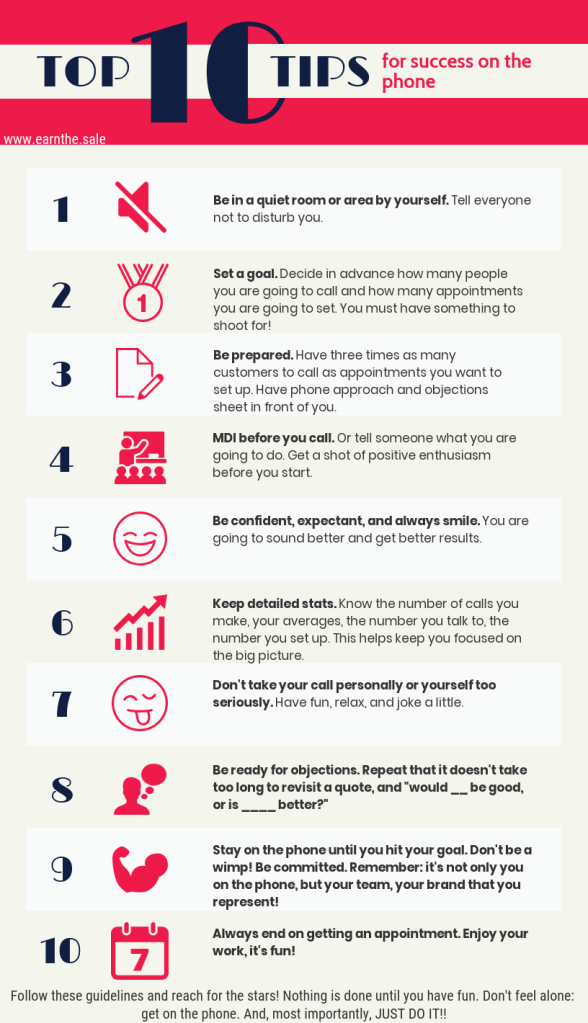
10 Tips for Success on the Phone

My current sales team has worked predominantly on an inbound lead system, however due to the current stay-at-home environment we have pivoted to reaching out to customers proactively. We’ve come together as a team and have scheduled daily call blasts and what this has reminded me of are the skill sets necessary to have success on the phone.

It’s not an entirely new muscle, but one that most of my team haven’t worked in a while. In re-engaging in this activity I have compiled these 10 Tips for Success on the Phone as a quick reminder of a few simple things to remember.