When we face a challenge that seems bigger than ourselves, we can find courage, strength and resilience at will. We discover powers that we never thought we had, but the secret is all inside our mind: true power lies in accepting the challenge and saying to yourself “No matter what happens, I’m going to make it. I can already see the finish line. I have nothing to lose and everything to gain”.
The above was a passage from Psycho-Cybernetics. A weighty read, but an important one that dives into the capacity we have, should we choose, to leverage the power of the mind.
For those of you who aren’t familiar with the author, Maxwell Maltz (1889–1975) was an American cosmetic surgeon and author. By combining his daily work experiences as a surgeon with profound studies of the human psychology, Maltz came to the conclusion that our self-image is the cornerstone of our mental state, and therefore of all the successes and failures that happen in our lives as a result.
His best-seller Psycho Cybernetic, published in 1960, is considered one of the best books in the self-help category, of the psychology masterpieces that paved the way for most of today’s personal empowerment programs.
When you are a new leader or manager it’s not always easy to tell if your choices are coming from the right place. Experience and time will bring insights, but how can you speed up the learning process and ultimately make better decisions? Learning from others is one way to shorten the learning curve. As a leader, learning the difference in how I have used intuition or ego in my decision making process has provided me a mental roadmap. Following your gut might be easier for some, but could lead to bad results and without examination there is no process to prevent the same results from happening again. Follow your ego and you might be successful in many ways, but you’re likely to find yourself wondering why you’re not as happy and ultimately not as effective as you could be as a leader.
Learning how to determine whether my decisions were guided by intuition or ego has made a huge difference in my approach to decision making. While there are no hard and fast rules to make the distinction, there are tendencies that I have personally found that can serve as a guide.
First let me start by stating, fear is the single biggest obstruction to the ahievement of anything.You must first start with this understanding.
Consider these differences:
1. Ego-based decisions are grounded in fear and self-preservation. If you decide to go into management or leadership primarily for reasons of financial security, that’s ego. If you decide to not engage in a new coaching process out of fear of looking unauthetic, that’s ego.
2. Ego-based decisions typically have emotion connected to them. A choice made from a place of intuition just feels “right” and often comes out of left field. You might be in the middle of a Netflix series and are hit with the realization that you should be spending time with your reps in the field. The resulting battle in your head is your ego fighting back.
3. Ego-based decisions consider external results. Are you leading a sales meeting in order to establish control, or are you leading a sales meeting because you’re fascinated with the idea of inpsiring, teaching, and motivating people? Are you taking an action to gain certain results, or does the action itself provide sufficient satisfaction?
4. Ego-based decisions involve rationalization. Your ego is wonderful at convincing you that its choice is the right one. “I’ll never get that job. Imagine how disappointed I’ll feel when it doesn’t work out. People like me are destined to only be supervisors, but there’s nothing wrong with that. I can still have a decent life.”
* It’s really just a rationalization based on fear – fear of success or fear of failure. ((not convinced there’s a real fear of success? See the Icarus Deception))
* The ego tries to justify itself with facts, figures, and logic. Intuition doesn’t require these tricks to compel you. If you’re using logic to convince yourself of a course of action, you can bet that’s your ego squawking.
5. Intuition doesn’t judge. A thought or decision arising from intuition doesn’t involve judgment statements about right or wrong, good or bad. Intuitive thoughts feel calm, relaxed, and peaceful. There’s a universal truth to an idea that arises from intuition.
6. Is the expected gratification coming from within or is it external. Would you make the same choice if no one would ever know? Would you purchase that BMW if no one ever knew you owned it? Or do you simply love German automobiles and love the idea of owning a precision car? Are you driven by money and admiration or by personal satisfaction in up-lifting others?
A mentor of mine told me a story that I think illustrates this point. He shared with me; there was an armored truck full of money that flipped over making a sharp turn while going too fast. As the truck tipped over all of the money that was loaded in the back blew across the streets. On the sidewalks stood groups of individuals. One group went running to grab up as much money as they could hold. Another group rushed to the truck to provide aid to the drivers, while others stood back and called 911. As he finished the story- he asked; which group would you be in and how long would it have taken you to decide?
While the ego can be very limiting, that doesn’t necessarily mean that it’s wrong. Remember that the ego’s motivation is largely based on self-preservation. Your ego believes that it has your best interests at heart. Ignoring the ego can be challenging. It uses fear to influence you. It’s only natural to avoid fear and seek comfort.
The trick is to realize when fear is holding you back from something bigger and better. As a leader not only is that fear holding you back, but it is also indirectly holding back those that you lead. Think before choosing which voice to follow: use these tips to help you make a decision that will bring you more joy, bring better results, and make an impact on those you lead.
Triggers: Creating Behavior That Lasts-Becoming the Person You Want to Be While this isn’t technically a “sales” book, being truly effective in sales is about engaging in the right behaviors consistently. While there are many books that will tell you exactly what sales behaviors to do- none of them get to the psychology of root behaviors. Goldsmith does an excellent job of understanding the psychology behind the behaviors we choose to engage in (sales or not).
Escaping the Price Driven Sale: How World Class Sellers Create Extraordinary Profit Anyone who knows me knows that I am a BIG fan of SPIN Selling. When your value is determined by your ability to be consultative, there is simply no better sales methodology than SPIN, in my opinion. Escaping the Price Driven Sale is a great companion to SPIN Selling and further deepens the understanding of the SPIN methodology.
Emotional Intelligence for Sales Success: Connect with Customers and Get Results Talk to anyone who works in sales and they will undoubtedly tell you that it’s an emotional rollercoaster of a profession. Enter; Emotional Intelligence. If you don’t have it- your success, if any, will be shortlived. If you don’t have it, and you find success, you’ll never become a great leader- you’ll be pigeon holed. Just get it and be grateful that you made the investment in yourself.
The Sales Bible: The Ultimate Sales Resource I simply enjoy Jeffrey’s approach to all things sales. It’s short and to the point. He over delivers on what he promises and his approaches simply work. The amount of complimentary resources he provides on his website through this book is worth 10x’s what he charges for the book. You’ll be referencing this for years to come and should be a staple on your shelf.
As with any list it’s hard to narrow down to just five, and some would be debatable depending on the stage of your sales career. I consider these to be foundational to the profession of sales. I could create lists upon lists should we get into the various facets of sales; presenting, speaking, communicating, building value, prospecting, asking for referrals, so on, and so on. Hey- there’s my next few lists ideas 🙂
Leading a team is hard work! There are so many variables that can make the role as team leader challenging.
It’s easy to get discouraged when you see that your team isn’t displaying the skills and strengths you thought they had. You’ll probably even spend some time wondering if you picked the right people.
However, before you make any drastic decisions, you owe it to yourself and your team to assess the effectiveness of your own role. Are you being the best team leader you can be?
Perhaps a new approach could drastically change your team’s results!
A key concept that many team leaders miss is that you have to be ready to be the team! You have to be willing to be the example you want your team to follow. There’s no doubt you know what you want from the team members – now it’s time to show them.
Signals That Team Members Look For
Anybody who isn’t at the top of a team always looks for guidance from above. There’s an unspoken expectation that you can and will guide them in the right direction.
Display these concepts to lead your team to the top:
1. Willingness to involve them. The first thing your workforce looks for is how inclined you are to include them in matters related to the operation of the business.
Team members like to know that their input is appreciated. It encourages them to embrace the idea of being part of the team.
2. Abide by your rules. Another signal that team members pay keen attention to is whether you spit out directives but follow your own agenda when it comes to compliance with rules.
If you want and expect compliance in specific areas from the team, you must be prepared to comply as well.
3. Loyalty. Whether the team you’re leading is a sales team, company department, or an entire organization, your team will rely on you to show how loyal you are to the cause.
If you’re not in agreement with every policy that’s in place, it’s important to avoid expressing your disagreement in the presence of your workforce.
Keep leadership discussions among leaders.
Maintain a positive outlook on the organization even if you’re not necessarily happy with your circumstances.
4. Recognition of contribution. There’s few things team members like better than being recognized for their contribution to the success of the team. Giving your team members sincere compliments by saying things like “Good work” or “You did it” will show them that you truly value their efforts.
When they see that they are valued, your team members will step up their efforts to do an excellent job.
By making each member feel important, you’ll have everyone on the team performing at a higher level, resulting in greater success for your team.
5. Value their point of view. One of the best ways to get the kind of results you want from your team is to really attempt to understand things from their perspective. Have consideration for the problems they face everyday and the things that make them tick.
The sooner you embrace their viewpoint and show that it’s a welcome part of the organization, the sooner you’ll be able to build an effective workforce.
Use these strategies to inspire your team. They’ll be motivated to work harder to garner the success and accolades you seek as a top-notch team.
When it comes to making decisions that take you out of your comfort zone, it can really be emotionally trying. As a manager of people and processes tough decisions are a requirement of the role.
The only way around those decisions is to be untrue to your beliefs. And that’s an approach you most likely want to avoid. Your conscience is bound to eat away at you if you go that route. Simply ignoring the decision is often abdicating the responsibility that the decision requires.
Instead, try this process to help you make those tough decisions with confidence:
1. Weigh the alternative. When a tough decision looms overhead, you know there’s always an alternative. It’s probably easier to go with that alternative, and save yourself the stress. But at what cost? What is the cost to your team? What is the cost to the business?
If you’re honest with yourself, you’ll realize that the tough decision may be the best decision from a moral standpoint. It’s hard to go wrong when you go the moral route!
Many decisions will not have the benefit of hindsight, and you can’t predict how certain decisions will weigh on you in the future. Reach out to someone who’s been faced with a similar decision and ask for their insight. While someone else can’t make the decision for you, they may have wisdom that can provide a different perspective.
2. Consider the outcome. Usually, it is the most difficult decisions work out for the better in the end. But what you’re worried about is those who may not be pleased with the decision. The toss up is between two glaring options. Do you continue in a less than favorable situation? Or do you decide to make a change for the better?
A great way to justify making a hard decision is to look at the outcome. Do you see yourself, those around you, or your reports in a more positive situation after you make this decision? Can you envision life for you and your team being less stressful?
Always remember what you’re trying to achieve for yourself, your team, and for the business. Make your decisions based on your vision for what you are trying to create, whether big or small. Avoid living according to the goals of others if you want to be truly happy.
3. Limit the advice you take. In some scenarios, advice is very helpful. However, in others, it can easily cloud your judgment. When making a tough decision, go with your gut. It’s usually correct if you’re aligned with your conscience!
When you start to hear several different opinions, you can get confused. Of course, you can be courteous to everyone offering their suggestion. You may want to respectfully listen to everybody who’s trying to help. But listen with one ear! Ultimately the responsibility of the decision falls on the role of being the manager.
It’s possible to hear the advice and not take it to heart. It’s also possible to weigh everybody’s feedback and filter the ones that aren’t helpful.
4. Think outside your comfort zone. Remember that life in general tends to be uncomfortable. While you would prefer otherwise, it’s a reality you just sometimes have to face. When you prime your mind to think of discomfort as the norm, those tough decisions become easier.
Nobody likes to be uncomfortable, especially for extended periods. But that’s what you’ll be if you avoid making the tough decision when it’s necessary for your well-being.
If you know something is right, aim to block out all the noise and listen to your conscience.
You may end up losing friends for the decision. But you may gain so much more as a result, too. Consider peace of mind, a clear conscience and genuine happiness. These can all be yours when you decide to do what’s truly best for you, your team, and the business.
So focus on the task at hand, and what accomplishing it can help you achieve and move those you lead closer to the stated vision. If the end result of your decision betters the situation and supports the goals and vision, then you can be confident that you’ve made a wise decision – even if it was tough.
One of the most rewarding experiences for many people is helping someone else succeed. You can do this in many ways. Among the best is finding a way to help someone with his or her career. A fulfilling career can produce a lifetime of joy and, with some effort, you can help others experience that joy.
When you help others achieve career success, you give them a priceless gift. There are many ways for you to help others advance their career in a way that allows them to reach their full potential.
Careers Are More Than Just Jobs
When you have a job, it’s often temporary. It might be something less than what you’re qualified for, or something you’re doing just so you can get by for the moment. When you have a career, it’s either something you went to school for, or have invested a considerable amount of time in and it is something you plan on doing for the rest of your life. Getting help to get that career started can make all the difference.
There are plenty of things that you can do to help others get their careers off the ground. Besides hiring them or giving them financial support, there are other ways to contribute to someone launching a new career. Consider the following options:
Be a mentor for good work habits and perseverance. If the company does not have a formal mentorship program, volunteer for a less formal one.
Teach others how to develop their skill set. The best way to learn is when you have to teach someone else. While this teaching is focused on building others up, it’s often the teacher that may benefit the most.
Encourage others to volunteer in meetings, departmental projects, and/or social committees. This will help broaden their exposure to others in the company and build cross-collaborative relationships.
Those who see the job they do every day as part of a bigger career picture often get farther in their career and ultimately experience a greater sense of fulfillment. Instead of staying where they are, they always work to move forward with their professional lives. They might be interested in financial success, but they also want to do something with their lives that leaves their mark of contribution for those that follow.
Encouragement is Very Important to Success
There are certainly stories of people who were successful without positive, encouraging words from others. But most of the successful people in their careers got there because they were told they had value. People in their lives encouraged them and told them how much they were capable of. By internalizing that information, they started believing it and putting it to good use.
With that in mind, ensure you encourage the people you work with. If you want others to see success in their careers, it helps if you let them know you believe in them. Sometimes all a person really needs is to know that his/her work matters and that he/she can make a difference. Having people that believe in you and your ability to deliver is very important.
Keep encouraging people to move forward with their career goals. Some of them may be lofty, but there’s nothing wrong with that. They need to know that they’re capable of more than what they’re doing now. When people see that they can accomplish more, they expand their thinking and rededicate themselves to their goals. You can be a part of their success story through your encouragement and support.
Good communication allows many situations to run smoothly. However, there are certain relationships that deserve extra attention, such as the relationship you have with your boss. You and your boss have drastically different roles, and when each of you fulfills these roles with a hard working and understanding attitude, you’ll both feel fulfilled.
Get To Know Your Boss
As in all personal and professional relationships, it’s important to understand how others communicate.
Everyone has their own set of likes and dislikes, and everyone has their own unique personality types and communication styles. Once you understand their preferences, you can adjust your style and methods of communication to best suit their needs.
It is important to take note of communication patterns. Does your boss email after hours? Does your boss email on weekends? Does he/she prefer face-to-face meetings? Does he/she prefer end-of-week summaries? The trouble with a lot of communication today is the perception that it has happened. By identifying patterns early in the relationship you can have an open conversation about what the expectations are around how and when to communicate.
Understand Your Relationship
It’s important to develop a good business relationship with your boss. Find out what he expects and what his/her goals for the business are, that way you can both be working toward the same goal.
The following tips can help you further improve your communication with your boss:
1.Avoid being too friendly. It’s important to be friendly, but only to a certain extent. You’re not true friends with your boss. While it may seem like a good idea at first, it can lead to some uncomfortable situations. Your boss might have trouble giving you negative feedback, or your co-workers may develop jealousy. Too often this is a lesson learned after the fact.
2.Schedule meetings with your boss. Managing up is just as important as managing down. Proactively scheduling regular meeting with your boss gives you an opportunity to manage up. Your boss may or may not be scheduling regular meetings with you. Regardless of this, take the initiative to schedule time with your boss if you feel the need. Your boss will know that you’re serious about developing your business relationship and that you really care about your job and the company.
3.Problem solving. Find out if you can help your manager with any problems that need attention. What are the burning imperatives? While you don’t want to step on any toes, your boss will surely appreciate you taking the initiative. Doing so will really give you the chance to stand out.
4. Maintain patience. The title “Supervisor” is misleading in that there is no super vision powers innate to the role. The pandemic has brought many challenges and situations where there were no answers or easy solutions. Perhaps you would’ve done things differently than your boss or you strongly feel that one of his/her decisions won’t turn out right. Develop the wisdom to know if you should keep your mouth shut and go with the flow, or if you should politely speak up.
5.Shift your perspective. You can improve your communication with your boss and feel less frustrated just by putting yourself in their shoes. Imagine what everything is like for them; they likely have more burdens and pressures on their shoulders than you realized. The hardest aspect of being a manager are the problems that are prevented hardly ever get recognized, it is the problems that could not have been prevented that get the attention.
Be Prepared
Even if you’re not quite sure what to say all the time, as long as you are prepared and honest in your communication, your boss will surely notice. So if you have to reflect and write down your thoughts ahead of time, so be it. That level of preparation will benefit you in the long run. As the saying goes, it is better to be silent and thought a fool than to speak up and remove all doubt. If you are a more deliberate speaker do not hesitate to take the appropriate time to come up with a well thought-out response to a particular situation.
With any relationship, good communication skills are a huge benefit. Strive to work on strengthening these skills every day and it will help your career to flourish. In the end, your positive attitude and willingness to understand others will help you forge stronger, more permanent bonds.
We’ve all had it happen before, we are in front of a prospect who has completely unrealistic price expectations. What do you do? Check out the video below for a few tips on how to address this scenario.
A potential client wants a 20 product bid. They tell you that they expect the price to be under $10,000; you know it will be considerably more than that. Now what?
Don’t be in a hurry to write off someone with an unrealistic expectation on price. If they called you, doesn’t that mean they need or want your product? Take the time to gather information before you decide they aren’t worth your time and energy. See if you can turn it into a sale.
This can be accomplished with the proper set of questions and a little patience. Start by asking the four basic questions that are needed to get to the contract. At some point, the budget will come up. Ask the question, “How did you arrive at the budget you have set?” You will get all kinds of answers, but the usual sources are other contractors, something from the media, or a hopeful wild guess on the part of the owner.
Give them the three price ranges that their job will fall into. Not one lump sum figure, not two broad figures, but three well-defined ranges based on your experience. You want them to make a decision, and that is why the wording is so important. Start with the middle range, move to the top range and finally explain what they will get in the low budget range.
Will they have sticker shock? Most likely. Will they think you and your prices are nuts? In some cases, yes. Will you get through to them that their budget is unrealistic? Maybe.
Most of it depends on how you present the information. Good questions can lead them to the conclusion you need them to reach. Blanket statements are not as effective. Remember that you have two ears and one mouth and use them in that ratio.
When you have given the three price ranges, ask the question, “Which of these three budget ranges would you like to invest in your home?” Or, “Which of these three budget ranges do you think would work best for you and your family?” There are several ways of asking this question but after you ask it, STOP! One of the biggest mistakes salespeople make is that they ask a question, and then keep on talking. Put a zipper on your lip. Button it up. Let them give their answer.
If they come back with the nonsense that they don’t know what it will cost, tell them it will be in the ranges you just discussed. Give the ranges again if necessary. They don’t like making decisions, and are trying to avoid the fact that you provided that info already.
Give your clients good information, help them adjust their budget, and make the sale. If they won’t adjust, move to the next client with a realistic price expectation.
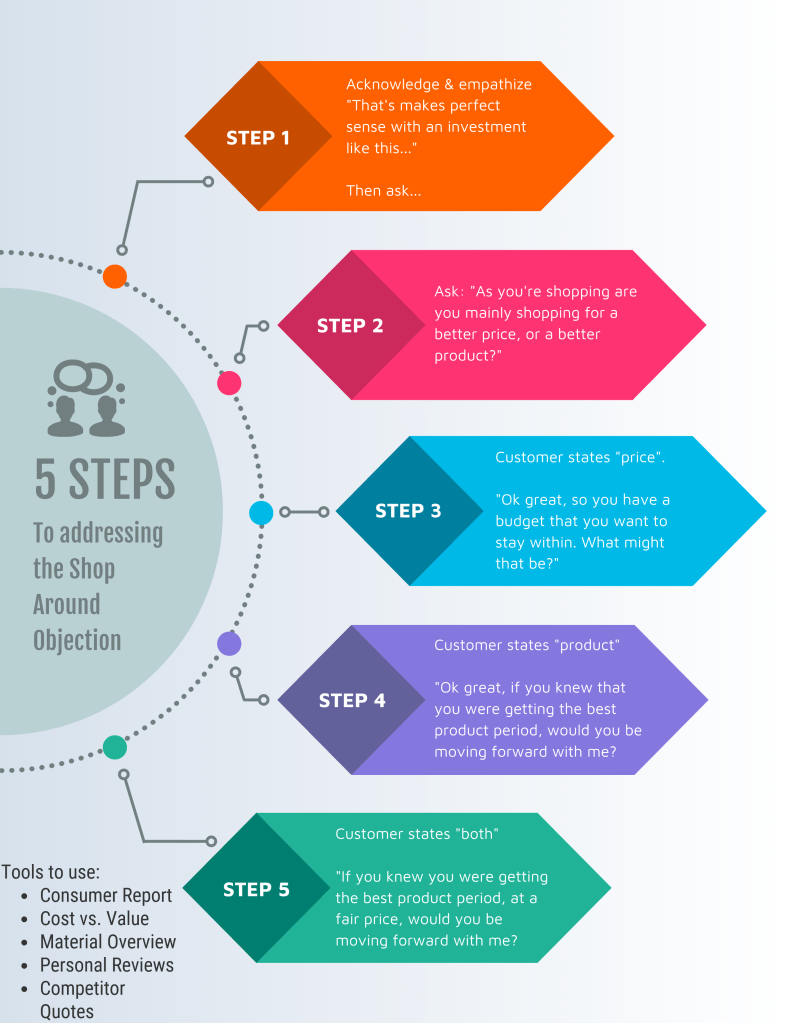
The closing stage of a sales presentation is one of the toughest- it’s fraught with emotions on both sides of the table. Customers begin to feel the tension of making a decision, and salespeople begin to battle the anticipated emotions of rejection, uncertainty, and stress.
Legendary sales trainer Brian Tracy states that whenever a customer experiences the emotions of the close “they retreat and begin to say things like, ‘let me think it over, ‘or can you email me the quote’, or ‘we need to get other quotes’, ‘I need to talk it over with someone else’, and so on.
It’s this sales resistance that necessitates a closing process. Otherwise as salespeople we begin to push for a result. The result is the process!
What’s the point of eating a bowl of ice cream: to get to the end, or savor every bite? My bet is that if you are a results driven person- you want to get to the end of that bowl as fast as possible. How about a goal of an exercise program? Unless you’re a professional athlete, the goal is to maintain a level of personal satisfaction.
Sales Coach and author of “Selling for Dummies”, Keith Rosen shares that “you don’t do a result; you execute a process, which produces the result as a natural by-product of your efforts.” To get better results you must focus on the process.
A well practiced closing process allows you to convey confidence. To address the shop around objection devote your attention to following the process and you’ll find that more of your customers will choose you rather than shop around.



 Catalyst Consulting