Essential Resources for Building Resilience and Grit in Sales

Books

1. Grit: The Power of Passion and Perseverance
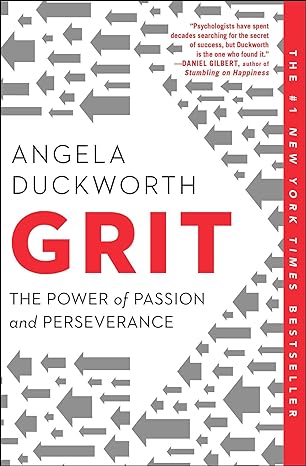
Author: Angela Duckworth

Angela Duckworth’s “Grit”

Duckworthโ€™s acclaimed book dives into the science of grit, a key driver for long-term success. In sales, where persistence often separates top performers from the rest, Duckworthโ€™s insights offer actionable steps for developing resilience. This book is packed with case studies and research that reinforces why passion and perseverance can elevate oneโ€™s career trajectory, making it an indispensable read for sales professionals who want to push past challenges and consistently close deals.

2. Mindset: The New Psychology of Success

Author: Carol S. Dweck 

Carol S. Dweck’s “Mindset”

Success in sales hinges on adaptability and a positive mindset. Dweckโ€™s โ€œMindsetโ€ explains how shifting from a fixed mindset to a growth mindset can be transformational, especially when handling rejection or navigating challenging quotas. Her approach empowers salespeople to see setbacks as opportunities for growth, fostering an outlook that drives performance under pressure.

3. Navigating Through the Valleys of Success: A Perspective in Perseverance

Author: Cleon Josephย 

Cleon Joseph’s “Navigating Through the Valleys of Success”

Sales professionals often encounter obstacles that test their perseverance. Cleon Joseph’s book provides strategies for managing setbacks and maintaining focus during tough times. Itโ€™s a guide for any salesperson striving to develop mental resilience and maintain their drive, regardless of external challenges. Josephโ€™s perspective is a valuable resource for those aiming to maintain momentum in high-stakes environments.

4. Mind Over Matter: The Self-Discipline to Execute Without Excuses
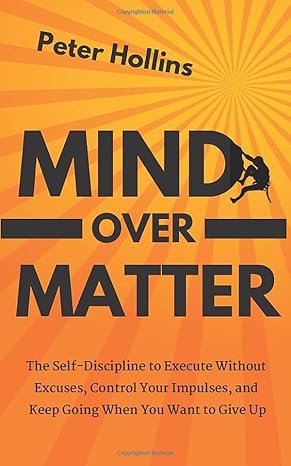
Author: Peter Hollins 

Peter Hollins’s Mind-Over-Matter-Self-Discipline

Self-discipline is at the heart of sales success. Hollinsโ€™ concise book on building self-discipline equips sales professionals with the tools to stay focused, control impulses, and push forward even when the pressure is high. With practical exercises and clear strategies, this book is a quick yet powerful read for anyone who wants to enhance their productivity and close deals consistently.

5. An Astronaut’s Guide to Life on Earth

Author: Chris Hadfield 

Chris Hadfield’s Astronauts-Guide-Life-Earth

Chris Hadfieldโ€™s experience as an astronaut offers unique insights into the importance of preparation and determination. Sales managers and team leaders will appreciate Hadfieldโ€™s lessons on staying calm under pressure, a skill as relevant in space as it is in the sales field. His book encourages sales professionals to adopt a meticulous approach to planning and to stay resilient when the stakes are high.

Videos

1. Grit: The Power of Passion and Perseverance | Angela Lee Duckworth

Angela Duckworthโ€™s TED Talk breaks down the importance of grit in achieving long-term goals. For sales teams, this talk offers an inspiring reminder that sustained effort and resilience are often more critical than natural talent. Itโ€™s an excellent motivational tool for those facing demanding sales cycles.

2. Leadership โ€“ When It Matters Most: Courage Up! | John C. Maxwell

In this talk, leadership expert John C. Maxwell discusses the role of courage in high-pressure situations. Sales managers can use this to inspire their teams to tackle challenging quotas and pursue ambitious targets without fear, instilling a culture of resilience and boldness.

https://www.youtube.com/live/qLq87C7hWjY?si=M0IhEcSmSs2Zjzcl

3. Finding Your Resolve

This motivational video is designed to help viewers find their inner resolve. Sales professionals facing burnt-out or difficult market conditions can find encouragement here to persist and overcome, making it a valuable resource for anyone who needs a motivational boost.

4. Digging Deeper: How a Few Extra Moments Can Change Lives | Cody Coleman

Cody Colemanโ€™s TEDx talk encourages taking that โ€œextra momentโ€ to make a difference, a principle highly relevant to sales. This talk is ideal for sales professionals who want to deepen their impact, build stronger relationships, and achieve lasting success through small, consistent efforts.

5. Pushing Through | Ruben Daniels

Ruben Daniels shares insights on perseverance, ideal for sales teams working in a high-pressure environment. This short talk is an excellent addition to any sales team meeting, reminding everyone that determination and a positive outlook are keys to success.

Articles and Blogs

1. The Power of Resolve

This article on resolve offers insights into how mental toughness can drive personal and professional success. Sales professionals can apply these principles to navigate competitive markets and stay focused on goals despite challenges.

https://www.psychologytoday.com/us/blog/happiness-in-world/200911/the-power-resolve

2. Finding Strength: How to Overcome Anything

Description: Sales success often requires overcoming significant obstacles. This article discusses strategies to harness inner strength, making it a useful read for sales teams looking to build resilience and face high-pressure environments with confidence.

https://www.psychologytoday.com/us/articles/199805/finding-strength-how-overcome-anything

3. Grit: A Complete Guide on Being Mentally Tough 

In this comprehensive guide, James Clear outlines the essentials of mental toughness. Sales professionals will find this article especially relevant, as it covers gritโ€™s role in achieving long-term goals and provides actionable strategies for building resilience.

https://jamesclear.com/grit

4. How to See Challenges as Opportunities

Description: This article reframes challenges as opportunities, an essential mindset shift for sales professionals. By adopting this perspective, salespeople can approach obstacles as chances to grow, making them better equipped to thrive in competitive environments.

https://www.psychologytoday.com/us/blog/what-doesnt-kill-us/201611/how-see-challenges-opportunities

5. How to Get Yourself Out of Rock Bottom

Description: For those facing a rough sales quarter, this article provides practical advice on overcoming tough periods. Itโ€™s an empowering read for any sales professional seeking to recharge and bounce back from difficult situations.

https://medium.com/swlh/how-to-get-yourself-out-of-rock-bottom-c005f899a66d

Discussion Questions for Sales Teams

How do you handle high-pressure deadlines?

Do you have strategies for โ€œdigging deepโ€ when it counts?

Share a time when you overcame a challenging sales target. What kept you motivated, and what lessons did you learn?

What are your strategies for staying positive in the face of rejection?

Reflect on a past sales experience where preparation made a significant difference. What would you do differently today?


Ready to take your sales game to the next level? ๐Ÿš€

Donโ€™t miss out on more tips, insights, and strategies to boost your sales and sales leadership skills! Subscribe today and join a community of sales enthusiasts like yourself!

๐Ÿ“ฉ Stay up-to-date with the latest blog posts, packed with practical advice and real-world examples that will help you close more deals and inspire your sales team. ๐Ÿ’ช

๐Ÿ”— Want more valuable content? Check out the library of articles for a treasure trove of sales wisdom just waiting to be discovered. From prospecting techniques to negotiation tactics, Iโ€™ve got you covered!

๐Ÿ‘ If you found this article helpful, give it a thumbs up and share it with your network. Help spread the word and empower others to achieve sales excellence!

Remember, success in sales starts with knowledge and continuous learning. Donโ€™t miss outโ€”subscribe, explore, and share today!

๐Ÿ“ข Come along the journey! Subscribe now, explore more, and share the knowledge! ๐ŸŒŸ

Navigating the Price Game: Mastering the Art of Negotiation with Buyers

When it comes to negotiations, buyers often try to push for lower prices to maximize their own gains. As a seller, it’s important to be aware of the tactics buyers use and to develop effective strategies to navigate these situations. In this article, I will explore the five most common ways buyers negotiate lower prices and provide insights on how to respond as a seller. Whether you are in sales or simply interested in understanding the dynamics of negotiation, this article will equip you with valuable knowledge to achieve win-win outcomes.

A LOST (when effectively negotiated) deal is often better than a BAD deal

1. One Last Request: Appealing to the Seller’s Desire for Closure

Buyers often employ the “one last request” tactic to secure a final concession from the seller. This tactic occurs at the end of a negotiation when the buyer requests one additional change to seal the deal. The effectiveness of this tactic lies in the seller’s eagerness to close the sale and their willingness to make a final concession in exchange for the buyer’s signature.

To effectively counter this tactic, sellers should remain diligent in evaluating the value of the requested change and considering whether it aligns with their pricing and objectives. It is essential to communicate the rationale behind your decision and signal that you understand the buyer’s request without compromising the overall value proposition.

2. Flinch Test: Challenging the Seller’s Initial Price

The “Flinch Test” tactic involves buyers insisting that the seller’s price is too high and demanding a better offer. This tactic is often used regardless of the circumstances and aims to evoke a concession from the seller solely based on a price reduction.

As a seller, it is crucial to resist the temptation to immediately concede to price demands. Instead, focus on highlighting the unique value your product or service offers and the reasons behind your pricing. Demonstrate the differentiation and benefits that set your offering apart from competitors. By emphasizing the value proposition, you can shift the negotiation away from pure price discussions and towards mutually beneficial outcomes.

3. Split the Difference: Appealing to Fairness

Buyers may suggest “splitting the difference” as a negotiation technique, portraying it as a reasonable compromise. However, sellers must be cautious, as meeting in the middle may not always result in a fair outcome for both parties.

To navigate this tactic, sellers should focus on rationalizing their pricing based on the value provided. Engage in open discussions with the buyer to understand their concerns and identify alternative concessions that align with the overall value proposition. By showing a willingness to collaborate while safeguarding your pricing, you can establish a partnership based on transparency and shared benefits.

Sellers want to be seen as reasonable. They want to create a partnership. When buyers say, “Why donโ€™t we meet in the middle?โ€ there’s an emotional appeal of showing good faith by splitting the difference.

Mike Schultz, Rain Group

4. Anchoring: Establishing a Low Budget Threshold

The “anchoring” tactic involves buyers sharing a low budget early in the negotiation to set the stage for further bargaining at a reduced price. By presenting a low anchor, buyers aim to influence sellers to provide lower estimates and increase their chances of securing a better deal.

Sellers must be aware of anchoring effects and the cognitive bias associated with the first offer in a negotiation. It’s crucial to understand the buyer’s budget and pricing expectations while highlighting the unique value your product or service brings. By framing the conversation around the value derived from your offering, you can counteract the anchoring effect and build a foundation for discussions based on the benefits your solution provides.

5. Meeting with Your Competitor Today: Leveraging Time Pressure

Buyers often use time-pressure tactics, such as presenting an offer within a tight timeframe or hinting at engaging with a competitor. These tactics aim to create a sense of urgency and scarcity, pushing sellers to make concessions quickly.

To counter time-pressure tactics, sellers should remain composed and analyze the situation objectively. Evaluate the buyer’s timeline and ensure you have a clear understanding of the value your product or service brings to the table. Demonstrate confidence in your offering and focus on the long-term benefits rather than succumbing solely to short-term pressures. By communicating the value and emphasizing the partnership potential, you can mitigate the effects of time-pressure tactics and maintain control over the negotiation process.

The Bottom Line

Negotiations are a crucial part of the consultative sales process, and understanding the tactics buyers employ can significantly impact your ability to secure favorable outcomes. By familiarizing yourself with the five most common ways buyers negotiate lower prices and developing effective responses, you can position yourself as a strategic partner who emphasizes value creation and mutual benefits.

Remember, negotiations should always strive for win-win outcomes where both parties feel satisfied with the agreement reached. By employing strategies that focus on highlighting the value of your offering and fostering open communication

FAQs:

Q1: How can sellers effectively respond to the “One Last Request” tactic?

In response to the “One Last Thing” tactic, sellers can employ Chris Voss’s technique of labeling, introduced in his book, “Never Split the Difference: Negotiating as if Your Life Depended on It”. Labeling involves acknowledging the buyer’s request and labeling it as legitimate while reframing it to gain perspective.

For example, respond with, “I understand that this is important to you, and I can see why you’d want this. Let’s take a step back and explore how this change aligns with the overall value we’re providing.”

Q2: What strategies can sellers employ to counter the “flinch test” tactic?

In dealing with the “Flinch Test” tactic, sellers can apply Chris Voss’s technique of mirroring. Mirroring entails repeating the buyer’s words or the last few key words to encourage further elaboration and create a collaborative atmosphere. By saying, “So you’re looking for a better price?”, sellers gather more information and show a willingness to understand the buyer’s perspective. This allows for a more thoughtful response rather than immediately conceding to price demands.

Q3: Are there situations where buyers’ negotiation tactics can be beneficial for sellers?

Yes, there are instances where buyers’ negotiation tactics can be advantageous for sellers. Chris Voss explains the importance of utilizing and adopting a mindset of “tactical empathy”. Through active listening, sellers can uncover the underlying motivations and concerns driving the buyer’s negotiation tactics. By understanding these factors, sellers can adapt their approach to address the true needs of the buyer and arrive at a mutually beneficial outcome.

Q4: How can sellers effectively respond to time pressures buyers use by leveraging competitive research?

An accusation audit, a technique introduced by Chris Voss, can be a powerful tool in negotiations. Instead of shying away from potential criticisms or concerns, the accusation audit allows sellers to address them head-on.

For example:

Buyer: “Iโ€™m meeting with your competitor this afternoon, and Iโ€™m sure they can do better. Is that the best you can do?”

Seller: “It sounds like you believe our price is too high and that we may not be offering enough value for the investment. I can understand why you might think that, as there are many options on the market. However, I’d like the opportunity to highlight the unique benefits and superior quality/service we provide.”

By leading with a statement that acknowledges the buyer’s concern or accusation, the seller demonstrates empathy and shows a willingness to address potential reservations. This can lead to a more open and constructive dialogue, allowing both parties to explore ways to create value and find a mutually beneficial solution.


Ready to take your sales game to the next level?๐Ÿš€

Don’t miss out on exclusive tips, insights, and strategies to boost your sales and sales leadership skills! Hit the subscribe button and join a community of sales enthusiasts like yourself!

๐Ÿ“ฉ Stay up-to-date with the latest blog posts, packed with practical advice and real-world examples that will help you close more deals and inspire your sales team.

๐Ÿ”— Want more valuable content? Check out the library of articles for a treasure trove of sales wisdom just waiting to be discovered. From prospecting techniques to negotiation tactics, I’ve got you covered!

๐Ÿ‘ If you found this article helpful, give it a thumbs up and share it with your network. Help spread the word and empower others to achieve sales excellence!

Remember, success in sales starts with knowledge and continuous learning. Don’t miss outโ€”subscribe, explore, and share today!


Subscriber Bonus:

If you want more tips & techniques for negotiating, then subscribe & leave a comment on this post. Iโ€™ll email you my new E-Book as a bonus: Negotiate Like a Proโ€ฆAnd Get What You Want More Often

[Week 2] 5-week Daily Plan To Fill Your Pipeline, Regain Control , & Master Your Sales Role

Photo by RDNE Stock project on Pexels.com

Over the next 5 weeks, I will be following up on a post that I made here and diving deeper into each weekly and daily objective. My hope is that this helps you on your sales journey to finishing BIG for 2023 and beyond!

Week 2: Developing a Sales Plan

Day 6: Identifying Your Target Audience and Their Pain Points

Task: Define your target audience and understand their pain points and challenges. Develop strategies to address these pain points effectively with your product or service.

Mark, a sales professional that I recently had the opportunity to work with in the tech industry, realized that his target audience was small businesses struggling with outdated software systems. I encouraged him to conduct more targeted research, and he found that these businesses were facing productivity losses due to system crashes. He tailored his sales approach to focus on how his software solution could alleviate this pain point and improve their efficiency. Prior to this exercise, Mark was leading with his product features and capabilities, rather than asking good questions around a defined buyer persona.

Oftentimes, buyer/user personas have been defined by marketing departments, as this guides where investments are made and where to find the appropriate audience. I’ve worked with some companies where there was a disconnect between marketing’s idea of who an ideal customer is, and what sales finds in the field. This is why it is imperative that marketing and sales keep open lines of communication to drive efficiencies in marketing dollars and put sales in a better position to pull the right customers through.

Takeaway: Understanding your target audience’s pain points allows you to position your product or service as a solution to their problems, increasing the likelihood of successful sales interactions.

Application: Create buyer personas that outline your ideal customers’ characteristics, challenges, and goals. Develop messaging that directly addresses their pain points and offers solutions.

Example Buyer & User Persona

Day 7: Crafting Your Unique Selling Proposition (USP)

Task: Define your unique selling proposition (USP) and devise strategies to effectively communicate it to potential customers.

There’s quite a bit of research and work to come up with a viable USP, which takes more time than I’ll cover here. However, defining your target customer and then composing your USP will make a big difference in your results. For example take Laura, a sales representative for a small business services firm located in Kansas City, discovered that her USP was the use of organic cleaning solutions, cruelty-free ingredients. She incorporated this into her sales conversations and marketing materials, highlighting how her products aligned with customers’ values.

Takeaway: A compelling USP sets you apart from competitors and gives customers a reason to choose your product or service.

Visit www.salesstar.com
Here’s a sample sales plan and how identifying your target customers leads to developing a unique selling proposition

Application: Craft a concise and compelling USP that highlights what makes your offering unique and valuable. Incorporate it into your sales pitches, presentations, and marketing materials.

Day 8: Tailoring Your Sales Approach

Task: Develop a flexible sales approach that can be tailored to different types of customers and various situations.

The initial approach is much different than the sales presentation. The latter is always tailored to a prospect’s unique problems and needs. The sales approach is much earlier in the process and is what leads to getting an appointment or at least an agreement to spend more time with the prospect. James, a sales professional selling office furniture, realized that his approach needed to differ when dealing with small businesses (typically less than 50 employees) versus larger businesses (typically businesses with 100โ€“1000 employees). For small businesses, he focused on cost-effectiveness and scalability, while for larger businesses, he emphasized quality and customization.

Takeaway: Adapting your sales approach based on your audience’s preferences and needs enhances your ability to connect and resonate with potential customers.

Application: Create multiple sales scripts or approaches that can be customized for different customer segments or scenarios. This ensures you’re prepared for a variety of interactions.

Day 9: Utilizing Data and Analytics

Task: Incorporate data and analytics into your sales plan. Leverage insights from previous sales performance and customer behavior to inform your strategies.

The opposition to using a CRM system as a sales tool rather than a repositor for useless data still baffles me. Granted, some sales managers do not help with some of the mandates for information to be included, as the problem with this approach is that it often leads to putting garbage in thus getting garbage out. My recommendation to inputting account info into a CRM is to use what I call the W.I.N. method. A simple acronym that helps with putting information in that is useful and actionable.

  • W. What was discussed in the conversation. Provide as much detail as necessary to be able to pick up in the next conversation immediately where you left off in the last. I have been on many ride-alongs where a rep covers a lot of information that has been covered numerous times before. This is a sure way to getting resistance in the future when asking for another appointment. When you stop wasting a prospects time you’ll notice that you begin to get more of it!
  • I. Insights covered or insights gained in the conversation. Did you learn about a new way that they could possibly use your service or product? Did you uncover another influencer that could push a potential deal along? Did you learn about a competitor and how their product is being perceived as difficult to use or implement?
  • N. Next-time will be the plan of conversation during the next visit. Planning this ahead of time with help make the most of the time a prospect has. This approach can lead to becoming a valued resource rather than just another sales annoyance of a prospects day.

Takeaway: Data-driven decision-making allows you to fine-tune your strategies and focus on what works best for your audience.

Application: Regularly review sales data to identify patterns and trends. Use these insights to refine your approach, allocate resources effectively, and identify areas for improvement.

Day 10: Reviewing and Updating Your Sales Plan

Task: Establish a process for consistently reviewing and updating your sales plan to ensure its ongoing relevance and effectiveness.

Takeaway: A sales plan should be dynamic, evolving with changes in the market and your customers’ preferences.

Application: Set up regular checkpoints to evaluate your sales plan’s performance. Consider factors such as market trends, customer feedback, and competitive landscape to determine necessary updates.

Developing a well-defined sales plan is essential for maintaining focus and organization while pursuing your sales goals. By identifying your target audience’s pain points, crafting a compelling USP, tailoring your sales approach, leveraging data and analytics, and regularly reviewing your plan, you can stay adaptable and effective in a dynamic sales environment. Remember that a successful sales plan is not a static document but a living strategy that evolves to meet the needs of your customers and the market.

Stay tuned for a follow up post breaking down the strategies and tactics for Week 3: Building Relationships with your Customers. Till then, I hope Week 2 brings a new level of confidence and focus on your path to finishing 2023 BIG!

Don’t Take Selling Personal

Photo byย Ryan Snaadtย onย Unsplash

Selling may be one of the most lucrative and exciting careers in the world when you’re closing sales and hitting your sales targets. However, if sales are down and prospects aren’t returning your calls, you may begin to doubt yourself and take it personally. So, let’s look at what it takes to stay motivated in order to bring in additional clients.

In order to get more clients and expand your business, follow these three steps.

1. Identifying and cultivating new customers.

2. Investing more time and effort into existing customers to increase referrals and business.

3. Making contact with higher-level decision-makers in order to gain larger deals. 

As a sales professional, we recognize the significance of reaching these goals. Why, then, do so many sales professionals struggle to get over the first hurdle? It appears that, as much as we want to succeed in sales, we also want to avoid rejection while calling on prospects and customers.

Let’s take a look at how rejection affects sales performance. Fear of rejection and failure might make you lose your excitement, confidence, and initiative. When you are rejected, it can be damaging to your ego. You may get disillusioned, upset, and defensive if you take the negativity personally.

We may take rejection personally for three reasons. Each of them is linked to one of the three goals. They are as follows:

Frequency: Studies have shown that reaching decision makers takes at least five attempts or more. You may be irritated, disheartened, and uncertain of yourself if you’ve been calling prospects all week and they haven’t responded. It’s difficult not to take it personally and believe you’ve done something wrong.

Emotional Involvement: You’ve had a long-term business relationship with a client. You put a lot of effort into building the relationship. You want to ask for referral business from them, but you’re terrified of putting them on the spot or getting a negative response. You’re worried that this may harm the connection you’ve fought so hard to build.

Perceived Importance: You may choose to call on prospects with whom you are most familiar. You may be hesitant to contact decision makers higher up the ladder in a company because you believe you lack the experience and confidence to engage with a seasoned senior executive. If you believe you have nothing in common with a company’s CEO, you are unlikely to contact him or her.

If we believe that in order to feel good about our work, we must be accepted by others, we will be vulnerable to failure and rejection. Because self-esteem is built on ones own sense of self-worth, successful sales professionals see failure as a chance to learn and improve. They feel that failure may teach them more than success, and that every mistake is an opportunity to learn and grow. This is why successful sales professionals are generally in a positive mind-set, whether they achieve or fail, whether they are liked or rejected.

So, what’s the secret to coping with rejection in a constructive way? It can be summed up in five terms… “Don’t take anything too seriously.” Shit happens Things take place. People get overworked. Customers are possibly having a rough day. The economy rises and falls. You have a decision to make. You may either take it personally and use it as an excuse for failure, or you can concentrate on the four things you have control over: your beliefs, attitude, emotions, and performance. Take care of those four things, and the rest will fall into place.

Change your thoughts to “My customer is extremely satisfied with my service and is eager to suggest me to others with similar challenges!” the next time you have a limiting thought like “I can’t ask for referrals because I don’t want my client to think I’m too pushy!” Shifting your thoughts is the first step toward changing your beliefs, but it’s not the end of the process. Begin by stating it out loud to yourself and then sharing it with others. It will become more real for you if you do so.

ASSIGNMENT:

Choose one of the three objectives in which you’d want to make a breakthrough:

1. Identifying and cultivating new clients.

2. Investing extra time in customers in order to earn referrals or new business.

3. Obtaining larger orders or contacting higher-level decision makers.

  • Cut a 3″ x 5″ index card in half. On one side of the card, put down all of your negative thoughts regarding achieving that goal. Don’t be afraid to speak your mind.
  • Reverse the negative thinking and write good thoughts on the other side of each index card. This is the first step toward changing a negative belief.
  • Begin by speaking the new affirmation aloud to yourself and sharing it with others to practice changing that thought.

Make a list of action items to take, and take one step toward achieving the goal today!

Sell for Change!

Photo byย Ross Findonย onย Unsplash

Selling is all about getting buy-in for people and businesses to change, and change is always inherently risky. When given an option, most individuals will invariably opt for the status quo. People, and especially businesses, are creatures of habit, and changing their habits necessitates breaking old ones and forming new ones. Selling is challenging because it requires you to battle against human nature by influencing others to change (and you thought it would be simple!).

When you think about it, a lot of the opposition you’ll face in sales (objections, delays) is a result of risk. Most people will resist change if they consider the danger of changing is greater than the risk of staying the same. It’s tough to build the momentum needed to encourage people to change because of the old concept that “it’s better to live with the devil you know than the devil you don’t know.” It is a formidable force with which we shall all have to contend.

So, how can we reduce risk, or at least reduce the impression of threat, so that more customers are willing to take the risks necessary to experience the positive future result?

 Two essential tactics spring to mind:

1. Identifying and thoroughly understanding your prospects’ problems will encourage them to believe that you are less likely to sell them a solution that will not work because of your understanding. Asking questions that allow you to fully comprehend their circumstances will help to reduce their fear of risk.

2. Assisting them in seeing that the current “discomfort” (consequences, circumstances of remaining the same) will be mitigated by their willingness to go through the “discomfort” of change. Helping them in overcoming the apparent risk once more.

The first technique requires our ability to ask excellent “information seeking” questions.

Questions such as:

  • Could you tell me more about the issues you’re having?
  • How long have you been having these issues?
  • What steps have you taken to address them?
  • How did that work out for you?
  • What influence or repercussions do they have on you and your firm, specifically?
  • Are the issues costing you or your firm money?
  • What will happen if you don’t take care of them?

As you gain knowledge, you develop the notion that using the insight you’ve obtained, you’ll be more likely to make a solid recommendation…thus minimizing risk (you may also find this is a good strategy that helps to differentiate you from your competition).

The second method necessitates the use of “consequence” questions.

Questions such as:

  • What happens if nothing is done about it?
  • Do you think you’ll be able to live with this?
  • How would you feel if you weren’t able to tackle the problems?
  • Is there anyone else who is impacted by these issues?
  • Is it possible that you don’t need to be concerned?

These questions assist the prospect in realizing that failing to solve the problem may be a greater risk than the risk of change. They’re frequently the questions you’ll need to generate change momentum.

Your ability to ask both of these type of inquiries will aid you and your prospect in recognizing and limiting the risks associated with making a change. One of the secrets to being effective in sales is to reduce risk!

The Mind As An Asset

When we face a challenge that seems bigger than ourselves, we can find courage, strength and resilience at will. We discover powers that we never thought we had, but the secret is all inside our mind: true power lies in accepting the challenge and saying to yourself โ€œNo matter what happens, Iโ€™m going to make it. I can already see the finish line. I have nothing to lose and everything to gainโ€.

The above was a passage from Psycho-Cybernetics. A weighty read, but an important one that dives into the capacity we have, should we choose, to leverage the power of the mind.

For those of you who arenโ€™t familiar with the author, Maxwell Maltz (1889โ€“1975) was an American cosmetic surgeon and author. By combining his daily work experiences as a surgeon with profound studies of the human psychology, Maltz came to the conclusion that our self-image is the cornerstone of our mental state, and therefore of all the successes and failures that happen in our lives as a result.

His best-seller Psycho Cybernetic, published in 1960, is considered one of the best books in the self-help category, of the psychology masterpieces that paved the way for most of todayโ€™s personal empowerment programs.

My Top 5 Recommended Books on Selling

Photo by Shiromani Kant

Mark Twain once said, “The man who does not read good books has no advantage over the man who cannot read.”

Here are short links for you to find on Amazon:

  1. Objections: The Ultimate Guide for Mastering the Art and Science of Getting Past No Jeb Blount does an excellent job of outlining the mental process of addressing objections rather than rejection. This is my favorite book on closing and isn’t your typical anectdotal approach to objections that you find in sales.
  2. Triggers: Creating Behavior That Lasts-Becoming the Person You Want to Be While this isn’t technically a “sales” book, being truly effective in sales is about engaging in the right behaviors consistently. While there are many books that will tell you exactly what sales behaviors to do- none of them get to the psychology of root behaviors. Goldsmith does an excellent job of understanding the psychology behind the behaviors we choose to engage in (sales or not).
  3. Escaping the Price Driven Sale: How World Class Sellers Create Extraordinary Profit Anyone who knows me knows that I am a BIG fan of SPIN Selling. When your value is determined by your ability to be consultative, there is simply no better sales methodology than SPIN, in my opinion. Escaping the Price Driven Sale is a great companion to SPIN Selling and further deepens the understanding of the SPIN methodology.
  4. Emotional Intelligence for Sales Success: Connect with Customers and Get Results Talk to anyone who works in sales and they will undoubtedly tell you that it’s an emotional rollercoaster of a profession. Enter; Emotional Intelligence. If you don’t have it- your success, if any, will be shortlived. If you don’t have it, and you find success, you’ll never become a great leader- you’ll be pigeon holed. Just get it and be grateful that you made the investment in yourself.
  5. The Sales Bible: The Ultimate Sales Resource I simply enjoy Jeffrey’s approach to all things sales. It’s short and to the point. He over delivers on what he promises and his approaches simply work. The amount of complimentary resources he provides on his website through this book is worth 10x’s what he charges for the book. You’ll be referencing this for years to come and should be a staple on your shelf.

As with any list it’s hard to narrow down to just five, and some would be debatable depending on the stage of your sales career. I consider these to be foundational to the profession of sales. I could create lists upon lists should we get into the various facets of sales; presenting, speaking, communicating, building value, prospecting, asking for referrals, so on, and so on. Hey- there’s my next few lists ideas ๐Ÿ™‚

What books are staples on your “sales” shelf?

On Goodreads? Let’s connect there!

“It’s way out of our budget”- Oh no!

We’ve all had it happen before, we are in front of a prospect who has completely unrealistic price expectations. What do you do? Check out the video below for a few tips on how to address this scenario.

A potential client wants a 20 product bid. They tell you that they expect the price to be under $10,000; you know it will be considerably more than that. Now what?

Don’t be in a hurry to write off someone with an unrealistic expectation on price. If they called you, doesn’t that mean they need or want your product? Take the time to gather information before you decide they aren’t worth your time and energy. See if you can turn it into a sale.

This can be accomplished with the proper set of questions and a little patience. Start by asking the four basic questions that are needed to get to the contract. At some point, the budget will come up. Ask the question, “How did you arrive at the budget you have set?” You will get all kinds of answers, but the usual sources are other contractors, something from the media, or a hopeful wild guess on the part of the owner.

Give them the three price ranges that their job will fall into. Not one lump sum figure, not two broad figures, but three well-defined ranges based on your experience. You want them to make a decision, and that is why the wording is so important. Start with the middle range, move to the top range and finally explain what they will get in the low budget range.

Will they have sticker shock? Most likely. Will they think you and your prices are nuts? In some cases, yes. Will you get through to them that their budget is unrealistic? Maybe.

Most of it depends on how you present the information. Good questions can lead them to the conclusion you need them to reach. Blanket statements are not as effective. Remember that you have two ears and one mouth and use them in that ratio.

When you have given the three price ranges, ask the question, “Which of these three budget ranges would you like to invest in your home?” Or, “Which of these three budget ranges do you think would work best for you and your family?” There are several ways of asking this question but after you ask it, STOP! One of the biggest mistakes salespeople make is that they ask a question, and then keep on talking. Put a zipper on your lip. Button it up. Let them give their answer.

If they come back with the nonsense that they don’t know what it will cost, tell them it will be in the ranges you just discussed. Give the ranges again if necessary. They don’t like making decisions, and are trying to avoid the fact that you provided that info already.

Give your clients good information, help them adjust their budget, and make the sale. If they won’t adjust, move to the next client with a realistic price expectation.

Remember, the best earn the sale!

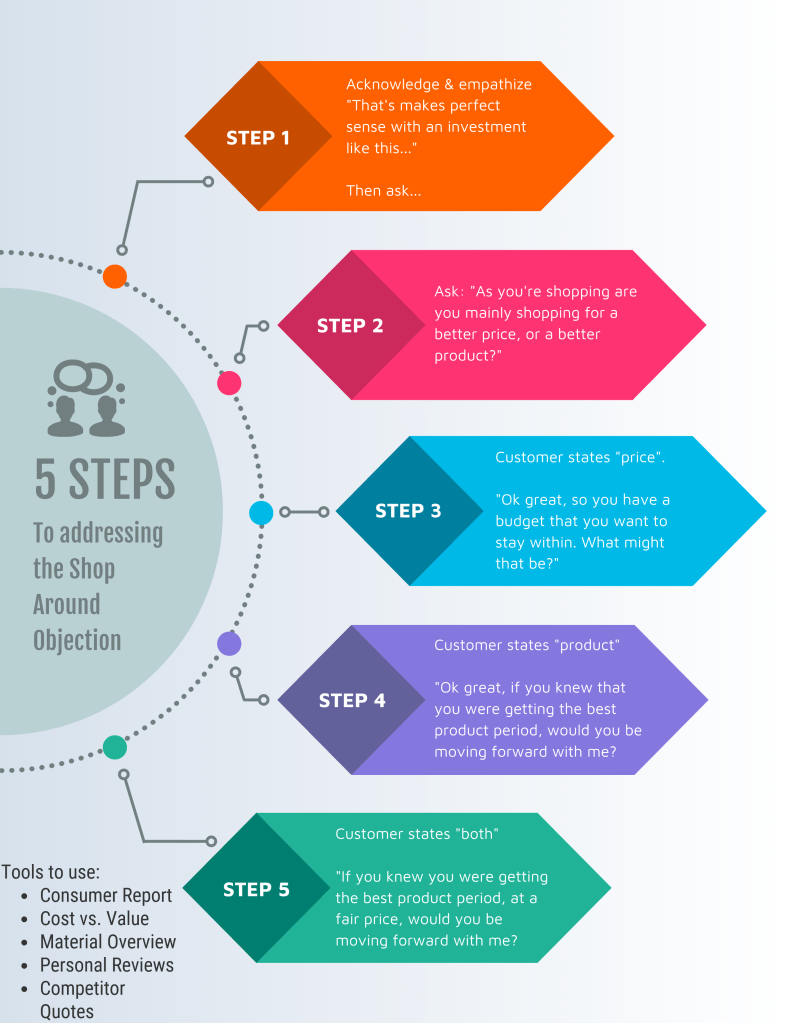
5 Steps To Addressing the Shop Around Objection

The closing stage of a sales presentation is one of the toughest- it’s fraught with emotions on both sides of the table. Customers begin to feel the tension of making a decision, and salespeople begin to battle the anticipated emotions of rejection, uncertainty, and stress.

Legendary sales trainer Brian Tracy states that whenever a customer experiences the emotions of the close “they retreat and begin to say things like, ‘let me think it over, ‘or can you email me the quote’, or ‘we need to get other quotes’, ‘I need to talk it over with someone else’, and so on.

It’s this sales resistance that necessitates a closing process. Otherwise as salespeople we begin to push for a result. The result is the process!

What’s the point of eating a bowl of ice cream: to get to the end, or savor every bite? My bet is that if you are a results driven person- you want to get to the end of that bowl as fast as possible. How about a goal of an exercise program? Unless you’re a professional athlete, the goal is to maintain a level of personal satisfaction.

Sales Coach and author of “Selling for Dummies”, Keith Rosen shares that “you don’t do a result; you execute a process, which produces the result as a natural by-product of your efforts.” To get better results you must focus on the process.

A well practiced closing process allows you to convey confidence. To address the shop around objection devote your attention to following the process and you’ll find that more of your customers will choose you rather than shop around.

When you don’t have an objection process

Sales Person vs. Sales Champion.

Coaching done wrong
Coaching done wrong

I feel extremely fortunate to have worked in sales for over 20 years now. 10 of which have been spent coaching and training sales people. In those years, I’ve noticed that both sales people and sales managers mistake the difference, and thus, the execution of sales training and sales coaching.

Sales people mistake their need for additional sales training, when in fact they need coaching. Sales managers mistakenly believe their sales people need new tricks and techniques, when they simply need help re-framing the narrative they’ve attached to an experience, which when left unattended, can turn into a limiting belief.

Do a quick Google search on books on sales coaching and you’ll get 59,000,000 results. There’s not a shortage of information on the topic. I’ve read many books on this topic and have found Keith Rosen’s work to be some of the best resources available. Below I’ve provided a quick one page of sales training vs. sales coaching.

More info on the topic don’t hesitate to check out Keith’s site here.