Data Analytics for Managerial Success: Applying Optimal Stop Theory for Recruiting

Hey there, managers and business leaders! In today’s fast-paced and competitive job market, finding the right talent for your team can be a daunting task. However, fear not, because I’m about to delve into the exciting realm of data analytics and the Optimal Stop Theory and explore how this data science tool can optimize your recruiting success. So, grab your thinking cap, get comfortable, and let’s dive in. By the end of this article, you’ll be equipped with the knowledge and insights to make informed, data-driven decisions that will propel your managerial success to new heights.

Understanding Data Analytics and the Optimal Stop Theory

Before we dive into the nitty-gritty of applying data analytics and the Optimal Stop Theory to your recruitment process, let’s take a moment to understand what these concepts are all about.

What is data analytics?

Data analytics involves the use of advanced tools and techniques to analyze raw data and extract valuable insights from it. In the context of recruitment, data analytics empowers managers to make evidence-based decisions by leveraging patterns and trends within large sets of applicant data.

The Optimal Stop Theory: A Game-Changer for Recruitment

The Optimal Stop Theory, also known as the secretary problem or the optimal stopping problem, is a mathematical concept that addresses the challenge of making decisions in the face of uncertainty and limited information. In the context of recruitment, this theory provides a framework for determining the optimal point at which to stop interviewing candidates and make a hiring decision.

Backed by over 20 years of recruiting and hiring experience, I work with many clients who are faced with two competing challenges. 1) a lack of a well defined recruitment process that results in decisions being made on intuition. 2) a recruitment process that takes too long that ultimately wastes qualified candidates and uses up a disproportionate amount of managements times.

Applying Data Analytics and the Optimal Stop Theory to Recruitment 

Now that we have a grasp of the foundational concepts and the challenges that managers face, let’s explore how you can effectively apply data analytics and the Optimal Stop Theory to enhance your recruiting success.

Leveraging Data Analytics to Identify Talent Trends

1. Utilize applicant tracking systems (ATS) to collect and analyze data on candidate qualifications, experience, and performance metrics.

2. Develop a top-grading criterion to identify patterns and trends in applicant data to gain insights into the characteristics of successful hires.

3. Use predictive analytic tools such as the Predictive Index, Culture Index, or DISC assessments to forecast which candidates are most likely to succeed based on benchmark historical data.

Implementing the Optimal Stop Theory in Interviewing and Selection 

Step 1: Establish clear criteria for evaluating candidates and determining the optimal threshold for making a hiring decision.

Step 2: Conduct a sufficient number of interviews to establish a baseline for comparison.

Step 3: Use the Optimal Stop Theory to calculate the optimal point at which to stop interviewing and extend an offer to the most qualified candidate.

Let’s apply the optimal stop theory to a real-world scenario. Imagine you’re in the process of hiring a new data analyst for your team, and you’ve decided to interview a total of 10 candidates. In this case, the sample size is 10, representing the number of candidates you plan to interview before making a hiring decision.

Now, to demonstrate the mathematical approach to the Optimal Stop Theory, let’s consider the logarithmic equation that can be used to calculate the optimal stopping point. The Optimal Stop Theory provides a framework for determining the point at which to stop interviewing and make a hiring decision, maximizing the probability of selecting the best candidate.

The general form of the Optimal Stop Theory equation can be represented as follows:

( k = n / e )

Where:

k = the optimal stopping point

n = the sample size (number of candidates to be interviewed)

e = the base of the natural logarithm, approximately equal to 2.71828

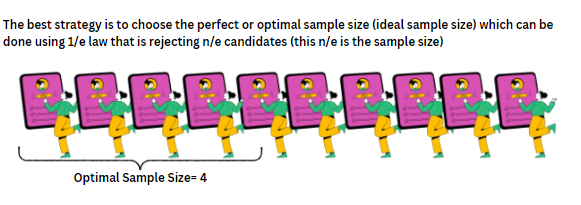
In this equation, “e” represents the mathematical constant that is the base of the natural logarithm. The Optimal Stop Theory suggests that to maximize the probability of selecting the best candidate, you should reject the first n/e candidates and then hire the first candidate who is better than any of the previously interviewed candidates. It’s important to note that the foundation of this process is that after each interview a decision must be made (yes or no). Once a candidate is interviewed you can’t go back.

Let’s get back to the data analyst example to illustrate this. If you’re interviewing 10 candidates (n = 10), the optimal stopping point (k) can be calculated as:

( k = 10 / e )

Based on the value of “e” of approximately 2.71828, the optimal stopping point (k) for a sample size of 10 candidates can be calculated as:

( k ≈ 10 / 2.71828 ≈ 3.67 )

In this case, the optimal stopping point is approximately 3.67, which means that according to the Optimal Stop Theory, you should reject the first 3 candidates and then hire the first candidate who is better than any of the first 3 candidates.

This mathematical approach provides a theoretical framework for making hiring decisions based on limited information, aiming to increase the likelihood of selecting the best candidate from a pool of applicants. The optimal strategy doesn’t always find the best candidate but selects the almost-best candidate most of the time. This, of course, works in a world in which you are faced with constraints while hiring. Otherwise, without constraints, you would use the maximum selection criteria. The maximum selection is based on a grading scale for each candidate, and you select the one that scores the highest, or until the highest score is reached. However, in recruiting, you may be faced with constraints such as a limited number of applicants, time to hire, and time of candidate in the market.

FAQs

Q: How can data analytics improve the efficiency of the recruitment process?

A: Data analytics can streamline the recruitment process through objective criteria, identifying top talent more efficiently, and reducing bias in decision-making.

Q: What are the potential challenges of implementing the Optimal Stop Theory in recruitment?

A: One of the challenges is the need for accurate data and a deep understanding of the hiring landscape to effectively apply the theory. Additionally, striking a balance between thorough evaluation and timely decision-making is crucial.

Q: How can small businesses leverage data analytics and the Optimal Stop Theory with limited resources?

A: Small businesses can start by leveraging cost-effective applicant tracking systems and software that offer basic analytics capabilities. Additionally, they can focus on defining clear hiring criteria and making the most of the data they do have to make informed decisions.

While this is not an exhaustive review of the benefits of using data analytics and the optimal stop theory, you hopefully have a glimpse of how helpful an approach such as this can be in your recruiting efforts. By harnessing the power of data-driven insights and strategic decision-making, you are positioned to transform your approach to talent acquisition. Remember, the key to unlocking the full potential of these tools lies in a combination of data analytics prowess and human intuition. As a manager, you have the opportunity to blend the art and science of recruitment to build high-performing teams that drive your organization’s success.

So, go forth with confidence, armed with the knowledge to make your next hiring decision a game-changing success. It’s time to harness the power of data and mathematical theory to take your recruitment game to the next level. Get ready to make smarter, more confident hiring decisions and build a team that propels your organization toward a brighter future.


Ready to take your sales game to the next level? 🚀

Don’t miss out on more tips, insights, and strategies to boost your sales and sales leadership skills! Subscribe today and join a community of sales enthusiasts like yourself!

📩 Stay up-to-date with the latest blog posts, packed with practical advice and real-world examples that will help you close more deals and inspire your sales team. 💪

🔗 Want more valuable content? Check out the library of articles for a treasure trove of sales wisdom just waiting to be discovered. From prospecting techniques to negotiation tactics, I’ve got you covered!

👍 If you found this article helpful, give it a thumbs up and share it with your network. Help spread the word and empower others to achieve sales excellence!

Remember, success in sales starts with knowledge and continuous learning. Don’t miss out—subscribe, explore, and share today!

📢 Come along the journey! Subscribe now, explore more, and share the knowledge! 🌟

[Week 1] 5-week Daily Plan To Fill Your Pipeline, Regain Control , & Master Your Sales Role

Photo by RDNE Stock project on Pexels.com

Over the next 5 weeks, I will be following up on a post that I made here, and diving deeper into each weekly and daily objective. My hope is that this helps you on your sales journey to finishing BIG for 2023 and beyond!

Week 1: Setting Clear and Specific Goals

Day 1: Refining Your Sales Goals

Task: Take some time to review your current sales goals and assess their specificity and measurability. If your goals are vague or difficult to measure, refine them to make them more actionable.

In my coaching, I see (I have been one too) many sales professionals who set their sales goals at the beginning of the year. In doing so they soon realize, once the year has begun, that their initial goals were too broad, like “increase sales” and “grow customer base”, or “hit bonus.” As a result, they hop on the struggle bus to staying motivated because they couldn’t track their progress effectively.

Takeaway: Specific and measurable goals provide clarity and direction. When you have clear objectives, you can break them down into actionable tasks, making it easier to stay motivated during down sales months. For example, let’s take the goal of increasing sales and break it down, make it actionable, and put a timeline on it. Let’s say that this rep wants to increase their close rate 33% by the end of the week.

Current state:

  • 10 opportunities a week
  • 30% close rate
  • $20,000 average deal size

So in the past week, this rep has closed three jobs. An increase of 33% would equate to four deals this week. Closing four deals out of 10 opportunities would put this rep’s closing rate at 40%. Just one extra contract! I know, this is just easy math, but this is the magic of taking vague goals and making them specific and measurable. To some, even increasing the closing rate by 33% seems a little abstract, but once you realize it’s just one additional contract per week, it seemingly becomes achievable just on it’s surface. When you take that one additional deal over weeks, months, and quarters, you begin to realize the commission impact that just a single deal per week can make, and that’s when this vague goal just became relevant.

Application: SMART goals ensure your goals are Specific, Measurable, Achievable, Relevant, and Time-bound. For example, instead of “increase sales,” make it “achieve a 33% increase in close rate by the end of the week.”

For more on SMART goals visit my previous post here

Day 2: Tracking Key Performance Indicators (KPIs)

Task: Identify the key performance indicators (KPIs) that will help you track progress towards your sales goals. KPI’s are usually relegated to management for measuring important company metrics, but for sales reps, the important metrics are the ones that track selling effectiveness. These can vary greatly by industry or even by company, but for simplicity, let’s use closing percentage, average deal size, and net sales per lead issued. It is really important to be clear on the metrics by which performance is graded. Once the metrics are identified, a system can be created to consistently measure and analyze them.

I really enjoy sports and movies; combine those two, and there’s an audience in my home theater. One of my favorite movies is Moneyball with Brad Pitt. While it’s a great baseball movie, it really conveys the importance and impact of tracking the right metrics. If there’s one thing that baseball does not lack, it’s stats. The movie is very analogous to sales, in my opinion. Andy, another sales professional I had the opportunity to coach, realized the importance of tracking his KPIs after a slow sales month. We identified that he had a weak pipeline, but when I asked about his call numbers, he would extort that he called “plenty of people” but “couldn’t get ahold of anyone.” When pressed to quantify “plenty”, he always had a convenient number of around 20. My experience told me that it was probably closer to 10. Let’s face it, that’s not enough activity to fill any pipeline. We implemented a tracking system, and he started monitoring metrics like the number of dials, contact rate, lead conversion rate, and the number of prospect meetings scheduled. By doing so, he could identify which areas needed improvement and adjust his strategies accordingly. Most notably, what he found was that he was talking to prospects, but he just lacked the right skills to convert them into appointments.

Takeaway: KPIs provide valuable insights into your sales performance. Regularly analyzing these metrics will enable you to make data-driven decisions and maintain motivation during challenging times.

Application: Use a CRM system or sales tracking tool to monitor your KPIs consistently. Set aside time each day to review your progress and identify areas that require attention.

For more tips on prospecting visit my previous post here

Day 3: Setting Achievable Targets

Task: Break down your sales goals into smaller, more achievable targets. Develop a daily action plan to work toward these targets.

Prior to COVID my wife and I would go on a cruise every year. It’s usually our one big trip per year, with a few smaller trips in other months. Over the years our packing routine hasn’t changed one bit. It goes like this; the week leading up to the trip we begin to get anxious about everything that needs to get done before we leave- our dogs scheduled for the kennel, have I mowed the yard, have we purchased our travel necessities, have we done all of the laundry (who wants to come back to five loads of laundry to do??), have we gotten our suitcases out from storage, have we packed, printed our boarding passes etc., etc. It is without fail that we wait till the day before we leave to do the majority of these items and we are often checking off this list of to-do’s till midnight with a flight schedule for 6 am the next morning. By the time we are in bed we feel like we’ve done more in the past four hours than we have in the past four days. I share this story because I see sales reps engage in planning for their sales targets in very much the same way. While I can relate with my vacation planning, I can’t when it comes to sales planning. Too many sales reps begin planning and stressing about achieving their targets when they have only a week left in the month, and just like my vacations, it’s due to bad planning and procrastination.

To prevent this sales dilemma, start by breaking down the most important sales activities into daily time blocks. What gets scheduled often doesn’t get ignored. If a reps follow-up to close rate is only 20%, and she needs five more deals to hit her goal, then she will need 25 contacts in her follow up pipeline. However, if her call to contact ratio is only 15% then she’ll need 166 prospects in which to follow up. Since the best reps track their activity, like discussed in Day 2, this rep knows that they can only effectively contact 20 prospects per hour. So, this reps needs to plan their follow up activity over eight hours in the week. See how knowing the numbers can begin to tell the story of how to best plan the days, weeks, and month? This rep that I coached, Emily, created a daily schedule that included making a certain number of prospecting calls, sending personalized follow-up emails, and attending sales meetings. This structured approach helped her make steady progress even during slow sales months.

Takeaway: By breaking down your goals into smaller milestones, you can avoid feeling overwhelmed and maintain a sense of accomplishment with each achievement.

Application: Use the “divide and conquer” approach. Divide your monthly or quarterly sales goals into weekly or daily targets, and then plan your activities accordingly.

For more on planning & productivity visit a previous post here

Day 4: Accountability and Support

Task: Determine how you will hold yourself accountable for achieving your sales goals. Identify someone you can share your goals with and set up a system to track progress together.

In my 24 years of selling, managing, coaching, and leading high-performing sales teams, I have noticed a few things. There is a common misperception that top salespeople do not need accountability. That is simply not true; however, it is often the case that accountability looks different from one rep to the next. While one rep finds accountability with a team member, another with a sales manager, others with a mentor, and another with performance metrics, Accountability isn’t a one-size-fits-all approach. The reps that last and become high performers test many approaches until they find what works best for them. My advice is to spend some time thinking about the qualities that would be important to look for in an accountability partner. Are they optimistic? Are they constructive? Do they need to have more experience? Can they be similar in terms of tenure? Asking these questions beforehand can help you avoid some potential landmines that could do more harm than good.

Takeaway: Having someone hold you accountable and provide support can significantly impact your motivation and determination to achieve important sales goals.

Application: Find an accountability partner within the organization or a mentor who can provide guidance and encouragement. Schedule regular check-ins to discuss progress and challenges.

Here’s a Weekly Accountability Plan template that I use with my coaching clients: Leave a comment (“accountability plan”) and I’ll be happy to send you the excel workbook

For more on finding a mentor and maintaining motivation visit a previous post here

Day 5: Celebrating Small Wins

Task: Identify how you will celebrate small wins and milestones along the way to achieving your sales goals. Consider ways to use these celebrations as motivation to keep going.

A veteran rep that I had the privilege to coach and mentor was Alex. He’s a seasoned sales professional, and I encouraged him to implement a reward system for himself. Whenever he achieved a significant milestone or exceeded his weekly targets, he would treat himself to something he enjoyed, like a nice dinner or a relaxing weekend getaway. He had my full support! If it meant me taking calls from his accounts during his getaway, then I was happy to do it. These celebrations not only boosted his motivation but also created a positive feedback loop.

Takeaway: Celebrating your achievements, no matter how small, reinforces a sense of accomplishment and keeps you motivated throughout the down sales months.

Application: Create a rewards system that aligns with your goals. Treat yourself to something special whenever you reach a target or milestone. It can be as simple as taking a break to enjoy a favorite snack after a successful day of prospecting. It will be very easy to fall into a routine over time in sales, and at times that can become monotonous. These small celebrations help keep the process fun and more enjoyable over a career.

In conclusion, staying motivated during down sales months requires a proactive and structured approach. By setting clear and specific goals, tracking your performance with KPIs, breaking down targets, seeking accountability, and celebrating small wins, you can maintain your motivation and drive towards achieving success in your sales career. Remember, highs and lows are natural in every sales professional’s journey, but with a consistent sales strategy and continuous improvement, you can navigate through the tough times and come out stronger on the other side.

Stay tuned for a follow up post breaking down the strategies and tactics for Week 2: Developing a Sales Plan. Till then, I hope Week 1 brings a new level of confidence and focus on your path to finishing 2023 BIG!

Featured

5-week Daily Plan To Fill Your Pipeline, Regain Control , & Master Your Sales Role

Staying motivated during down sales months can be challenging, but it’s important to remember that every sales professional experiences highs and lows in their career. The key to success is to develop a consistent sales strategy and continuously work to improve your sales techniques. Below, I have outlined a 5-week plan with objectives broken down into daily action items:

Week 1. Set clear and specific goals: Create measurable goals that are achievable and align with your overall sales strategy. This will help you stay focused and motivated even during the downswing months.

  • Day 1: What are your current sales goals? Are they specific and measurable? If not, how can you refine them to make them more actionable?
  • Day 2: What are the key performance indicators (KPIs) that will help you track progress towards your sales goals? How can you ensure that you are consistently measuring and analyzing these metrics?
  • Day 3: How can you break down your sales goals into smaller, achievable targets? What steps can you take each day to work towards these targets?
  • Day 4: How can you stay accountable for achieving your sales goals? Who can you share them with, and how can you track progress together?
  • Day 5: How can you celebrate small wins and milestones along the way to achieving your sales goals? How can you use these celebrations as motivation to keep going?

For a deep dive into Week 1 tactics and strategies, visit my post here

Week 2. Develop a sales plan: Create a sales plan that outlines your target audience, sales approach, and key metrics. This will help you stay organized and focused on achieving your sales goals.

  • Day 6: Who is your target audience? What are their pain points and challenges, and how can you address them with your product or service?
  • Day 7: What is your unique selling proposition (USP)? How can you communicate this effectively to potential customers?
  • Day 8: What is your sales approach? How can you tailor it to different types of customers and situations?
  • Day 9: How can you use data and analytics to inform your sales plan? What insights can you gain from previous sales performance and customer behavior?
  • Day 10: How can you consistently review and update your sales plan to ensure it remains relevant and effective?

For a deep dive into Week 2 tactics and strategies, visit my post here

Week 3. Build relationships with your customers: Building strong relationships with your customers is essential for long-term success in sales. Focus on understanding their needs and pain points, and offer solutions that address their specific challenges.

  • Day 11: How can you actively listen to your customers to understand their needs and pain points?
  • Day 12: What are some effective ways to build rapport with customers? How can you use these techniques in your sales approach?
  • Day 13: How can you personalize your interactions with customers to make them feel valued and understood?
  • Day 14: How can you follow up with customers after a sale to ensure their satisfaction and build a long-term relationship?
  • Day 15: How can you leverage social media and other digital channels to connect with and engage customers?

For a deep dive into Week 3 tactics and strategies, visit my post here

Week 4. Improve your communication skills: Effective communication is key to successful sales. Work on improving your listening and communication skills, and focus on building rapport with your customers.

  • Day 16: What are some effective techniques for active listening? How can you incorporate these into your sales approach?
  • Day 17: How can you use storytelling to communicate the value of your product or service to customers?
  • Day 18: How can you use body language and nonverbal cues to establish trust and build rapport with customers?
  • Day 19: What are some effective questioning techniques that can help you better understand customer needs and pain points?
  • Day 20: How can you stay up-to-date with the latest sales trends and techniques? What resources and training programs can you access to continuously improve your sales approach?

For a deep dive into Week 4 tactics and strategies, visit my post here

Week 5: Continuously learn and adapt: The sales industry is always changing, and it’s important to stay up-to-date with the latest trends and techniques. Attend sales training programs, read industry publications, and seek feedback from your colleagues and customers to continuously improve your sales approach.

  • Day 21: Reflect on your recent sales interactions. What worked well? What could have been improved? Identify specific areas where you can enhance your sales techniques.
  • Day 22: Review industry publications, blogs, or podcasts to stay updated on the latest trends in your field. Identify one key insight or strategy that you can incorporate into your sales approach.
  • Day 23: Seek feedback from your colleagues or mentors. Ask them to evaluate your sales techniques and provide suggestions for improvement. Consider their input and determine actionable steps to enhance your approach.
  • Day 24: Attend a sales training or webinar. Choose a topic that aligns with your development needs, such as negotiation skills or objection handling. Apply the knowledge gained to your sales practice.
  • Day 25: Analyze customer feedback and testimonials. Identify common themes or areas of improvement mentioned by customers. Use this feedback to refine your sales approach and better address customer needs.
  • Day 26: Experiment with a new sales technique or approach. Step out of your comfort zone and try something different to see how it resonates with customers. Evaluate the results and determine if it’s worth incorporating into your regular practice.
  • Day 27: Engage in role-playing exercises with a colleague or mentor. Practice different sales scenarios and receive constructive feedback on your performance. Use this opportunity to refine your communication and persuasion skills.
  • Day 28: Reflect on your overall progress throughout the month. Celebrate your accomplishments and identify any remaining areas for improvement. Set new learning goals for the upcoming month to continue your professional growth.

Remember that sales success takes time and effort, and it’s important to stay motivated and focused even during the down months. With the right approach and mindset, you can achieve your sales goals and build a successful career.

The Sales Managers Guide for the Quietly Quitting Sales Force

Photo by Magnet.me on Unsplash

You are responsible for leading your team to success as a sales manager. You seek to ensure that your team members are motivated, successful, and, above all, continually striving towards improvement. But what happens when members of your team begin quitting without ever saying a word? This is a problem that many sales managers are facing in todays (post-covid) environment – the quietly quitting sales force. When salespeople quietly leave, it can be challenging to identify the reasons behind their departure and address the issues that led to it. This guide is designed to help sales managers navigate the issue of a quietly quitting sales force.

Identifying the Quietly Quitting Sales Force

The first step in addressing the issue of a quietly quitting sales force is identifying the signs that your team members are unhappy and may be considering leaving. Here are some common signs to look out for:

  • A decline in productivity or work quality
  • A rise in absenteeism or tardiness is observed.
  • A lack of engagement during team meetings or one-on-one meetings.
  • A sudden shift in work-related behavior or attitude
  • A decline in sales performance or missed targets
  • A lack of interest in professional development or training
  • A rise in conflicts with team members or superiors

If you observe any of these symptoms, it is crucial that you address them promptly. Don’t wait for your team members to quit before taking action.

Preventing the Quietly Quitting Sales Force

The best way to address a sales force that is quietly quitting is to prevent it from occurring in the first place. Here are some strategies for maintaining the engagement and motivation of your team members:

  • Create a positive workplace: Ensure that the members of your team feel valued and appreciated. Celebrate their successes and provide regular feedback.
  • Offer development opportunities: Offer your team members opportunities to acquire new skills and build their effectiveness. This may help them feel more invested in their work by helping them to increase their ability to influence. 
  • Provide regular feedback: Regular feedback can help your team members improve their performance and feel more engaged with their work.
  • Offer competitive compensation and benefits packages to ensure that your team members feel valued. Many team members do not equate higher-pay to a greater sense of happiness, but more often do want the ability to affect their income with merit based raises or bonuses. 
  • Value work-life balance: Encourage your team members to take breaks and prioritize their well-being by setting goals around this value. This can help prevent burnout and increase job satisfaction.

By implementing these strategies, you can help prevent the quietly quitting sales force and keep your team members motivated and engaged.

Addressing the Quietly Quitting Sales Force

If you detect signs of a quietly quitting sales force, it is crucial to address the situation immediately. Here are some strategies for addressing the issue:

  • Have open and honest conversations: Schedule one-on-one conversations with your team members to discuss any concerns they may have. Listen to their feedback and work together to find solutions.
  • If team members decide to depart, conduct exit interviews to collect feedback and identify areas for improvement.
  • Provide training and support: Provide training and support to team members who may be struggling with their work or experiencing feelings of being overburdened.
  • Take action based on feedback: Improve your management style, company culture, and policies and procedures based on the feedback you receive from your team members.
  • Celebrate success: Celebrate successes while recognizing the hard work of your team members. This can help boost morale and prevent resignations in the future.

By taking action to address the quietly quitting sales force, you can prevent further turnover and ensure the success of your sales team.

FAQs 

1. How can I determine if my sales team is quietly quitting?

  • Look for signs of decreased productivity, increased absenteeism, lack of engagement in meetings, and a sudden change in behavior or attitude towards work.

2. What can I do to prevent the quietly quitting sales force? 

  • Creating a positive work environment, offering career development opportunities, providing regular feedback, offering competitive compensation, and encouraging work-life balance can help prevent the quietly quitting sales force.

3. How can I address the quietly quitting sales force?

  • Having open and honest conversations with your team members, conducting exit interviews, providing training and support, taking action on feedback, and celebrating successes can help address the quietly quitting sales force.

4. Why is addressing the quietly quitting sales force important?

  • Addressing the quietly quitting sales force is important because it can prevent further turnover and ensure the success of your sales team. Additionally, addressing the underlying issues that led to the resignation can improve company culture and increase employee morale.

The quietly quitting sales force is a problem that sales managers cannot afford to ignore. Identifying the signs of a quietly quitting sales force, preventing turnover, and addressing the issue when it arises are critical steps to ensuring the success of your sales team. By creating a positive work environment, offering career development opportunities, providing regular feedback, offering competitive compensation, encouraging work-life balance, having open and honest conversations, conducting exit interviews, providing training and support, taking action on feedback, and celebrating successes, you can prevent the quietly quitting sales force and keep your team members motivated and engaged. As a sales manager, it’s your responsibility to ensure the success of your sales team. Use this guide to help prevent and address the quietly quitting sales force and keep your team members on the path to success.

The Cause of Procrastination

Photo by Natasha Connell on Unsplash

Why do we as humans frequently act in ways that we don’t actually want to? How many times have you said or done something that makes you wince when you think about it later? The fact is that your unconscious mind is in charge of most of your actions, especially those that are difficult to explain logically. Procrastination is when you know what you should do and have the capacity and desire to do it, but you don’t. Although there are several apparent grounds for procrastination, the main cause of this irrational behavior is found in your subconscious mind.

Your conscious mind’s ability to deal with life is severely constrained. The amount of conscious control you have is usually restricted to one item at a time. This is why relying on your willpower to effect long-term change seldom succeeds. What you need to do is alter your automatic behavior, which is stored in your unconscious mind, the portion of your brain that regulates all of your mind’s and body’s critical activities. Willpower can be used to combat procrastination, although it is typically only a temporary solution. Your unconscious connections, not your conscious acts, are to a considerable measure responsible for your procrastination.

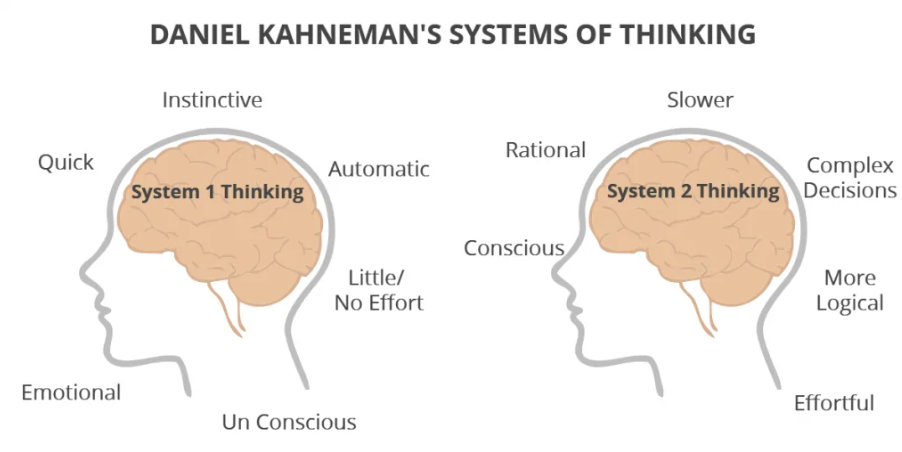
Daniel Kahneman’s bestseller Thinking Fast and Slowclaims that human decision making is subject to many follies, biases, and inherent human laziness. Daniel is also a Nobel Prize winner and is acknowledged as the father of the field of Behavioral Economics.

The basic idea of “Thinking fast and slow” is that we have two modes of thinking. The first mode is called System 1 (S1). This is intuitive in nature, it is emotional and acts automatically and quickly. It is based on mental rules of thumb (heuristics) and biases (cognitive). This system doesn’t involve much effort. It is often sloppy and wrong.

The second mode of thinking is System 2 (S2). This is rational thinking. In contrast to S1, this type of thinking is slow, deliberate and often requires significant effort. It doesn’t just go by intuition or gut but is more instilled in reason or logic. This thinking is often much more accurate or precise. As this type of thinking is effortful, the human brain has limited capacity for this kind of thinking.

Back to procrastination. Your System 1 thinking is created to protect you, and when fear arises, your nervous system will “kick in” to “defend you” through the subconscious. The irony is that we unknowingly train ourselves to dread some things by associating incorrect meanings with them. Nothing in life has any significance until you give it that significance. You physically “store” neurological connections to events in your nervous system so that you can act fast and efficiently the following time. Whenever anything happens to you, the way you describe the event to yourself gives it significance. Unconsciously, you’re continually trying to figure out what anything means, and at the most basic level, you’re trying to figure out if it implies pain or pleasure. This meaning is then stored in your subconscious mind, where it will later help you act (or re-act) properly. The problem is that when associations are reinforced, beliefs are formed that have a significant impact on your behavior and are frequently the source of procrastination.

Despite the fact that procrastination defies logic, it exposes a lot about your unconscious and self-imposed limitations and (in)abilities. Worry, primarily the fear that taking action would result in discomfort or a terrible experience of some type, is the leading cause of procrastination. Your unconscious mind mixes and searches its “files” to create a “link” that connects the action to an unpleasant event. This might be anything from a minor annoyance to something that is really painful. Even if you consciously desire to do something, your unconscious mind will stop you because it links the activity with pain. As humans, we instinctively seek comfort and will nearly always choose whatever seems most comfortable at the time. This is why you delay on chores that don’t feel good right now but will provide you a lot of joy in the future.

Learning (System 2) to fight against this drive for comfort is what leads to all of the essential progress for you to achieve actual success. When you consider procrastination as a gift in disguise, you may begin to exploit it and benefit from the behavioral insights it provides. Procrastination exposes your worries and, by design, provides the necessary resistance for you to expand and grow in your ability to push through your fears and build the lifestyle you truly desire. The amount of “discomfort” you can comfortably live with determines the quality of your experience. Procrastination may also shed light on the goals that you value the most, as your anxiety over postponing demonstrates that some part of you cares enough to be concerned.

It’s been stated that we shape our habits first, and then our habits shape us. This is also true of mental habits, and procrastination is frequently manifested as a regular pattern of thought. Your ideas influence and are influenced by your actions. Your behavior will “play the same song” every time, like the etched pattern on a record. Your connections with pain and pleasure play a significant role in determining what you will or will not do in your regular behavior. When your habit pattern is triggered, you create habitual thought patterns that drive you to automatically act or withdraw in specific ways.

In order to address the core cause of procrastination, you must be conscious of your associations with pain and pleasure. There are several symptomatic remedies that will not provide a long-term solution. Although willpower is required at first, the goal is to re-establish your associations with the tasks you are avoiding. If you can overcome your self-imposed anxieties and take action, you can be, do, or have anything your heart desires. Although the root of procrastination is in your subconscious mind, your conscious actions are ultimately in charge.

How the Pomodoro Technique Can Help You Get More Done

Do you wish you could get more done each day? Would you like to accomplish a lot without feeling exhausted when it’s time to go home? Over the years, several time management approaches have been created. Some of them are more effective than others. The Pomodoro Technique is one of the most well-known. This time management approach, which has been around for more than 30 years, uses alternating periods of work and brief breaks to optimize the amount of work you get done each day.

You’ll also be surprised at how good you feel at the end of the day!

Taking pauses on a regular basis allows your brain to rest and refresh. It’s lot simpler to stay focused and motivated when you know you’ll only be working for a short time. The method is effective for mental, physical, and creative tasks. The conventional Pomodoro routine consists of 25 minutes of work followed by a five-minute rest. After four cycles, you’ll need to take a 30-minute rest. What could be more simple?

Use the Pomodoro Technique to get more done every day:

1. Set a timer for yourself. Keeping one eye on the clock while attempting to complete your task is a mistake. Use a timer and place it where you won’t be able to see it. You may use your phone, computer, or a physical timer to do this.

  • You may find specialist apps for your computer or mobile phone. (I like ToDoIst) They take into account the amount of time you spend working, taking breaks, and taking extended breaks.
  • Using a timer is essential. It gives you a sense of urgency as well as the assurance that you’ll have a break shortly. Check out how much you can do in 25 minutes. You’ll be pleasantly surprised.

2. Experiment with different intervals to see what works best. Many people do well on a standard schedule of 25 minutes of work followed by five minutes of relaxation. Others are able to work for 50 minutes and take 10-minute breaks. Check out which option works best for you. You can get access to a cheat sheet below to help put this process to work for you!

  • You might discover that longer or shorter intervals work better for different jobs. It’s essential to try new things and be adaptable in your approach.

3. Take a longer break every two hours. This can last anywhere from 15 to 30 minutes. Moving around is a good idea. Take a quick walk or get a sip of water. This extended pause should not be skipped. It will be well worth it later in the day! You’ll have more energy and be able to maintain your attention.

4. Keep distractions to a minimum. Focusing carefully on the work at hand contributes to the technique’s effectiveness. Keep your thoughts on track since you’ll be taking a little break in a few minutes.

  • Make it clear to others that you do not want to be bothered. Remember, for the next 25 minutes, you won’t be doing anything except your task.

It’s as simple as that. Try it for a few days and see how much you get done and how much better you feel compared to your typical workday. The Pomodoro Technique will also improve your capacity to concentrate and focus.

Most individuals find this time management strategy to be quite helpful, and they feel much more refreshed at the end of the day.

This technique isn’t exclusive to work, try it at home as well. Set a timer for 25 minutes and see how much cleaning you can get done. The strategy may be used for homework and studying by your kids. You’ll discover that 25 minutes may do far more than you ever imagined.

Put the Pomodoro Technique to the test and discover how much you can accomplish each day.

Self-Reflection Questions:

  1. Do I manage my time efficiently?
  2. What can I do to get more done in less time?
  3. Can I delegate tasks that do not require my immediate attention?

If you would like a Pomodoro Technique Cheat Sheet simply leave a comment below and I’ll provide you a download link!

6 Simple Steps to Get More Out of Your Day

Photo by Glenn Carstens-Peters

Let’s face it – time is probably our greatest resource. We never seem to have enough of it and it seems to pass so quickly. Well we won’t get any more of it and we can’t slow it down.

What we can do is make the most of the time we have. Here are some simple steps you can take to get the most out of your day.

  1. Plan your day the night before – At the end of each day write out all the things you need to do the following day to achieve your goals. Pull together all the information you’ll need, phone numbers and relevant paperwork.  
  2. Prioritise the list – Number each item and do the harder jobs first. There’s always the temptation to do the easy jobs first. However, think how the thought of doing the hard jobs hangs over you as you do the easy stuff. Think how good you’ll feel when the nasties are out of the way and how motivated you’ll feel.
  3. Stick to your list – Check off each item as you go and avoid distractions. You don’t need to answer every email/text as they come in. Set a schedule to check your email/notifications once every hour, or whatever works best for you.
  4. Remember the Three “D’s” – Do it, Delegate it or Dump it. Handle each piece of paper only once. Either do something about it now, delegate it to someone else or throw it in the trash. And remember – “Only do it if only you can do it.”
  5. Don’t procrastinate – Procrastination really is the “Thief of Time” It’s so easy to put things off till another time or till “I’ve had time to think about it.” DO IT NOW!
  6. Plan your leisure time – Schedule out time for you to relax, workout, go shopping, whatever it is that you enjoy.

Be honest with yourself – Keep asking – “Is what I’m doing now getting me to where I want to get to?” if the answer is “no,” change what you’re doing

6 Different Types of Goals. Are you using them?

Sales leaders set goals. But they often set only one type of goal, and in doing so they set themselves up for failure. Here are different types of goals to set:

  1. Achievement goals – These describe results that you will have when you finish the goal. Examples include: retire with a million dollars at age 65, earn a promotion by June, increase sales by 5%. Most major goals are achievement goals.

2. Action goals – These describe specific actions that you will take to accomplish achievement goals. Examples include: meet with an investment counselor, attend a workshop to learn new job skills, contact all of the prospects in the database.

3. Layered goals – These specify the same goal with different levels of priority and difficulty.

4. Rate goals – These specify actions repeatedly done over time. Examples include: Read two books per month, exercise three times per week, or write in a journal every day. Many personal growth activities can be performed as rate goals.

5. Limit goals – These set boundaries. Examples include: Spend less than $5,000 on new equipment, go to bed before 10 PM each night, take less than 45 minutes for lunch while at work. These help manage priorities.

6. Exclusion goals – These state things that you will not do. Examples include: Do not watch TV after 8 P.M., do not use a cell phone when with other people, do not eat junk foods. These help you decide in advance which activities you will avoid.

Now that you know the six types of goals begin thinking about how you can incorporate these into your short and long term plans. Doing so will put you on a path to maximum achievement!

7 Strategies to Embrace Change at Work

Learning to accept change at work is critical to being successful in your career. Dealing with alterations to your normal work procedures can be frustrating, unwanted, and even scary, but change can bring many positive elements to an environment that has become stagnant.

What can you do to welcome change at your job with confidence?

Consider these suggestions to guide you towards embracing workplace changes with optimism:

  1. Why do you feel negatively about the change? Ask yourself what scares you or makes you angry about a recent change at work. Explore all the possibilities.
  • List your concerns. Maybe you think your job or paycheck is threatened. Perhaps you think that certain positions may be cut because of the change. Think through these concerns.
  • If you find that your concerns are legitimate, create a Plan B that you can implement in your worst-case scenarios.
  • Once you make an action plan, let go of anxieties about situations you can’t control and optimistically expect the best results that could happen from the change.

2. Remind yourself those in charge have good reasons for the change. You must trust that the people running the company are making the choice to change for a reason that will benefit the company.

  • Recognize that people in power have a picture of the entire situation. They have information that you might not have.

3. Help reduce workplace negativity about the change. Avoid lengthy discussions with co-workers about changes in the workplace, especially if your peers are focusing on negativity related to the changes.

  •  Some co-workers might be especially antagonistic about upcoming changes due to their own fears and insecurities. Realizing their less-than-positive comments spring from fear will help you refrain from participating in such conversations.
  • Make an effort to be understanding, but decline to share any thoughts that might be interpreted as negative about the changes.
  • Share thoughts about the positive results the change may bring.

4. Accept the change as part of your job. Recognize that an important aspect of your work is to support the management and carry out directives.

  • Simplify the situation for yourself by pledging to respect the changes and perform your duties as required.

5. Consider the new plans a challenge. Make a decision to face the change head-on and do whatever it takes to glean positive results from the new plans.

  • Show yourself that you can roll with the punches. The changes may even result in your adding some very important career experiences to your resume for the future.

6. Have confidence that you can handle any change. Remind yourself that you strive for excellence in your work, regardless of the situation.

7. Embrace the positive possibilities. Your work situation might actually improve because of the new changes. Even though it might take some time to experience, you’ll most likely see some positive results emerge from the adjustments in your work environment.

  • This could be a time of rejuvenation, renewal and newfound efficiency.
  • Be patient throughout the implementation process.
  • Allow yourself to expect your work situation to improve because of the changes.

Although changes at work might be scary and unwanted, open your mind to the possibilities of change. Put some of these strategies into practice if changes occur where you work. Yes, you can embrace change at work with positivity, confidence, and patience!

Slay Procrastination & Eliminate Distractions

You’re likely aware of the benefits of making a “to-do” list, and you likely have a list of actions that make up your day. Even for the most seasoned to-do list users procrastination and distractions are the silent killers of productivity. If you’ve found yourself procrastinating or getting easily distracted throughout the day, it may be time to make a “not to-do-list”.
 
This simple exercise helps you STOP doing things that slow you down or get in the way of you achieving your goals. You may already have an idea of things you could stop doing. Use this tool for a one-off ‘efficiency boost’ or complete it monthly to refocus and refine your time management.

Feel free to use the download link below to get your exercise template.

*The download removes the watermark