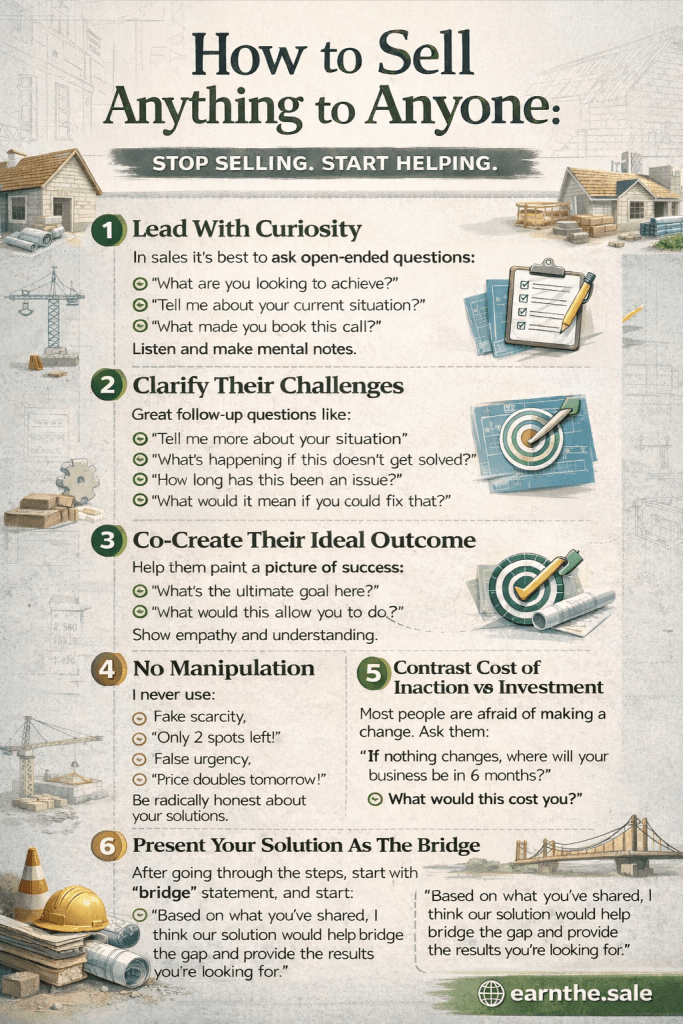
6-Step Consultative Process
I recently caught a clip of Chris Rock riffing on relationships. His message? “It’s about serving each other.” That got me thinking: isn’t sales really just a (hilarious and sometimes complicated) relationship, too?
In sales, we all know it’s rarely about who has the best product or the slickest pitch; it’s about building relationships and showing up for each other. Here’s how great sales mirrors great relationships:
At the end of the day, great salespeople know their role isn’t just to sell but to serve. Build the trust, understand their goals, and—yes—make them laugh. That’s how relationships last, and we could all use a good laugh right now.
When it comes to negotiations, buyers often try to push for lower prices to maximize their own gains. As a seller, it’s important to be aware of the tactics buyers use and to develop effective strategies to navigate these situations. In this article, I will explore the five most common ways buyers negotiate lower prices and provide insights on how to respond as a seller. Whether you are in sales or simply interested in understanding the dynamics of negotiation, this article will equip you with valuable knowledge to achieve win-win outcomes.

Buyers often employ the “one last request” tactic to secure a final concession from the seller. This tactic occurs at the end of a negotiation when the buyer requests one additional change to seal the deal. The effectiveness of this tactic lies in the seller’s eagerness to close the sale and their willingness to make a final concession in exchange for the buyer’s signature.
To effectively counter this tactic, sellers should remain diligent in evaluating the value of the requested change and considering whether it aligns with their pricing and objectives. It is essential to communicate the rationale behind your decision and signal that you understand the buyer’s request without compromising the overall value proposition.
The “Flinch Test” tactic involves buyers insisting that the seller’s price is too high and demanding a better offer. This tactic is often used regardless of the circumstances and aims to evoke a concession from the seller solely based on a price reduction.
As a seller, it is crucial to resist the temptation to immediately concede to price demands. Instead, focus on highlighting the unique value your product or service offers and the reasons behind your pricing. Demonstrate the differentiation and benefits that set your offering apart from competitors. By emphasizing the value proposition, you can shift the negotiation away from pure price discussions and towards mutually beneficial outcomes.
Buyers may suggest “splitting the difference” as a negotiation technique, portraying it as a reasonable compromise. However, sellers must be cautious, as meeting in the middle may not always result in a fair outcome for both parties.
To navigate this tactic, sellers should focus on rationalizing their pricing based on the value provided. Engage in open discussions with the buyer to understand their concerns and identify alternative concessions that align with the overall value proposition. By showing a willingness to collaborate while safeguarding your pricing, you can establish a partnership based on transparency and shared benefits.
Sellers want to be seen as reasonable. They want to create a partnership. When buyers say, “Why don’t we meet in the middle?” there’s an emotional appeal of showing good faith by splitting the difference.
Mike Schultz, Rain Group
The “anchoring” tactic involves buyers sharing a low budget early in the negotiation to set the stage for further bargaining at a reduced price. By presenting a low anchor, buyers aim to influence sellers to provide lower estimates and increase their chances of securing a better deal.
Sellers must be aware of anchoring effects and the cognitive bias associated with the first offer in a negotiation. It’s crucial to understand the buyer’s budget and pricing expectations while highlighting the unique value your product or service brings. By framing the conversation around the value derived from your offering, you can counteract the anchoring effect and build a foundation for discussions based on the benefits your solution provides.
Buyers often use time-pressure tactics, such as presenting an offer within a tight timeframe or hinting at engaging with a competitor. These tactics aim to create a sense of urgency and scarcity, pushing sellers to make concessions quickly.
To counter time-pressure tactics, sellers should remain composed and analyze the situation objectively. Evaluate the buyer’s timeline and ensure you have a clear understanding of the value your product or service brings to the table. Demonstrate confidence in your offering and focus on the long-term benefits rather than succumbing solely to short-term pressures. By communicating the value and emphasizing the partnership potential, you can mitigate the effects of time-pressure tactics and maintain control over the negotiation process.
Negotiations are a crucial part of the consultative sales process, and understanding the tactics buyers employ can significantly impact your ability to secure favorable outcomes. By familiarizing yourself with the five most common ways buyers negotiate lower prices and developing effective responses, you can position yourself as a strategic partner who emphasizes value creation and mutual benefits.
Remember, negotiations should always strive for win-win outcomes where both parties feel satisfied with the agreement reached. By employing strategies that focus on highlighting the value of your offering and fostering open communication
Q1: How can sellers effectively respond to the “One Last Request” tactic?
In response to the “One Last Thing” tactic, sellers can employ Chris Voss’s technique of labeling, introduced in his book, “Never Split the Difference: Negotiating as if Your Life Depended on It”. Labeling involves acknowledging the buyer’s request and labeling it as legitimate while reframing it to gain perspective.
For example, respond with, “I understand that this is important to you, and I can see why you’d want this. Let’s take a step back and explore how this change aligns with the overall value we’re providing.”
Q2: What strategies can sellers employ to counter the “flinch test” tactic?
In dealing with the “Flinch Test” tactic, sellers can apply Chris Voss’s technique of mirroring. Mirroring entails repeating the buyer’s words or the last few key words to encourage further elaboration and create a collaborative atmosphere. By saying, “So you’re looking for a better price?”, sellers gather more information and show a willingness to understand the buyer’s perspective. This allows for a more thoughtful response rather than immediately conceding to price demands.
Q3: Are there situations where buyers’ negotiation tactics can be beneficial for sellers?
Yes, there are instances where buyers’ negotiation tactics can be advantageous for sellers. Chris Voss explains the importance of utilizing and adopting a mindset of “tactical empathy”. Through active listening, sellers can uncover the underlying motivations and concerns driving the buyer’s negotiation tactics. By understanding these factors, sellers can adapt their approach to address the true needs of the buyer and arrive at a mutually beneficial outcome.
Q4: How can sellers effectively respond to time pressures buyers use by leveraging competitive research?
An accusation audit, a technique introduced by Chris Voss, can be a powerful tool in negotiations. Instead of shying away from potential criticisms or concerns, the accusation audit allows sellers to address them head-on.
For example:
Buyer: “I’m meeting with your competitor this afternoon, and I’m sure they can do better. Is that the best you can do?”
Seller: “It sounds like you believe our price is too high and that we may not be offering enough value for the investment. I can understand why you might think that, as there are many options on the market. However, I’d like the opportunity to highlight the unique benefits and superior quality/service we provide.”
By leading with a statement that acknowledges the buyer’s concern or accusation, the seller demonstrates empathy and shows a willingness to address potential reservations. This can lead to a more open and constructive dialogue, allowing both parties to explore ways to create value and find a mutually beneficial solution.
Ready to take your sales game to the next level?🚀
Don’t miss out on exclusive tips, insights, and strategies to boost your sales and sales leadership skills! Hit the subscribe button and join a community of sales enthusiasts like yourself!
📩 Stay up-to-date with the latest blog posts, packed with practical advice and real-world examples that will help you close more deals and inspire your sales team.
🔗 Want more valuable content? Check out the library of articles for a treasure trove of sales wisdom just waiting to be discovered. From prospecting techniques to negotiation tactics, I’ve got you covered!
👍 If you found this article helpful, give it a thumbs up and share it with your network. Help spread the word and empower others to achieve sales excellence!
Remember, success in sales starts with knowledge and continuous learning. Don’t miss out—subscribe, explore, and share today!
If you want more tips & techniques for negotiating, then subscribe & leave a comment on this post. I’ll email you my new E-Book as a bonus: Negotiate Like a Pro…And Get What You Want More Often


In continuation of the 5-week Daily Plan series, this blog post aims to provide specific tactics for building strong relationships with customers in sales.
Readers will learn practical strategies to understand customer needs, establish rapport, personalize interactions, follow up after a sale, and leverage digital channels for customer engagement.
I’ll continue breaking down the topic into specific tactics for each day of the week.
Day 11: Actively listen to understand customer needs and pain points.
Task: Actively listen to customers.
Over the last 15 years, I have averaged three to four ride-alongs a week. That would be around 2,800 sales appointments where I have witnessed a sales rep in action, with a portion of those having me actively involved in the sales interaction. In this time, there have been reoccurring themes with many new and old (by tenure) sales professionals. One that I’ll focus on for the purpose of this article is a rep’s excitement to talk about their company, product, or service before truly understanding and acknowledging a customer’s need or existence thereof. Many assumptions are made early in sales interactions, and it’s these assumptions that lead to many stalled sales and ineffective sales calls.
On one particular sales call, Mark was a new rep selling in the B2B space for a small local company. He was able to get a meeting with a CEO that had been on his target list. During Mark’s call to the CEO to get a discovery appointment set, the CEO remarked that he was currently using a larger competitor that initially offered a lot of resources for his growing business. In preparing for this meeting, Mark expressed his concern about being a smaller player in his space when the prospect had many other bigger companies to select from. Mark built his initial conversation around giving this prospect the impression that his company was far larger and could compete with as much agility as his competitors. At the end of the meeting, the CEO thanked Mark for his time but went on to share that they previously worked with a larger firm and felt ignored due to the perception that the CEO’s company wasn’t as large, thus less important, and didn’t receive the attention he felt the company needed.
In my coaching conversation afterwards, I asked Mark where his belief is that being a smaller competitor equates to being disadvantaged. Mark stated he’s gotten that objection from other prospects and assumed this CEO would have felt the same. Voila, an inaccurate assumption was carried into a conversation where the conversation was built around Mark’s company and capabilities rather than a conversation focused on the problems and needs of the customer. This miss was that Mark didn’t engage the CEO on whether he felt better served by a larger firm or even if that was a requisite for choosing another provider. By engaging and actively listening to customers, sales professionals can gain a deeper understanding of their needs and pain points, leading to more effective solutions.
Take-away: Actively listening helps sales professionals uncover valuable insights and tailor their approach to meet customer needs.
Application: There are numerous resources and sales conversation templates available, and I won’t go into great detail outlining specific sales methodologies.
For a list of resources, visit a previous post here
However, a lot of bad sales calls and conversations could have been prevented with a process of pre-call planning. Below is a sales call checklist from Rain Group that I have personally used and trained other sales reps on how to use.

By focusing on the questions above, a rep can be better prepared to focus solely on the buyer and the impact of the problems they are experiencing. Acknowledging relative strengths and weaknesses prior to an important sales call can eliminate negative emotions driven by being caught off guard and will help deliver a professional conversation.
Day 12: Build rapport with customers and apply techniques in sales.
Task: Build rapport with customers.
Oftentimes, during a ride-along, I have a skills analyzer where I take notes on important aspects of the conversation and points of the sales call. Typically, before the ride-along, I have determined a specific area on which I’ll be focusing based on prior coaching conversations. This prevents me from having to detail an entire conversation and keeps me honed in on what the customer may be saying. If I’m on a ride-along for the first time with a rep or listening in on a prospect call, there is typically only one thing that I am paying attention to, and that is the rep’s ability to build rapport. Now granted, not every prospecting call will give a rep time to build good rapport, but there’s usually an opening to do so at some point in the conversation.
A common mistake that I see reps make is that they are so excited to have an opening to discuss their company, product, features, and benefits that they completely overlook the importance of establishing rapport with the prospect. Depending on the type of selling (transactional vs. consultative) that is taking place, it will determine how much rapport may be needed. Building rapport can happen at the beginning of the conversation or throughout, but make no mistake, people will often buy from people that they like. All things being equal, the rapport that is built may determine who a prospect selects.
For building rapport, I like to follow a simple acronym: F.O.R.M., where F stands for family, O stands for occupation, R stands for recreation, and M stands for message. Using a bio page on the company’s website, social media profiles, or recent company announcements are all great resources to use in finding context clues on what may be good to build rapport on or around. Doing a little research can prevent rapport from seeming like small talk and make it more productive. A good rule of thumb that I’ve found over the years is that when a prospect begins asking questions about you, it’s a good sign that you have built good rapport so far in the conversation.
Another important aspect of building rapport, outside of establishing a connection, is that during the process of building rapport, a sales professional can begin to determine the personality style of your prospect. Getting training on personality assessments such as the DISC, Hermann Brain Dominance Instrument (HBDI), or Predictive Index can be really useful in picking up additional context clues on how to communicate with the prospect. Many sales managers understand the importance of these assessments in hiring talent but fall short in training sales reps on how to use these same tools in adapting communications with high value clients. This article will not service to be an exhaustive description of these tools or how to apply them in conversations, but more so to reinforce the usefulness of these tools in the context of rapport building and facilitating better sales conversations. For example, below will be a description of the DISC profile with tendencies and behaviors.


Takeaway: Building rapport helps sales professionals establish trust, understand customer preferences, and adapt their approach accordingly.
Application: Sales professionals should show genuine interest, use active listening skills, find common ground, use positive language, and adapt their communication style to match the customer’s preferences.
Day 13: Personalize interactions to make customers feel valued and understood.
Task: Personalize interactions with customers.
According to The Salesforce State of Connected Customers Report, which polled over 6700 consumers and business buyers, 72% of business buyers expect vendors to personalize engagements to their needs. In fact, 67% of B2B buyers have switched to vendors who provide a more consumer-like experience. Early in my selling career, I worked for a national training provider. I called on C-level executives, HR managers, and senior department managers. My goals were to understand the specific staff development issues and sell either an off-the-shelf course or customize a course that addressed the specific needs of the employees. This was before online training had really taken hold, and many companies relied on in-person training for all of their staff development. There are common issues that face all teams and companies that span change management, transitioning from contributor to manager, dealing with difficult people, and many others. The point is that it is really easy to take a cookie-cutter approach to discussing these issues and how they affect all employees. However, at the same time that I was working at this company, I was taking college courses at night in an effort to complete my degree. One of my courses was in finance and accounting. During this course, an assignment was to look at the accounting statements of publicly traded companies. My territory at this time was San Francisco, and I had many high-profile clients with whom I was able to pour over their financial statements. I ordered all of my top 20 clients 10-K reports and began familiarizing myself with all of their financial statements, many of which contained forward-looking statements. This gave me the insight and ability to tie the financial numbers to department goals and employee development. Personalized interactions go beyond just getting the correct name for the “to” line in a cold email campaign. Understanding customer issues and personalizing your conversation to the customer will enhance their experience, making them feel valued and understood.
I am not suggesting that you need an accounting degree or an advanced understanding of financial statements; this was just an example of how I began personalizing my outreach to a customer base at that time. Some readers will not have access to this level of information on a potential customer; however, that does not mean that information cannot be found to personalize communications. Any Google search today can just about get you all of the information you need on a business or contact within a company. A great exercise to deepen your level of personalization is to use “Mackay 66“, developed by author, sales professional, and business owner Harvey Mackay. He details 66 questions that sales professionals should know about their customers. Since trust and loyalty are built over time, a sales professional can use these questions to broaden customer relationships.
Takeaway: Personalization fosters stronger customer relationships and increases customer loyalty.
Application: Sales professionals should use multiple resources to learn more about their customers, tailor recommendations, remember previous interactions, offer customization, and express appreciation for the customer’s business.
Day 14: Follow up with customers after a sale for satisfaction and long-term relationship building.
Task: Follow up with customers after a sale.
Never underestimate the impact a quick post-sales follow-up can have. The level of follow-up will vary depending on the product or service that is being sold, but post-sale follow-up is nonetheless important. For lower-ticket, high-transactional sales, it might only require a thank-you card or a brief phone call thanking them for their business. When an on-going service or system is sold, whereas there will be ongoing purchases or usage of a product, it is important to understand that a change is the “way of doing things” is taking place. Oftentimes, this will involve changes within multiple areas of the business, from onboarding new employees, changes in purchasing, field implementation, and IT deployment, among many others. While many of these areas can be discussed during the purchase process, it’s important to schedule follow-up touch points post-sale to keep a pulse on how these potential roadblocks affect a positive customer experience.
Takeaway: Post-sale follow-up ensures customer satisfaction, addresses concerns, and strengthens the customer relationship.
Application: Sales professionals should send personalized thank-you notes or emails, check in with customers, address concerns promptly, offer post-sale support, and maintain regular communication.
For a list of 40+ Email Templates for Thanking, Upselling, Onboarding, & Account Handoffs, leave a comment below “templates” and I’ll send to your inbox
Day 15: Leverage social media and digital channels for customer connection and engagement.
Task: Leverage social media and digital channels.
It is highly likely that readers of this blog have found it via a social media post; therefore, it would not be necessary to describe the importance of social media today and how useful it can be. However, I will say this: I am shocked to this day at how many people I run into don’t utilize social media for prospecting, networking, competitive intelligence, and customer engagement. Those who are currently using social platforms have an opportunity to improve, and that is a topic that I am currently doing a lot of coaching around. Those who recognize the importance but haven’t taken the leap in leveraging social media are an area in which I have developed a course to help sales professionals begin developing their personal brand and profiles. If that is something that interests you, feel free to reach out, and I would be happy to schedule a call to discuss. Utilizing social media and digital channels allows sales professionals to connect with and engage customers on platforms they frequent.
I have numerous examples where I have leveraged social media to close deals, network with dream accounts, engage with new customers, and build a network of referral partners. The numbers on social media today prove that it is no longer a fad. It is imperative that businesses have social media accounts, and their engagement with customers is a differentiator.
If you go to Google and search for all the different ways to grow your business and get clients, you’ll get thousands of different results telling you hundreds of different ways to get clients.
A great way to expand your customer base is by using social media platforms. Customers can easily connect with you and others who have similar interests, and it’s simple to keep them updated on what’s happening with your business. And tons of other inbound and outbound methods.
Not all social media are created equal. And if you’re in the business-to-business (B2B) space, there is one platform that reigns over all the others: LinkedIn.
LinkedIn is the premier B2B social media platform. And it is the best B2B platform because it did not start out as a social media platform. However, it has evolved over the years to become a powerful social media platform for businesses.
LinkedIn is not just another social media platform for you to connect with your friends and your family or to post pictures of your latest vacation. LinkedIn is designed to be a business networking tool.
Because of this, the users that engage on LinkedIn are usually high-income individuals. On average, people who use LinkedIn make more money than those using other social media accounts, and they’re much more likely to be receptive to any sort of business proposal.
LinkedIn is widely known as a platform to learn business secrets and sell/purchase services that help businesses grow. Therefore, LinkedIn is the perfect place to acquire new clients, as it is more accepted than other social media platforms such as Facebook, Instagram, or Twitter.
In a 2020 RAIN Group Center for Sales Research study of close to 500
buyers, they learned that the overwhelming majority—82%!—will look
up a seller on LinkedIn before replying to a seller’s prospecting efforts.
Compare that to back in 2005, when sellers told us social media
wasn’t important because enterprise-level decision makers couldn’t
be bothered using it. How times have changed!
Whatever means you use for prospecting, or any aspect of virtual
or face-to-face selling, know that eight out of every 10 buyers are
vetting you on LinkedIn before deciding whether to respond to you.
Reaching out to the C-level?
You may be surprised to learn the C-level is more likely than others to
connect with you on LinkedIn—even when they don’t know you.


Takeaway: Leveraging digital channels expands the reach and engagement with customers, boosting sales opportunities.
Application: Sales professionals should create an active presence on relevant social media platforms, share valuable content, respond promptly to customer inquiries, encourage feedback and reviews, and utilize targeted advertising or promotional campaigns. The goal is to move from a mindset of social media to social selling. My advice would be to start with LinkedIn, as it can be extremely beneficial for your business, but first you have to put in the work. It may seem like a lot at first, but if you just sit down and get started, you’ll see how easy it is. Follow the steps we talked about in this guide, and LinkedIn will help take your company to new heights.
If you would like some 1-on-1 guidance on setting up your profile, do’s & don’ts, networking tips, working with LinkedIn groups, and content creation, reach out to me personally, and I can set up a session or invite you to a live webinar.
By following the tactics outlined in this blog post, sales professionals can effectively build strong relationships with their customers, understand their needs, and enhance customer satisfaction and loyalty.
Stay tuned for a follow-up post breaking down the strategies and tactics for Week 4. Improve your communication skills: Effective communication is the key to successful sales. Till then, I hope Week 3 brings a new level of confidence and focus on your path to finishing 2023 BIG!

Over the next 5 weeks, I will be following up on a post that I made here and diving deeper into each weekly and daily objective. My hope is that this helps you on your sales journey to finishing BIG for 2023 and beyond!
Week 2: Developing a Sales Plan
Day 6: Identifying Your Target Audience and Their Pain Points
Task: Define your target audience and understand their pain points and challenges. Develop strategies to address these pain points effectively with your product or service.
Mark, a sales professional that I recently had the opportunity to work with in the tech industry, realized that his target audience was small businesses struggling with outdated software systems. I encouraged him to conduct more targeted research, and he found that these businesses were facing productivity losses due to system crashes. He tailored his sales approach to focus on how his software solution could alleviate this pain point and improve their efficiency. Prior to this exercise, Mark was leading with his product features and capabilities, rather than asking good questions around a defined buyer persona.
Oftentimes, buyer/user personas have been defined by marketing departments, as this guides where investments are made and where to find the appropriate audience. I’ve worked with some companies where there was a disconnect between marketing’s idea of who an ideal customer is, and what sales finds in the field. This is why it is imperative that marketing and sales keep open lines of communication to drive efficiencies in marketing dollars and put sales in a better position to pull the right customers through.
Takeaway: Understanding your target audience’s pain points allows you to position your product or service as a solution to their problems, increasing the likelihood of successful sales interactions.
Application: Create buyer personas that outline your ideal customers’ characteristics, challenges, and goals. Develop messaging that directly addresses their pain points and offers solutions.
Day 7: Crafting Your Unique Selling Proposition (USP)
Task: Define your unique selling proposition (USP) and devise strategies to effectively communicate it to potential customers.
There’s quite a bit of research and work to come up with a viable USP, which takes more time than I’ll cover here. However, defining your target customer and then composing your USP will make a big difference in your results. For example take Laura, a sales representative for a small business services firm located in Kansas City, discovered that her USP was the use of organic cleaning solutions, cruelty-free ingredients. She incorporated this into her sales conversations and marketing materials, highlighting how her products aligned with customers’ values.
Takeaway: A compelling USP sets you apart from competitors and gives customers a reason to choose your product or service.

Application: Craft a concise and compelling USP that highlights what makes your offering unique and valuable. Incorporate it into your sales pitches, presentations, and marketing materials.
Day 8: Tailoring Your Sales Approach
Task: Develop a flexible sales approach that can be tailored to different types of customers and various situations.
The initial approach is much different than the sales presentation. The latter is always tailored to a prospect’s unique problems and needs. The sales approach is much earlier in the process and is what leads to getting an appointment or at least an agreement to spend more time with the prospect. James, a sales professional selling office furniture, realized that his approach needed to differ when dealing with small businesses (typically less than 50 employees) versus larger businesses (typically businesses with 100–1000 employees). For small businesses, he focused on cost-effectiveness and scalability, while for larger businesses, he emphasized quality and customization.
Takeaway: Adapting your sales approach based on your audience’s preferences and needs enhances your ability to connect and resonate with potential customers.
Application: Create multiple sales scripts or approaches that can be customized for different customer segments or scenarios. This ensures you’re prepared for a variety of interactions.
Day 9: Utilizing Data and Analytics
Task: Incorporate data and analytics into your sales plan. Leverage insights from previous sales performance and customer behavior to inform your strategies.
The opposition to using a CRM system as a sales tool rather than a repositor for useless data still baffles me. Granted, some sales managers do not help with some of the mandates for information to be included, as the problem with this approach is that it often leads to putting garbage in thus getting garbage out. My recommendation to inputting account info into a CRM is to use what I call the W.I.N. method. A simple acronym that helps with putting information in that is useful and actionable.
Takeaway: Data-driven decision-making allows you to fine-tune your strategies and focus on what works best for your audience.
Application: Regularly review sales data to identify patterns and trends. Use these insights to refine your approach, allocate resources effectively, and identify areas for improvement.
Day 10: Reviewing and Updating Your Sales Plan
Task: Establish a process for consistently reviewing and updating your sales plan to ensure its ongoing relevance and effectiveness.
Takeaway: A sales plan should be dynamic, evolving with changes in the market and your customers’ preferences.
Application: Set up regular checkpoints to evaluate your sales plan’s performance. Consider factors such as market trends, customer feedback, and competitive landscape to determine necessary updates.
Developing a well-defined sales plan is essential for maintaining focus and organization while pursuing your sales goals. By identifying your target audience’s pain points, crafting a compelling USP, tailoring your sales approach, leveraging data and analytics, and regularly reviewing your plan, you can stay adaptable and effective in a dynamic sales environment. Remember that a successful sales plan is not a static document but a living strategy that evolves to meet the needs of your customers and the market.
Stay tuned for a follow up post breaking down the strategies and tactics for Week 3: Building Relationships with your Customers. Till then, I hope Week 2 brings a new level of confidence and focus on your path to finishing 2023 BIG!
Successful managers and salespeople alike are constantly looking for new opportunities. They are confident in their product and their consumers’ ability to purchase it, and they are aware that tough economic times present opportunities that aren’t present in more prosperous times.

It just makes sense that your advertising will generate less of a return than it would during an economic boom when the economy takes a turn for the worse. Of course, less money is being spent, but that doesn’t mean you have to see your profit margin shrink!
Just like you, advertisers are suffering from the recession, which has made them more desperate for customers. Even when you are already receiving a good bargain, the environment is ideal for negotiating your way to a lower price. For instance, if you have been paying an agency fee, rather than a flat fee, can you negotiate a percentage of revenue from sales driven by the agency’s efforts? This saves you the initial outlay of cash and gets your agency to have “skin” in the game. You will profit from the products by that much more for every up-front advertising dollar you can save.
Have you considered obtaining free publicity? Newspapers in your area are constantly looking for local news. Create news! Publicity is often free, but it’s a great way to expose your company to potential customers. If you have a new service offering or a new product line, use free resources like openpr.com (there are many others) to generate activity online that can be linked to and is SEO-friendly.
Is the size of your advertisements truly necessary? We have a tendency to believe that bigger is better, but the truth is that ads with 11 words or fewer frequently get more attention than longer ones. Try it out to immediately cut some expenses from your advertising budget. Additionally, is there a complimentary business or product to yours that you could co-op advertise together?
During a downturn, not all of your clients experience hardship. It is common for many managers and salespeople alike to believe that consumers will begin to lean more towards cheaper products when times are tough, and that couldn’t be further from the truth. Don’t fall into the trap of thinking that you have to discount your product or service to stay ahead. Keep in mind that if you discount prices by 10% (assuming you’re at a 30% gross margin), you would need to sell 50% more units to maintain the same gross profit dollars. When considering a discount, always look at the other side of the equation to evaluate if you have the capacity, inventory, and capital to increase sales volume by an additional X% to maintain profit margins. Many consumers will evaluate risk differently during a downturn, and if your product is more expensive but a “safer” option, then don’t shy away from offering larger ticket items. Consumers who have a lot of faith in your products and services will also appreciate them much more in times of financial difficulty.
3. Increase Your Customer base.
Your clients are already aware of your excellent products and friendly customer service. They have faith in you to deliver for them. Consider this: Selling to someone you already have a relationship with is considerably simpler.
Take advantage of every chance to boost sales among your current consumer base. Do you sell a product to complement the one they’re buying? Toss it their way at the time of sale—think of it as “super sizing” their order. It is a tried-and-true strategy for boosting sales. The additional sales you can make from customers who currently do business with you might astound you.

Staying motivated during down sales months can be challenging, but it’s important to remember that every sales professional experiences highs and lows in their career. The key to success is to develop a consistent sales strategy and continuously work to improve your sales techniques. Below, I have outlined a 5-week plan with objectives broken down into daily action items:
Week 1. Set clear and specific goals: Create measurable goals that are achievable and align with your overall sales strategy. This will help you stay focused and motivated even during the downswing months.
For a deep dive into Week 1 tactics and strategies, visit my post here
Week 2. Develop a sales plan: Create a sales plan that outlines your target audience, sales approach, and key metrics. This will help you stay organized and focused on achieving your sales goals.
For a deep dive into Week 2 tactics and strategies, visit my post here
Week 3. Build relationships with your customers: Building strong relationships with your customers is essential for long-term success in sales. Focus on understanding their needs and pain points, and offer solutions that address their specific challenges.
For a deep dive into Week 3 tactics and strategies, visit my post here
Week 4. Improve your communication skills: Effective communication is key to successful sales. Work on improving your listening and communication skills, and focus on building rapport with your customers.
For a deep dive into Week 4 tactics and strategies, visit my post here
Week 5: Continuously learn and adapt: The sales industry is always changing, and it’s important to stay up-to-date with the latest trends and techniques. Attend sales training programs, read industry publications, and seek feedback from your colleagues and customers to continuously improve your sales approach.
Remember that sales success takes time and effort, and it’s important to stay motivated and focused even during the down months. With the right approach and mindset, you can achieve your sales goals and build a successful career.

Selling home improvements can be a lucrative business, but it can also be challenging, especially during times of economic uncertainty. With many homeowners tightening their belts and cutting back on expenses, it can be difficult to convince some to invest in home renovations. However, with the right sales techniques, you can still close deals and grow your business even during a recession.
Here, I’ll share some of the top recession-proof sales techniques for selling home improvements to homeowners. From building trust to offering financing options, we’ll cover everything you need to know to close more deals and thrive in a challenging market.
One of the most important things you can do as a salesperson is to build trust with your potential customers. Homeowners want to work with someone they can trust to do a good job and not take advantage of them. In a recession many businesses will be cutting costs in an effort to lower prices and in doing so quality can suffer. In a race to the lowest price, homeowners are willing to pay more for companies they can trust. Here are some ways to build trust with your customers:
By building trust with your customers, you’ll be more likely to close deals and earn repeat business.
During a recession, many homeowners may be hesitant to spend money on home improvements, even if they’re necessary. Offering financing options can help make your services more accessible and affordable. This is another area where some business will see financing as an expense and look for cost-savings by either limiting financing options or eliminating them. Here are some financing options you can offer:
By offering financing options, you can make your services more accessible to a wider range of customers and increase your chances of closing deals.
Creating a sense of urgency can be a powerful sales technique, especially during a recession when customers may be more hesitant to spend money. Here are some ways to create a sense of urgency:
By creating a sense of urgency, you can encourage your customers to act quickly and increase your chances of closing deals.
Homeowners may have objections to investing in home improvements, especially during a recession. Here are some common objections and how to overcome them:
“It’s too expensive”: Offer financing options or emphasize the long-term benefits of the investment. For products or services that have a strong return on investment, whether through greater resale value or energy-savings, long-term financing options let these homeowners offset the initial costs through a low cost of ownership.
“I don’t have time”: Emphasize the convenience and time-saving benefits of your services. You can also work with the customer to create a timeline that works for them.
“I’m not sure it’s necessary”: Emphasize the potential cost savings and energy efficiency that come with home improvements. You can also provide references or testimonials from previous customers who have seen the benefits of your services.
By addressing objections and providing solutions, you can help your customers overcome their reservations and close more deals.
Upselling and cross-selling can be effective sales techniques for increasing the value of each sale. Here are some tips for upselling and cross-selling:
Offer complementary services: If a customer is interested in one service, offer a related service that complements it. For example, if they’re interested in a window replacement, offer to also update their entry door as well.
Suggest upgrades: If a customer is considering a certain product or service, suggest an upgraded version that offers more features or benefits.
Large project discounts: Offer discounts for jobs that keep crews busy and reduces downtime to encourage customers to invest in larger projects.
By upselling and cross-selling, you can increase the value of each sale and grow your business.
Selling home improvements during a recession can be challenging, but it’s not impossible. By building trust, offering financing options, creating a sense of urgency, overcoming objections, and upselling and cross-selling, you can increase your chances of closing deals and growing your business. Remember to be honest, transparent, and customer-focused throughout the sales process, and you’ll be well on your way to recession-proof success.

Remember what it was like courting your spouse? It’s likely that you didn’t propose on your very first date! A two-way interaction develops before reaching the church doors. Much like dating, in selling, if you want the fulfillment of a life-long customer, you can’t rush it.
It takes time and effort to get to know your customer. While every customer is unique in personality, likes and dislikes, there are some constants that sellers may leverage. Give them what they want, and they’ll become devoted, lifelong clients.
1. Forget Selling… Focus on Buying
One of my favorite selling mantra’s is from Jeffrey Gitomer in which he states; no one likes to be sold, but everyone loves to buy! People want to imagine they make all their purchases based on their own brilliant ideas and savvy purchasing. No one likes a pushy salesperson. A salesperson who “HELPS” their customer find the best deal is a hero.
When a customer enters into conversations with you, they are probably already planning to buy something. You don’t have to sell them. You may relax and just assist them in making the greatest buy decision.
Focus on the customer’s needs. Consider… what rewards would she seek? What is his budget? Remember that you are there to help, not to persuade. By doing so the stress is gone!
2. Buy A “Sure Bet”
There are always risks associated with buying, or at least an opportunity cost. The higher the price, the greater the perceived risk! Yes, a customer is seeking a product that meets his wants and needs. Always remember that internally the customers is asking themselves, “Is it worth it?”.
It’s a valid question. The world is full of scams where you spend money on junk that doesn’t last and can’t be maintained. Or a previous salesperson has overpromised on what their service or product could provide. A few hard lessons make people weary of impulse purchases. They want something reliable.
A “no risk” guarantee helps negate many customer fears. They may relax knowing that if the goods do not live up to expectations, they won’t be stuck paying for a dud. If you’re in a business where providing a money-back guarantee isn’t realistic, then explain that you’re in the business of making it right and that is what they are paying for in choosing you.
Customer testimonials also show “potential” customers that you truly work towards customer satisfaction. No one can say it better than a happy customer, but don’t overuse them. Choose precise and detailed testimonials, and provide as much about the consumer as you can to bolster their credibility. Do you have a customer that initially had a bad experience, but you turned it around? Don’t hesitate to ask them to detail their experience in a testimonial.
3. Assure Them It’s A Simple Process
Review your sales process and evaluate if it’s too complex. Yes, your stressed-out clients can experience buyer’s fatigue. One of my favorite examples of simplifying the buying process is the convenience store Quik-Trip. A few years ago they embarked on a multi-store remodeling initiative to where now every Quik-Trip you enter is exactly the same. I know precisely where my favorite protein bar is whether I’m in Oklahoma, or Kansas. Make sure you process is customer friendly, not company compliance friendly.
Any darn fool can make something complex; it takes a genius to make something simple. — Albert Einstein
When developing your selling strategy, don’t forget to highlight your product or services convenience. Value isn’t everything. With a little knowledge, you may easily attract your dream customer. Keep these three strategies in mind as you work to increase your business and client base, and watch your revenues skyrocket.

Selling may be one of the most lucrative and exciting careers in the world when you’re closing sales and hitting your sales targets. However, if sales are down and prospects aren’t returning your calls, you may begin to doubt yourself and take it personally. So, let’s look at what it takes to stay motivated in order to bring in additional clients.
In order to get more clients and expand your business, follow these three steps.
1. Identifying and cultivating new customers.
2. Investing more time and effort into existing customers to increase referrals and business.
3. Making contact with higher-level decision-makers in order to gain larger deals.
As a sales professional, we recognize the significance of reaching these goals. Why, then, do so many sales professionals struggle to get over the first hurdle? It appears that, as much as we want to succeed in sales, we also want to avoid rejection while calling on prospects and customers.
Let’s take a look at how rejection affects sales performance. Fear of rejection and failure might make you lose your excitement, confidence, and initiative. When you are rejected, it can be damaging to your ego. You may get disillusioned, upset, and defensive if you take the negativity personally.
We may take rejection personally for three reasons. Each of them is linked to one of the three goals. They are as follows:
Frequency: Studies have shown that reaching decision makers takes at least five attempts or more. You may be irritated, disheartened, and uncertain of yourself if you’ve been calling prospects all week and they haven’t responded. It’s difficult not to take it personally and believe you’ve done something wrong.
Emotional Involvement: You’ve had a long-term business relationship with a client. You put a lot of effort into building the relationship. You want to ask for referral business from them, but you’re terrified of putting them on the spot or getting a negative response. You’re worried that this may harm the connection you’ve fought so hard to build.
Perceived Importance: You may choose to call on prospects with whom you are most familiar. You may be hesitant to contact decision makers higher up the ladder in a company because you believe you lack the experience and confidence to engage with a seasoned senior executive. If you believe you have nothing in common with a company’s CEO, you are unlikely to contact him or her.
If we believe that in order to feel good about our work, we must be accepted by others, we will be vulnerable to failure and rejection. Because self-esteem is built on ones own sense of self-worth, successful sales professionals see failure as a chance to learn and improve. They feel that failure may teach them more than success, and that every mistake is an opportunity to learn and grow. This is why successful sales professionals are generally in a positive mind-set, whether they achieve or fail, whether they are liked or rejected.
So, what’s the secret to coping with rejection in a constructive way? It can be summed up in five terms… “Don’t take anything too seriously.” Shit happens Things take place. People get overworked. Customers are possibly having a rough day. The economy rises and falls. You have a decision to make. You may either take it personally and use it as an excuse for failure, or you can concentrate on the four things you have control over: your beliefs, attitude, emotions, and performance. Take care of those four things, and the rest will fall into place.
Change your thoughts to “My customer is extremely satisfied with my service and is eager to suggest me to others with similar challenges!” the next time you have a limiting thought like “I can’t ask for referrals because I don’t want my client to think I’m too pushy!” Shifting your thoughts is the first step toward changing your beliefs, but it’s not the end of the process. Begin by stating it out loud to yourself and then sharing it with others. It will become more real for you if you do so.
ASSIGNMENT:
Choose one of the three objectives in which you’d want to make a breakthrough:
1. Identifying and cultivating new clients.
2. Investing extra time in customers in order to earn referrals or new business.
3. Obtaining larger orders or contacting higher-level decision makers.
Make a list of action items to take, and take one step toward achieving the goal today!
 Catalyst Consulting