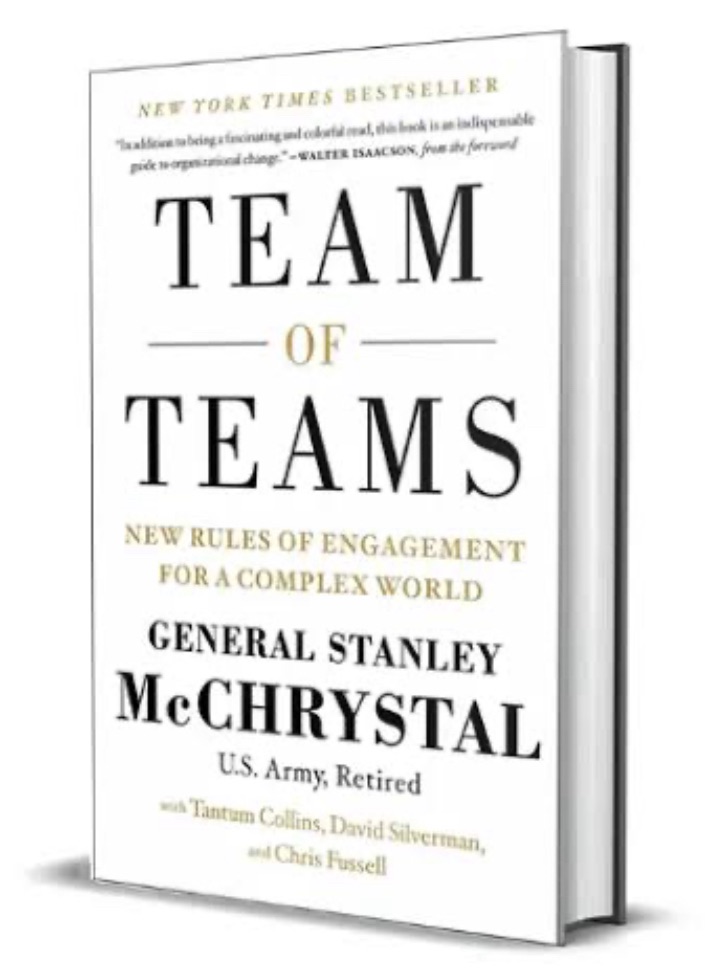
After six blissful days sailing through the Caribbean, I found not just a sun-soaked escape but also leadership insights in Team of Teams—a book that could prove to be impactful in the application of sales management and leadership.
General Stanley McChrystal’s Team of Teams is a thoughtful exploration of leadership, adaptability, and organizational transformation. Drawing from his experience leading U.S. military operations in Iraq, McChrystal offers a compelling case for rethinking how we structure teams and lead people in an increasingly complex and interconnected world. While its military origins may seem distant from the sales profession, the lessons within are profoundly relevant for sales leaders grappling with change, competition, and unpredictability.
The book blends gripping storytelling with strategic insights, grounded in both military history and modern organizational theory. A combination that I have grown to be very fond of. McChrystal balances tactical anecdotes with high-level ideas, though at times, the military-centric framing may feel overextended for readers outside that context. Nonetheless, the lessons resonate well beyond the battlefield, particularly in sales and sales management where adaptability and collaboration are essential.
Important Takeaways for Sales and Sales Management
1. Adaptability Over Hierarchy
McChrystal argues that rigid hierarchies fail in fast-changing environments. In sales, where market dynamics, customer behavior, and technology evolve rapidly, traditional top-down management can be a bottleneck. Sales leaders can apply McChrystal’s concept of “empowered execution,” enabling front-line sales teams to make decisions autonomously while staying aligned with the broader organizational mission. This shift expedites responsiveness to customer needs and accelerates sales cycles.
“Efficiency remains important, but the ability to adapt to complexity and continual change has become an imperative.”
2. Shared Consciousness: Breaking Down Silos
The book emphasizes the power of a “shared consciousness,” where information flows freely across teams. In sales, this translates into cross-departmental collaboration, integrating marketing, operations, and customer support with the salesforce. Sales leaders can adopt tools like regular alignment meetings, shared dashboards, and real-time communication platforms to ensure everyone understands both the big picture and their role in achieving it.
“The role of the leader is no longer to command and control but to cultivate and coordinate the actions of others.”
3. Building a Resilient Culture
Team of Teams highlights the importance of trust and transparency. I have seen firsthand how leaders often focus on hitting quotas but may neglect the cultural foundation that drives long-term success. A resilient sales culture, as McChrystal describes, values experimentation, rewards collaboration, and accepts failure as part of growth. This mindset is particularly valuable in navigating high-pressure environments and fostering innovation in sales strategies.
4. Managing Complexity with Networks
In an interconnected world, the traditional approach of managing individual contributors can fall short. McChrystal’s vision of transforming hierarchical organizations into dynamic networks of teams is directly applicable to sales. By creating agile, specialized sales “pods”—such as a team dedicated to key accounts or a rapid-response group for product innovation —organizations can improve efficiency and adapt to customer demands with greater precision.
Applications to the Sales Profession
Sales professionals operate in a battlefield of their own—one marked by fierce competition, changing buyer behaviors, and complex decision-making processes. McChrystal’s lessons offer a guide for sales leaders looking to evolve their strategies:
• Strategic Flexibility: Empower sales reps to pivot tactics in real-time without waiting for managerial approval.
• Data-Driven Decisions: Foster transparency by ensuring teams have access to the same data and insights, minimizing misalignment.
• Team Dynamics: Shift focus from individual performance to team effectiveness, emphasizing collaboration and shared success.
While Team of Teams is rich with insights, its heavy reliance on military analogies may alienate some readers looking for more direct business applications. Some of the concepts, like “shared consciousness,” while inspiring, are more aspirational than prescriptive, which left me to think through practical implementation on my own. Less experienced sales leaders may find themselves wishing for more concrete tools tailored to their specific challenges. Additionally, the book could explore the emotional and interpersonal dynamics of leadership more deeply, an area especially crucial in sales management.
My Final Verdict
Team of Teams is a thought-provoking and transformative read for sales professionals willing to embrace change and challenge traditional leadership norms. It’s a wake-up call for those clinging to outdated, hierarchical approaches and a blueprint for building resilient, high-performing sales teams. While not a step-by-step manual, the principles in the book—adaptability, trust, transparency, and collaboration—can be a paradigm shift in how sales leaders approach their teams and markets.
For those in the sales profession looking to future-proof their strategies and lead with agility, Team of Teams can be a playbook for the new era of leadership.
P.S.
I did enjoy many other aspects of my vacation but this isn’t a travel blog 😃

 Catalyst Consulting