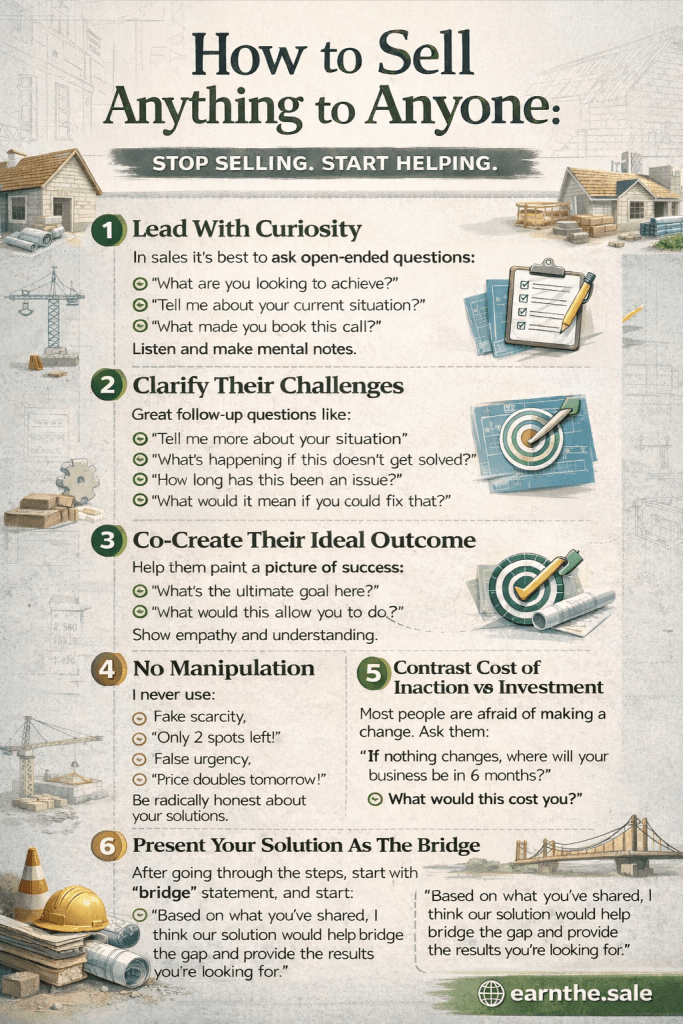
6-Step Consultative Process
Avoiding tasks, situations, or even people can be more common in sales than many realize. For sales professionals and managers alike, understanding the root cause of avoidance can be the first step to creating a sales culture that takes action. Avoidance can take many forms, often rooted in different mental or emotional responses, and can prevent you from reaching your goals or performing at your best. Here, I’ll explore three types of avoidance, breaking down why each happens and how you, as a sales professional, can address it effectively.
In sales, emotional or cognitive avoidance happens internally. It’s often invisible to others but has a real impact on your performance and mindset. When you emotionally or cognitively avoid something, you’re choosing to avoid thinking about it altogether. This might look like pushing aside the thought of following up on a challenging prospect, blocking out stressful client interactions, or not addressing feelings of burnout.
Common triggers in sales that can lead to emotional avoidance include:
This type of avoidance can often lead to procrastination or disengagement. If it persists, consider identifying specific thought patterns that are holding you back. A sales manager might find it helpful to provide coaching support, focusing on building resilience against these stressors. Seeking professional help can also be valuable if emotional avoidance becomes overwhelming or stems from deeper issues.
Situational avoidance is when you consciously avoid specific people, places, or tasks. In the sales environment, this could mean avoiding meetings, skipping networking events, or avoiding interactions with certain clients or colleagues. This type of avoidance is often a response to past negative experiences, where sales professionals steer clear of situations they associate with discomfort or conflict.
Here are a few examples of situational avoidance in sales:
The risk here is that situational avoidance limits your growth and narrows your opportunities. If you recognize this pattern, try gradually confronting the avoided situations with small steps. Sales managers can also help by creating an open environment where team members feel supported, even in uncomfortable situations. Encouraging honest discussions can often alleviate some of the tension that causes situational avoidance.
Protective avoidance is when you go out of your way to shield yourself from perceived risks, often by creating patterns or behaviors that feel “safe.” This type of avoidance can become particularly tricky in sales, as it can lead to habits that hinder growth and productivity. Protective avoidance often manifests as overly cautious behavior, where fear of failure or rejection leads to over-preparing or avoiding risks altogether.
Some signs of protective avoidance in sales might include:
While these protective actions may feel safe, they often lead to missed opportunities. Sales professionals need to find a balance between preparation and action, and sometimes that means taking calculated risks. Sales managers can play a pivotal role here by encouraging risk-taking in a structured way, offering feedback and reassurance to prevent protective behaviors from holding back growth.
Avoidance can be a significant barrier to success in sales. By recognizing the type of avoidance that’s impacting your behavior—whether it’s emotional, situational, or protective—you can take targeted steps to address it. Sales professionals who confront their avoidance tendencies head-on often experience personal growth, better client relationships, and increased sales outcomes. Sales managers, too, can use this understanding to provide supportive, growth-oriented environments for their teams.
By identifying and addressing avoidance patterns, you can break free from self-imposed limitations and open the door to new sales opportunities. When avoidance becomes persistent or too difficult to manage alone, consider seeking support through professional development programs or coaching. Remember, the first step to overcoming any type of avoidance is awareness—only then can you take steps toward meaningful change in your sales journey.
Below is a helpful exercise to use in your personal development journey or 1:1 sessions.
Ready to take your sales game to the next level? 🚀
Don’t miss out on more tips, insights, and strategies to boost your sales and sales leadership skills! Subscribe today and join a community of sales enthusiasts like yourself!
📩 Stay up-to-date with the latest blog posts, packed with practical advice and real-world examples that will help you close more deals and inspire your sales team. 💪
🔗 Want more valuable content? Check out the library of articles for a treasure trove of sales wisdom just waiting to be discovered. From prospecting techniques to negotiation tactics, I’ve got you covered!
👍 If you found this article helpful, give it a thumbs up and share it with your network. Help spread the word and empower others to achieve sales excellence!
Remember, success in sales starts with knowledge and continuous learning. Don’t miss out—subscribe, explore, and share today!
📢 Come along the journey! Subscribe now, explore more, and share the knowledge
Books
1. Grit: The Power of Passion and Perseverance

Author: Angela Duckworth
Angela Duckworth’s “Grit”
Duckworth’s acclaimed book dives into the science of grit, a key driver for long-term success. In sales, where persistence often separates top performers from the rest, Duckworth’s insights offer actionable steps for developing resilience. This book is packed with case studies and research that reinforces why passion and perseverance can elevate one’s career trajectory, making it an indispensable read for sales professionals who want to push past challenges and consistently close deals.
2. Mindset: The New Psychology of Success

Author: Carol S. Dweck
Carol S. Dweck’s “Mindset”
Success in sales hinges on adaptability and a positive mindset. Dweck’s “Mindset” explains how shifting from a fixed mindset to a growth mindset can be transformational, especially when handling rejection or navigating challenging quotas. Her approach empowers salespeople to see setbacks as opportunities for growth, fostering an outlook that drives performance under pressure.
3. Navigating Through the Valleys of Success: A Perspective in Perseverance

Author: Cleon Joseph
Cleon Joseph’s “Navigating Through the Valleys of Success”
Sales professionals often encounter obstacles that test their perseverance. Cleon Joseph’s book provides strategies for managing setbacks and maintaining focus during tough times. It’s a guide for any salesperson striving to develop mental resilience and maintain their drive, regardless of external challenges. Joseph’s perspective is a valuable resource for those aiming to maintain momentum in high-stakes environments.
4. Mind Over Matter: The Self-Discipline to Execute Without Excuses

Author: Peter Hollins
Peter Hollins’s Mind-Over-Matter-Self-Discipline
Self-discipline is at the heart of sales success. Hollins’ concise book on building self-discipline equips sales professionals with the tools to stay focused, control impulses, and push forward even when the pressure is high. With practical exercises and clear strategies, this book is a quick yet powerful read for anyone who wants to enhance their productivity and close deals consistently.
5. An Astronaut’s Guide to Life on Earth

Author: Chris Hadfield
Chris Hadfield’s Astronauts-Guide-Life-Earth
Chris Hadfield’s experience as an astronaut offers unique insights into the importance of preparation and determination. Sales managers and team leaders will appreciate Hadfield’s lessons on staying calm under pressure, a skill as relevant in space as it is in the sales field. His book encourages sales professionals to adopt a meticulous approach to planning and to stay resilient when the stakes are high.
Videos
1. Grit: The Power of Passion and Perseverance | Angela Lee Duckworth
Angela Duckworth’s TED Talk breaks down the importance of grit in achieving long-term goals. For sales teams, this talk offers an inspiring reminder that sustained effort and resilience are often more critical than natural talent. It’s an excellent motivational tool for those facing demanding sales cycles.
2. Leadership – When It Matters Most: Courage Up! | John C. Maxwell
In this talk, leadership expert John C. Maxwell discusses the role of courage in high-pressure situations. Sales managers can use this to inspire their teams to tackle challenging quotas and pursue ambitious targets without fear, instilling a culture of resilience and boldness.
https://www.youtube.com/live/qLq87C7hWjY?si=M0IhEcSmSs2Zjzcl
3. Finding Your Resolve
This motivational video is designed to help viewers find their inner resolve. Sales professionals facing burnt-out or difficult market conditions can find encouragement here to persist and overcome, making it a valuable resource for anyone who needs a motivational boost.
4. Digging Deeper: How a Few Extra Moments Can Change Lives | Cody Coleman
Cody Coleman’s TEDx talk encourages taking that “extra moment” to make a difference, a principle highly relevant to sales. This talk is ideal for sales professionals who want to deepen their impact, build stronger relationships, and achieve lasting success through small, consistent efforts.
5. Pushing Through | Ruben Daniels
Ruben Daniels shares insights on perseverance, ideal for sales teams working in a high-pressure environment. This short talk is an excellent addition to any sales team meeting, reminding everyone that determination and a positive outlook are keys to success.
Articles and Blogs
1. The Power of Resolve
This article on resolve offers insights into how mental toughness can drive personal and professional success. Sales professionals can apply these principles to navigate competitive markets and stay focused on goals despite challenges.
https://www.psychologytoday.com/us/blog/happiness-in-world/200911/the-power-resolve
2. Finding Strength: How to Overcome Anything
Description: Sales success often requires overcoming significant obstacles. This article discusses strategies to harness inner strength, making it a useful read for sales teams looking to build resilience and face high-pressure environments with confidence.
https://www.psychologytoday.com/us/articles/199805/finding-strength-how-overcome-anything
3. Grit: A Complete Guide on Being Mentally Tough
In this comprehensive guide, James Clear outlines the essentials of mental toughness. Sales professionals will find this article especially relevant, as it covers grit’s role in achieving long-term goals and provides actionable strategies for building resilience.
4. How to See Challenges as Opportunities
Description: This article reframes challenges as opportunities, an essential mindset shift for sales professionals. By adopting this perspective, salespeople can approach obstacles as chances to grow, making them better equipped to thrive in competitive environments.
https://www.psychologytoday.com/us/blog/what-doesnt-kill-us/201611/how-see-challenges-opportunities
5. How to Get Yourself Out of Rock Bottom
Description: For those facing a rough sales quarter, this article provides practical advice on overcoming tough periods. It’s an empowering read for any sales professional seeking to recharge and bounce back from difficult situations.
https://medium.com/swlh/how-to-get-yourself-out-of-rock-bottom-c005f899a66d
Discussion Questions for Sales Teams
How do you handle high-pressure deadlines?
Do you have strategies for “digging deep” when it counts?
Share a time when you overcame a challenging sales target. What kept you motivated, and what lessons did you learn?
What are your strategies for staying positive in the face of rejection?
Reflect on a past sales experience where preparation made a significant difference. What would you do differently today?
Ready to take your sales game to the next level? 🚀
Don’t miss out on more tips, insights, and strategies to boost your sales and sales leadership skills! Subscribe today and join a community of sales enthusiasts like yourself!
📩 Stay up-to-date with the latest blog posts, packed with practical advice and real-world examples that will help you close more deals and inspire your sales team. 💪
🔗 Want more valuable content? Check out the library of articles for a treasure trove of sales wisdom just waiting to be discovered. From prospecting techniques to negotiation tactics, I’ve got you covered!
👍 If you found this article helpful, give it a thumbs up and share it with your network. Help spread the word and empower others to achieve sales excellence!
Remember, success in sales starts with knowledge and continuous learning. Don’t miss out—subscribe, explore, and share today!
📢 Come along the journey! Subscribe now, explore more, and share the knowledge! 🌟
As a sales manager or leader, one of the most crucial roles you play is helping your team navigate “The Dip”—that tough period where progress stalls, motivation wanes, and the path to success feels steep. Seth Godin’s The Dip highlights how essential it is to recognize these moments in ourselves and others, making the choice to either persevere or pivot. For your team members, the Dip can often feel isolating, leading them to question their abilities. This is where leadership can make all the difference.
Encourage individuals by acknowledging their struggles and reinforcing their potential. Sometimes, simply knowing they’re heard and supported can help them renew their willingness to push through. But it’s equally important to recognize when a challenge has become a “cul-de-sac”—a dead end that leads nowhere. In these cases, guide team members to re-evaluate their path. If their efforts aren’t yielding meaningful progress or if the market or strategy has shifted significantly, it might be time to redirect their focus.
The key is to distinguish temporary obstacles from enduring roadblocks. For challenges that promise growth and learning, encourage grit and perseverance. But for those that offer little return on investment, be willing to support a graceful exit. Ultimately, your role is to help them identify worthwhile pursuits and see them through, turning any Dip into an opportunity for growth rather than frustration. Leading with clarity and empathy creates a resilient, focused team ready to achieve lasting success.
Personally, I love this story from John Krasinski. It illustrates the impact of encouragement and how success, luck, and opportunities lie on the other side of the dip.
Ready to take your sales game to the next level? 🚀
Don’t miss out on more tips, insights, and strategies to boost your sales and sales leadership skills! Subscribe and join a community of sales enthusiasts like yourself!
📩 Stay up-to-date with the latest blog posts, packed with practical advice and real-world examples that will help you close more deals and inspire your sales team. 💪
🔗 Want more valuable content? Check out the library of articles for a treasure trove of sales wisdom just waiting to be discovered. From prospecting techniques to negotiation tactics, I’ve got you covered!
👍 If you found this article helpful, give it a thumbs up and share it with your network. Help spread the word and empower others to achieve sales excellence!
Remember, success in sales starts with knowledge and continuous learning. Don’t miss out—subscribe, explore, and share today!
📢 Come along the journey! Subscribe, explore, and share the knowledge! 🌟
Sales is fast-paced, particularly within the building materials industry; clarity, resilience, and goal alignment are essential. Whether you’re a sales professional or manager, decision-making and goal-setting shape your day-to-day success. A framework that I’ve personally found to be useful and have leveraged for personal coaching, goal achievement, and decision-making is the Cartesian Questions model. This framework helps to explore the depth of any decision or goal, helping me uncover insights that might otherwise go unnoticed.
The Cartesian Questions model is based on a philosophical approach by René Descartes, who suggested evaluating any theory from multiple perspectives. For sales professionals, these questions are used to challenge and validate your thoughts around a specific decision or goal. By answering each question, you gain a clearer view of the potential outcomes and can confront self-imposed limitations. Here’s a breakdown of the four Cartesian Questions:
At first glance, these questions might seem redundant. However, each question serves to engage your mind from a different angle, sparking creative thinking and surfacing hidden beliefs.
Using the Cartesian Questions for self-coaching provides clarity in complex decisions and reinforces commitment to your goals. Here’s how to approach it:
To achieve meaningful goals, it’s crucial to understand both your motivations and any potential barriers. Cartesian Questions can help break down these goals into manageable insights:
For sales managers and professionals, decision-making can often feel like high-stakes poker. The Cartesian model can empower you to make decisions grounded in comprehensive reasoning. Here’s a step-by-step guide:
Incorporating Cartesian Questions into your coaching or management toolkit can enhance not only your own decision-making but also help guide your team members in clarifying their goals. The discipline of systematic questioning can be the difference between achieving superficial goals and making impactful, career-advancing moves. Remember, every decision is a step closer to or further from success. Where are your decisions leading you?
Below is a useful tool to use in one-on-one coaching sessions or for personal use.
Contrast bias is a cognitive bias in which our perception of something is influenced by a previous experience or exposure to a contrasting stimulus. This bias can lead to an exaggerated difference in our perception of two similar things due to the direct comparison between them.

In sales and sales management, contrast bias can have significant implications. For example, when a salesperson presents a high-priced product after showing a series of even more expensive options, the customer may perceive the high-priced product as a good deal in comparison, even if it is still expensive in absolute terms. Conversely, if the salesperson presents the same high-priced product after showing a series of lower-priced options, the customer may perceive it as excessively expensive, despite its actual value. This demonstrates how the perception of value is heavily influenced by the context in which it is presented.
In sales management, contrast bias can affect performance evaluations. For instance, if a sales manager evaluates a salesperson who has been consistently meeting moderate targets after observing another salesperson exceed exceptionally high targets, they may perceive the first salesperson’s performance as subpar, despite it being objectively satisfactory in a different context. This can lead to unfair assessments and demotivation among the sales team.
To mitigate contrast bias in sales, salespeople can strategically present products in a consistent context to avoid exaggerated perceptions of value. Sales managers can reduce the impact of contrast bias by evaluating each salesperson’s performance based on individual targets and industry standards rather than direct comparisons with colleagues. By understanding and addressing contrast bias, sales professionals and managers can make more objective decisions and improve overall performance.
Here are 10 questions to help identify where the contrast effect may be present in your day-to-day. The contrast bias is not inherently bad or good. However, identifying where this bias may be contributing to both positive and negative outcomes can be important to achieving the results you want.
Ready to take your sales game to the next level? 🚀
Don’t miss out on more tips, insights, and strategies to boost your sales and sales leadership skills! Subscribe today and join a community of sales enthusiasts like yourself!
📩 Stay up-to-date with the latest blog posts, packed with practical advice and real-world examples that will help you close more deals and inspire your sales team. 💪
🔗 Want more valuable content? Check out the library of articles for a treasure trove of sales wisdom just waiting to be discovered. From prospecting techniques to negotiation tactics, I’ve got you covered!
👍 If you found this article helpful, give it a thumbs up and share it with your network. Help spread the word and empower others to achieve sales excellence!
Remember, success in sales starts with knowledge and continuous learning. Don’t miss out—subscribe, explore, and share today!
📢 Come along the journey! Subscribe now, explore more, and share the knowledge! 🌟
When it comes to negotiations, buyers often try to push for lower prices to maximize their own gains. As a seller, it’s important to be aware of the tactics buyers use and to develop effective strategies to navigate these situations. In this article, I will explore the five most common ways buyers negotiate lower prices and provide insights on how to respond as a seller. Whether you are in sales or simply interested in understanding the dynamics of negotiation, this article will equip you with valuable knowledge to achieve win-win outcomes.

Buyers often employ the “one last request” tactic to secure a final concession from the seller. This tactic occurs at the end of a negotiation when the buyer requests one additional change to seal the deal. The effectiveness of this tactic lies in the seller’s eagerness to close the sale and their willingness to make a final concession in exchange for the buyer’s signature.
To effectively counter this tactic, sellers should remain diligent in evaluating the value of the requested change and considering whether it aligns with their pricing and objectives. It is essential to communicate the rationale behind your decision and signal that you understand the buyer’s request without compromising the overall value proposition.
The “Flinch Test” tactic involves buyers insisting that the seller’s price is too high and demanding a better offer. This tactic is often used regardless of the circumstances and aims to evoke a concession from the seller solely based on a price reduction.
As a seller, it is crucial to resist the temptation to immediately concede to price demands. Instead, focus on highlighting the unique value your product or service offers and the reasons behind your pricing. Demonstrate the differentiation and benefits that set your offering apart from competitors. By emphasizing the value proposition, you can shift the negotiation away from pure price discussions and towards mutually beneficial outcomes.
Buyers may suggest “splitting the difference” as a negotiation technique, portraying it as a reasonable compromise. However, sellers must be cautious, as meeting in the middle may not always result in a fair outcome for both parties.
To navigate this tactic, sellers should focus on rationalizing their pricing based on the value provided. Engage in open discussions with the buyer to understand their concerns and identify alternative concessions that align with the overall value proposition. By showing a willingness to collaborate while safeguarding your pricing, you can establish a partnership based on transparency and shared benefits.
Sellers want to be seen as reasonable. They want to create a partnership. When buyers say, “Why don’t we meet in the middle?” there’s an emotional appeal of showing good faith by splitting the difference.
Mike Schultz, Rain Group
The “anchoring” tactic involves buyers sharing a low budget early in the negotiation to set the stage for further bargaining at a reduced price. By presenting a low anchor, buyers aim to influence sellers to provide lower estimates and increase their chances of securing a better deal.
Sellers must be aware of anchoring effects and the cognitive bias associated with the first offer in a negotiation. It’s crucial to understand the buyer’s budget and pricing expectations while highlighting the unique value your product or service brings. By framing the conversation around the value derived from your offering, you can counteract the anchoring effect and build a foundation for discussions based on the benefits your solution provides.
Buyers often use time-pressure tactics, such as presenting an offer within a tight timeframe or hinting at engaging with a competitor. These tactics aim to create a sense of urgency and scarcity, pushing sellers to make concessions quickly.
To counter time-pressure tactics, sellers should remain composed and analyze the situation objectively. Evaluate the buyer’s timeline and ensure you have a clear understanding of the value your product or service brings to the table. Demonstrate confidence in your offering and focus on the long-term benefits rather than succumbing solely to short-term pressures. By communicating the value and emphasizing the partnership potential, you can mitigate the effects of time-pressure tactics and maintain control over the negotiation process.
Negotiations are a crucial part of the consultative sales process, and understanding the tactics buyers employ can significantly impact your ability to secure favorable outcomes. By familiarizing yourself with the five most common ways buyers negotiate lower prices and developing effective responses, you can position yourself as a strategic partner who emphasizes value creation and mutual benefits.
Remember, negotiations should always strive for win-win outcomes where both parties feel satisfied with the agreement reached. By employing strategies that focus on highlighting the value of your offering and fostering open communication
Q1: How can sellers effectively respond to the “One Last Request” tactic?
In response to the “One Last Thing” tactic, sellers can employ Chris Voss’s technique of labeling, introduced in his book, “Never Split the Difference: Negotiating as if Your Life Depended on It”. Labeling involves acknowledging the buyer’s request and labeling it as legitimate while reframing it to gain perspective.
For example, respond with, “I understand that this is important to you, and I can see why you’d want this. Let’s take a step back and explore how this change aligns with the overall value we’re providing.”
Q2: What strategies can sellers employ to counter the “flinch test” tactic?
In dealing with the “Flinch Test” tactic, sellers can apply Chris Voss’s technique of mirroring. Mirroring entails repeating the buyer’s words or the last few key words to encourage further elaboration and create a collaborative atmosphere. By saying, “So you’re looking for a better price?”, sellers gather more information and show a willingness to understand the buyer’s perspective. This allows for a more thoughtful response rather than immediately conceding to price demands.
Q3: Are there situations where buyers’ negotiation tactics can be beneficial for sellers?
Yes, there are instances where buyers’ negotiation tactics can be advantageous for sellers. Chris Voss explains the importance of utilizing and adopting a mindset of “tactical empathy”. Through active listening, sellers can uncover the underlying motivations and concerns driving the buyer’s negotiation tactics. By understanding these factors, sellers can adapt their approach to address the true needs of the buyer and arrive at a mutually beneficial outcome.
Q4: How can sellers effectively respond to time pressures buyers use by leveraging competitive research?
An accusation audit, a technique introduced by Chris Voss, can be a powerful tool in negotiations. Instead of shying away from potential criticisms or concerns, the accusation audit allows sellers to address them head-on.
For example:
Buyer: “I’m meeting with your competitor this afternoon, and I’m sure they can do better. Is that the best you can do?”
Seller: “It sounds like you believe our price is too high and that we may not be offering enough value for the investment. I can understand why you might think that, as there are many options on the market. However, I’d like the opportunity to highlight the unique benefits and superior quality/service we provide.”
By leading with a statement that acknowledges the buyer’s concern or accusation, the seller demonstrates empathy and shows a willingness to address potential reservations. This can lead to a more open and constructive dialogue, allowing both parties to explore ways to create value and find a mutually beneficial solution.
Ready to take your sales game to the next level?🚀
Don’t miss out on exclusive tips, insights, and strategies to boost your sales and sales leadership skills! Hit the subscribe button and join a community of sales enthusiasts like yourself!
📩 Stay up-to-date with the latest blog posts, packed with practical advice and real-world examples that will help you close more deals and inspire your sales team.
🔗 Want more valuable content? Check out the library of articles for a treasure trove of sales wisdom just waiting to be discovered. From prospecting techniques to negotiation tactics, I’ve got you covered!
👍 If you found this article helpful, give it a thumbs up and share it with your network. Help spread the word and empower others to achieve sales excellence!
Remember, success in sales starts with knowledge and continuous learning. Don’t miss out—subscribe, explore, and share today!
If you want more tips & techniques for negotiating, then subscribe & leave a comment on this post. I’ll email you my new E-Book as a bonus: Negotiate Like a Pro…And Get What You Want More Often


Maslow’s Hammer, also known as the Law of the Instrument, is a cognitive bias that refers to the tendency of individuals to rely on familiar tools or methods to solve problems, even when they may not be the most suitable or effective options. It is based on the idea that when you have a hammer, everything looks like a nail. In other words, people tend to use the tools or approaches they are most comfortable with, regardless of whether they are the best fit for the situation.

“It is tempting, if the only tool you have is a hammer, to treat everything as if it were a nail.”
Abraham Maslow
In the context of sales and sales management, Maslow’s Hammer can have several implications. Sales professionals may have a preferred sales technique or strategy that they rely on heavily, even if it may not be the most appropriate for a particular customer or situation. For example, a salesperson who excels at aggressive, high-pressure sales tactics may default to using those techniques in every sales interaction, even when a more consultative or relationship-building approach would be more effective.
Sales managers can also fall victim to Maslow’s Hammer by applying a one-size-fits-all approach to managing their sales team. They may have a preferred management style or set of performance metrics that they use for all salespeople, regardless of individual strengths and weaknesses. This can lead to missed opportunities for tailored coaching and development.
Below are just a few examples of Maslow’s Hammer that I have personally witnessed in sales and sales management:
To overcome the bias of Maslow’s Hammer in sales and sales management, it is important to encourage flexibility, creativity, and a willingness to try new approaches. Sales professionals should be open to learning and adopting different sales techniques based on the unique requirements of each customer. Sales managers who strive to understand the individual strengths and weaknesses of their team members and tailor their coaching and performance management strategies accordingly will influence behavior over the long-term. By doing so, sales organizations can enhance their effectiveness and better meet the diverse needs of their customers.
Ready to take your sales game to the next level? 🚀
Don’t miss out on exclusive tips, insights, and strategies to boost your sales and sales leadership skills! Hit the subscribe button and join a community of sales enthusiasts like yourself!
📩 Stay up-to-date with the latest blog posts, packed with practical advice and real-world examples that will help you close more deals and inspire your sales team. 💪
🔗 Want more valuable content? Check out the library of articles for a treasure trove of sales wisdom just waiting to be discovered. From prospecting techniques to negotiation tactics, I’ve got you covered!
👍 If you found this article helpful, give a thumbs up and share it with your network. Help spread the word and empower others to achieve sales excellence!
Remember, success in sales starts with knowledge and continuous learning. Don’t miss out—subscribe, explore, and share today!

Company culture plays a major role in job satisfaction and the sense of security that comes along with it. Fortunately, you can have a powerful impact on your workplace, whether you’re a senior manager or a summer intern. Try these suggestions to create an environment where everyone can feel valued and appreciated.
Steps to Take by Yourself
1. Maintain a growth mindset by continually learning. Invest in your education and training. Developing your knowledge and skills will broaden your opportunities at your current company and in all of your future positions. Should your company offer opportunities to lead discussions and/or present in front of other teammembers don’t hesitate to raise your hand to lead a topic. You’ll be a stronger member of any team for it.
2. Think long term. While you may not be an entrepreneur running your own business and taking all the risks associated, but there’s no reason you can’t be an intrapreneur! An intrapreneur runs a business inside of the business. Intrapreneurs take on an ownership mindset where she takes on projects and drives initiatives to conclusion. Owning your role and the results needed to elevate you and the teams success requires a long term focus. Keep your goals in mind. Evaluate how your actions will affect your company’s future and drive your actions towards that future. Going the extra mile could lead to repeat business, glowing reviews, and valuable referrals.
3. Take risks. Creativity in the workplace is seemingly becoming a lost art. It may be because there is not a culture around rewarding resourcefulness, creativity, and taking risks. However, what you see lacking in the workplace culture presents an opportunity to catalyze the team, other departments, and your development. Reward yourself for being innovative, even if some of your efforts fail to pan out. If you’re persistent, you’re bound to come up with some breakthrough ideas. Maybe you’ll find a new tool to help close more deals, or a technology to streamline communication across teams. Or perhaps you’ll work on redesigning a company process or policy.
4. Ask questions. Being able to ask for information and advice is a sign of confidence. There is a balance to questioning the companies way of doing business versus challenging it. Approaching co-workers and/or your managers with a sense of curiosity (intention) will often be reciprocated, however challenging others can be viewed as antagonistic and destructive. For example, approaching others with, “It makes no sense to me the way the company is approaching XYZ issue, how can this ever change if it makes no sense to begin with?” Now you can image the potential defensive reactions that a question like this may solicit. It’s not constructive and the intent of the question sounds more like a disparaging comment than a real question. Compare that to the language of a curious intent; “I’m curious- the team seems to have a wealth of experience around XYZ issue, I’d be interested in learning how the decision came to be with addressing it the current way?” You’ll do your job better and show your colleagues you appreciate their experience and expertise.
5. Be social. While many leave it up to the managers and owners of an organization to shape the culture of an organization, it’s equally the responsibility of individuals to reinforce and build the culture. Culture involves both internal and external factors. Get to know your coworkers as people, not just as coworkers, and help them. Be the person who goes out of their way to make friends with new team members. Many of them may feel out of place when they join your organization or have to adjust to a hybrid environment. Invite them to lunch or to a virtual coffee to talk. You could suggest other people for them to meet, or if you’re in the office, you could go ahead and introduce them.
Steps to Take with Your Co-Workers
1. Build consensus. Think about all the parties whose interests your work will affect. Request feedback and input across multiple departments. Attempt to gain understanding how your work affects their role within the organization. Involve others when you’re making important project decisions. They’ll be more likely to support projects that they helped develop.
2. Welcome new hires. Reach out to new employees. Explaining the corporate culture to them may reinforce your own beliefs and actions. Additionally, during the Pandemic many teams experienced high-turnover, therefore it’s easy for teammembers to fall into the mindset of, “why take the time getting to know them when they’ll likely only be here for a short period of time?” This thinking perpetuates a siloed environment and a negative culture.
3. Give praise. Be generous in acknowledging the talents and achievements of your colleagues. Congratulate a colleague who recently completed an important project. Let the office manager know that you like the way he reorganized the supply cabinet. Thank the warehouse staff for organizing product on time for a tight deadline.
4. Share credit. Recognize teamwork. Thank others individually and in public for how they contribute to group victories. Throw a party or write a letter expressing your gratitude.
5. Communicate openly. Speak directly and respectfully. Thank your coworkers for sharing their viewpoints.
6. Resolve conflicts. Disagreements are unavoidable. Hold yourself accountable for your actions and apologize when needed. Be courteous, even when you find yourself on the opposing side of an issue.
7. Focus on strengths. Remember to pay attention to the things you and your co-workers do well. Everyone’s strengths are the essence of your company’s culture and the foundation you can build upon to keep growing.
8. Give back to the community. Your company’s philanthropy and community programs say a lot about its corporate culture. Take part in initiatives you care about, such as holiday food drives or volunteer outings. Does your company not participate in community event? This is a perfect opportunity to coordinate one!
You’ll find your work more meaningful and gratifying when your employer’s culture aligns with your own values. Whatever your job title, you can have a positive influence on the culture in your workplace.

Triggers: Creating Behaviors That Last – Becoming the Person You Want to Be by Marshall Goldsmith is a powerful book that delves deeply into the psychology of behavior change. Goldsmith, a renowned executive coach, shares his insights on how to create lasting change in our lives and become the person we want to be.
One of the key themes of the book is that behavior change requires a conscious effort on our part. Goldsmith explains that our environment and the people around us can trigger certain behaviors, both positive and negative. He uses the term “triggers” to describe these environmental cues that can influence our behavior. By becoming aware of our triggers and taking action to modify them, we can create new habits and behaviors that will serve us better.
Outside of our environment, our internal beliefs that can stop change. An awareness of these beliefs, along with self-reflection, can turn these beliefs into positive triggers for success. These beliefs include:
Goldsmith suggests that these beliefs can be overcome by adopting a growth mindset, being open to feedback and new ideas, and developing a sense of accountability to ourselves and to others. By doing so, we can create lasting change and become the person we want to be.
The writing style of the book is direct and practical, with Goldsmith offering a wealth of actionable advice and exercises that help to implement his ideas. He also emphasizes the importance of accountability, both to ourselves and to others, in order to stay on track and achieve our goals.
A tip that Goldsmith suggests to drive personal accountability is to ask the five questions below at the end of each day. He offers some interesting research data (although anecdotal at best) conveying the efficacy of these questions and goal achievement.
- Did I do my best to set clear goals today?
- Did I do my best to make progress toward my goals today?
- Did I do my best to find meaning and purpose in my work today?
- Did I do my best to be happy today?
- Did I do my best to be fully engaged in my interactions with others today?
As a sales professional, I found this book to be incredibly valuable. Sales is a highly competitive field, and success often requires a combination of skill, discipline, and perseverance. Goldsmith’s insights on behavior change are directly applicable to the sales profession, as we constantly face challenges and opportunities that can trigger positive or negative behaviors. By developing greater awareness of our triggers and consciously modifying our behavior, we can become more effective salespeople and achieve greater success.
One important takeaway from the book is the importance of setting achievable goals. Goldsmith emphasizes that small, incremental changes can lead to significant improvements over time. By setting specific, measurable goals and tracking our progress, we can build momentum and create lasting change in our behavior.
Another key lesson from the book is the importance of humility and openness to feedback. Goldsmith encourages readers to seek out constructive feedback from others and to be open to criticism. By doing so, we can identify areas for improvement and make the necessary changes to become better versions of ourselves.
Overall, I highly recommend Triggers: Creating Behaviors That Last – Becoming the Person You Want to Be to anyone looking to create positive change in their lives. While the book is not without its flaws, particularly in its somewhat repetitive structure, the insights and advice it offers are invaluable. As a sales professional, I have found the concepts and strategies outlined in the book to be directly applicable to my work, and have seen tangible improvements in my sales results as a result of implementing Goldsmith’s advice.
Following are ten reflection questions based on my reading. These questions are designed to facilitate reflection on the key concepts and strategies outlined in the book, and to help you apply them to your own professional development and career goals.
Want to join me on Goodreads?
 Catalyst Consulting