Recession Proof Sales Techniques for Selling Home Improvements to Homeowners

Selling home improvements can be a lucrative business, but it can also be challenging, especially during times of economic uncertainty. With many homeowners tightening their belts and cutting back on expenses, it can be difficult to convince some to invest in home renovations. However, with the right sales techniques, you can still close deals and grow your business even during a recession.

Here, I’ll share some of the top recession-proof sales techniques for selling home improvements to homeowners. From building trust to offering financing options, we’ll cover everything you need to know to close more deals and thrive in a challenging market.

Building Trust

One of the most important things you can do as a salesperson is to build trust with your potential customers. Homeowners want to work with someone they can trust to do a good job and not take advantage of them. In a recession many businesses will be cutting costs in an effort to lower prices and in doing so quality can suffer. In a race to the lowest price, homeowners are willing to pay more for companies they can trust. Here are some ways to build trust with your customers:

  • Be honest and transparent: Don’t make false promises or exaggerate the benefits of your services. Be transparent about pricing and what your services include.
  • Provide references and testimonials: Show your potential customers that you have a track record of satisfied customers. Provide references and testimonials from previous clients to demonstrate your expertise and reliability. Many homeowners are aware of how easily some testimonials can be misrepresented (testimonials from family members, friends, employees, etc) so be sure to leverage other sources of credibility such as Better Business Bureau ratings, and other third party ratings.
  • Offer guarantees: Offer a satisfaction guarantee or warranty to show your customers that you stand behind your work.

By building trust with your customers, you’ll be more likely to close deals and earn repeat business.

Offering Financing Options

During a recession, many homeowners may be hesitant to spend money on home improvements, even if they’re necessary. Offering financing options can help make your services more accessible and affordable. This is another area where some business will see financing as an expense and look for cost-savings by either limiting financing options or eliminating them. Here are some financing options you can offer:

  • Payment plans: Offer payment plans that allow customers to pay for your product or services over time instead of all at once.
  • Home equity loans: Help your customers secure home equity loans to finance their home improvements.
  • Credit cards: Accept credit cards to make paying for your services more convenient for your customers.

By offering financing options, you can make your services more accessible to a wider range of customers and increase your chances of closing deals.

Creating a Sense of Urgency

Creating a sense of urgency can be a powerful sales technique, especially during a recession when customers may be more hesitant to spend money. Here are some ways to create a sense of urgency:

  • Limited-time offers: Offer limited-time discounts or promotions to encourage your customers to act quickly.
  • Emphasize the benefits: Highlight the benefits of your services and how they can improve your customers’ quality of life. Remind them of the potential costs of delaying or not investing in home improvements.
  • Show your availability: Let your customers know that your schedule is filling up quickly and that they may miss out on the opportunity to work with you if they don’t act soon.

By creating a sense of urgency, you can encourage your customers to act quickly and increase your chances of closing deals.

Overcoming Objections

Homeowners may have objections to investing in home improvements, especially during a recession. Here are some common objections and how to overcome them:

“It’s too expensive”: Offer financing options or emphasize the long-term benefits of the investment. For products or services that have a strong return on investment, whether through greater resale value or energy-savings, long-term financing options let these homeowners offset the initial costs through a low cost of ownership.

“I don’t have time”: Emphasize the convenience and time-saving benefits of your services. You can also work with the customer to create a timeline that works for them.

“I’m not sure it’s necessary”: Emphasize the potential cost savings and energy efficiency that come with home improvements. You can also provide references or testimonials from previous customers who have seen the benefits of your services.

By addressing objections and providing solutions, you can help your customers overcome their reservations and close more deals.

Upselling and Cross-Selling

Upselling and cross-selling can be effective sales techniques for increasing the value of each sale. Here are some tips for upselling and cross-selling:

Offer complementary services: If a customer is interested in one service, offer a related service that complements it. For example, if they’re interested in a window replacement, offer to also update their entry door as well.

Suggest upgrades: If a customer is considering a certain product or service, suggest an upgraded version that offers more features or benefits.

Large project discounts: Offer discounts for jobs that keep crews busy and reduces downtime to encourage customers to invest in larger projects.

By upselling and cross-selling, you can increase the value of each sale and grow your business.

Selling home improvements during a recession can be challenging, but it’s not impossible. By building trust, offering financing options, creating a sense of urgency, overcoming objections, and upselling and cross-selling, you can increase your chances of closing deals and growing your business. Remember to be honest, transparent, and customer-focused throughout the sales process, and you’ll be well on your way to recession-proof success.


Book Review 📚 Emotional Intelligence for Sales Success: Connect with Customers and Get Results by Colleen Stanley

Emotional Intelligence (EI) for Sales Success by Colleen Stanley is a must-read for anyone in the sales profession. This book is a comprehensive guide that offers valuable insights and strategies to help salespeople connect with customers on a deeper level and achieve better results.


“Sales success is not about being the best at selling; it’s about being the best at connecting.”- Colleen Stanley

One of the key themes of the book is the importance of emotional intelligence in sales. Stanley emphasizes that sales success is not just about having the right product or service, but also about understanding and connecting with the emotions of your customers. By developing emotional intelligence, salespeople can build stronger relationships, establish trust, and ultimately close more deals.

The writing style is engaging and conversational, making it easy to read and understand. Stanley provides real-life examples and practical advice that can be applied in any sales situation. I found her to be relatable and down-to-earth, making it easy to connect with the material.

One of the most important takeaways from the book is the concept of “empathetic listening.” Stanley explains that this involves not just hearing what your customers are saying, but truly understanding their needs, concerns, and emotions. By practicing empathetic listening, salespeople can build trust and establish themselves as trusted advisors, rather than just another salesperson pushing a product.

Another important aspect of the book is its direct application to the sales profession, whereas other EI materials can seem abstract. Stanley provides practical strategies for applying emotional intelligence in a sales context, such as how to handle objections, build rapport, and close deals. She also provides tips for managing stress and maintaining a positive attitude in the face of rejection and setbacks.

As a sales professional myself, I can attest to the impact that this book has had on my sales results. By applying the strategies and techniques outlined in Emotional Intelligence for Sales Success, I have been able to build stronger relationships with my customers, close more deals, and ultimately achieve greater success in my sales career. This is a book that I share will all of my sales teams.

While the book is certainly a valuable resource, there are a few areas where it falls short. For example, some of the concepts and strategies presented in the book may be familiar to those who have already studied emotional intelligence or sales techniques. Additionally, the book focuses primarily on business-to-business (B2B) sales, so those in other types of sales roles may perceive some of the advice inapplicable. Having done both B2B and B2C, I didn’t find it too difficult to connect the dots across various roles.

Overall, Emotional Intelligence for Sales Success is a valuable resource for anyone in the sales profession. By focusing on the importance of emotional intelligence and providing practical strategies for applying it in a sales context, Colleen Stanley has created a book that is both informative and engaging. Whether you are a seasoned sales professional or just starting out in your sales career, this book is definitely worth a read.


Below are 10 reflection questions based on the insights from Emotional Intelligence for Sales Success:

  1. What are some examples of situations where you have demonstrated empathy in your sales interactions? How did it impact the outcome?
  2. How do you typically handle objections from customers? How could you apply the concept of empathetic listening to improve your approach?
  3. Reflect on a recent sales interaction where you felt you could have done better. What emotional intelligence strategies could you have applied in that situation?
  4. How do you typically manage stress in your sales role? What techniques have worked well for you, and what could you improve on?
  5. Reflect on your current sales goals. How could developing your emotional intelligence help you achieve these goals?
  6. What are some examples of times when you may have made assumptions about a customer’s needs or emotions? How could you have used empathetic listening to better understand their perspective?
  7. Think about a sales interaction where you felt you established a strong rapport with a customer. What strategies did you use to build that connection?
  8. How do you typically follow up with customers after a sale? How could you use emotional intelligence to strengthen those customer relationships?
  9. Reflect on a recent rejection or setback in your sales career. How could you apply emotional intelligence to maintain a positive attitude and keep moving forward?
  10. What are some examples of ways you could apply the strategies and techniques from this book in your day-to-day sales interactions? How could you measure the impact of these efforts?

Want to connect on Goodread ?

How to Be Assertive Without Being Rude or Pushy

Assertiveness is an important skill in sales that can make your work much more enjoyable, but, unfortunately, it’s also vastly misconstrued. Sometimes it’s difficult to be assertive, or make your position known, while still maintaining professionalism and understanding. 

Assertive people often come off as rude or pushy. This is because generally people don’t like to be told what to do or how to do it. The trick is in learning how to stand up for yourself without making others feel imposed upon. This is a skill you can develop with a little know-how and practice.

Try using the following tips in order to properly assert yourself:

1. Choose your words carefully. This is especially important if you’re going to assert yourself in situations where you were previously passive. Think about the different ways that your words can be interpreted. Write them down and read them back to yourself if that helps. Oftentimes the mistake that many make in sales is that they don’t leverage the advantage of using scripts. With scripts the words have been selected very carefully and have been tried and tested. New salespeople are more concerned about the perception of “being themselves” which leads to bad wording in important selling situations.

  • Remember that there’s a fine line between being assertive and being aggressive. 

2. Develop good listening skills. Being assertive takes some great communication skills. Remember that communication has two sides – speaking and listening. Truly listening will help you clearly understand the situation at hand. Additionally, when actively listening you will oftentimes learn exactly what you need to say, but in the other persons words. When you follow up with thoughtful and assertive response or request, others are more likely to value your opinion.

3. Avoid taking things personally. Since being assertive can be touchy, sometimes you’ll do everything right and still end up rubbing someone the wrong way. You’ll never please 100% of your listeners, 100% of the time. Learn how to brush off comments that don’t matter. 

4. Be humble. You can combat resistance to your assertiveness by being humble. Avoid bragging about yourself, even if it’s in a joking manner. There is an attachment to ego in sales, and it’s important, however that attachment can bring upon negative results in times of being assertive.

5. Show confidence. People enjoy being led by people who ooze confidence. If you’re going to be assertive and take charge, show the confidence to back it up. People will sense your lack of confidence if it isn’t truly there, so give yourself permission to feel good about yourself and your accomplishments. Share what you have accomplished with your listeners, not to impress them, but to impress upon them that you’ve been in this scenario before and here is what you’ve been able to do, presumably for your listeners.

6. Handle negative issues quickly. If problems arise, jump on them immediately. It’s a part of being assertive. Handle issues with kindness and respect and people will remember you for it. If you let problems linger or treat them in a negative manner, people will remember that too. Assuming that by ignoring issues early in any conversation that they’ll be less likely to reappear later, you would be wrong.

7. Deal with feelings of superiority. You’re only human, so perhaps you do feel superior in a situation where you’re being assertive. If so, be careful to avoid acting rudely. 

8. Apologize for mistakes. When you’re being assertive, you’re no doubt in the spotlight. When you make a mistake in the spotlight, everyone knows about it. Act appropriately and apologize, and people will respect you for owning up to it. 

Remember that the skill of assertiveness is something that develops over time. It may be overwhelming to try to make drastic changes overnight. Ease yourself into it and test the waters. It’s always best to think with clarity and make your changes slowly. 

With a gradual change, others will be more likely to accept your new assertiveness. Before you know it, you’ll have their respect for the new, improved you!

Why do customers stall?

One thing I take a lot of pride in is that I was able to have some of the best years (at that point) of my sales career during the 08′-12′ Great Recession. While many of my counterparts were frozen (rightfully so- it was brutal) in how to move forward in that business environment, I was busy doubling down on my craft and subsequently finished many of those years as the #1 sales person in the organization. I don’t say that to impress you, but to impress upon you that there are opportunities to be had during this time. You just have to begin using the right strategies & stay in the right frame of mind moving forward.

Today I want to share some strategies on how to move deals through your sales cycle that may have stalled.

In consultative sales you’ve got four outcomes: a sale, a no sale, an advancement, or a continuation (another word for stall). As with any type of selling, you want as many sales as possible, limited amount of no sales (they happen), absolutely no CONTINUATIONS/STALLS, and more ADVANCEMENTS than no sales.

Some examples of continuations from a prospect: “call me next week”, “send me a quote and I’ll follow up with you”, etc. Anything where there’s a perception of a next step, but there’s no commitment or plan on what that next step may be. An advancement is where there is a solid commitment on what the next steps are, and a commitment on what you, as the sales rep, and the prospect will be doing.

What we don’t want are continuations- when you get one it’s important to be able to identify whether this is a STALL or a CONDITION to not moving forward. A condition would be any legitimate reason as to why the prospect cannot move forward- examples would be; there’s an approval process, another decision maker needs to be involved, a payment stipulation (bonus coming). It’s easy to identify stalls- if you’ve done a good job in your presentation, things line up- you’ve gained agreements along the way, and then all of sudden once a decision needs to be made, you’re given reasons that just don’t seem consistent to what’s been discussed and agreed upon.

Now-think about your projection. How much of your pipeline, or past opportunities, suffer from stalled opportunities? Opportunities- where you may believe you have a chance, but you can’t identify why they haven’t moved forward. They seemingly string you along.

If you are like most, stalled opportunities easily account for 30% and 50%. In a tough market one of the biggest returns you can reap is to reduce the impact of stalled decisions; however, to jump start a stalled sale, you must understand the cause of the stall. Here are a few common causes to investigate:

Lack of connection to a the most important issues to the prospect. Unless your solution increases savings, improves aesthetics, home value, comfort, efficiency, sound, and security, or some other looming implication, you can expect a stall. When purse strings tighten, homeowners will only spend on matters that impact them the most.

A sales rep only has reengage and ask three questions to uncover issues:

  1. Why do you want this solution?
  2. Why are those problems important to solve?
  3. Why does this matter to you?

Lack of perceived value. Most people can really only juggle five or six critical issues at a time. We all live with problems that we don’t need to solve today. However, competing priorities are constant. Can your prospect articulate the value or impact of addressing the issue? If your solution, from your prospects perspective, doesn’t have enough value to get in his top three or four, you get stalled or put on the back burner. Ask the prospect to quantify the impact of resolving the issue. Better yet, ask her how the solution will impact her personally.

Lack of differentiation. Lack of differentiation will cause the prospect to spend more time evaluating, which translates to a stall. If you are unable to differentiate on features and solving problems, you will be forced to differentiate on price.

Decision authority. Decision authority is one of the most common causes of stalled decisions. It’s important to ask yourself, “Has the person you’re in contact with made this type of decisions before? When and how?”. Understanding their decision authority and decision making process early in the conversation will help identify whether you are dealing with a STALL or a CONDITION.

Risk. Making a decision involves risk. The prospects perception of risk can span impacts like lost budget flexibility,(do we forgo our Cruise this year??), lost time, or fear of making the wrong decision. As a prospect gets closer to making a decision, the risk becomes greater in her mind. Common tools for alleviating risk include supplying references, using reliable third-party data, and demonstrating return-on-investment analysis.

My hope is that you can take these above strategies and immediately apply them to begin helping your prospects move forward.

Thanks for stopping by and remember- the best earn the sale!

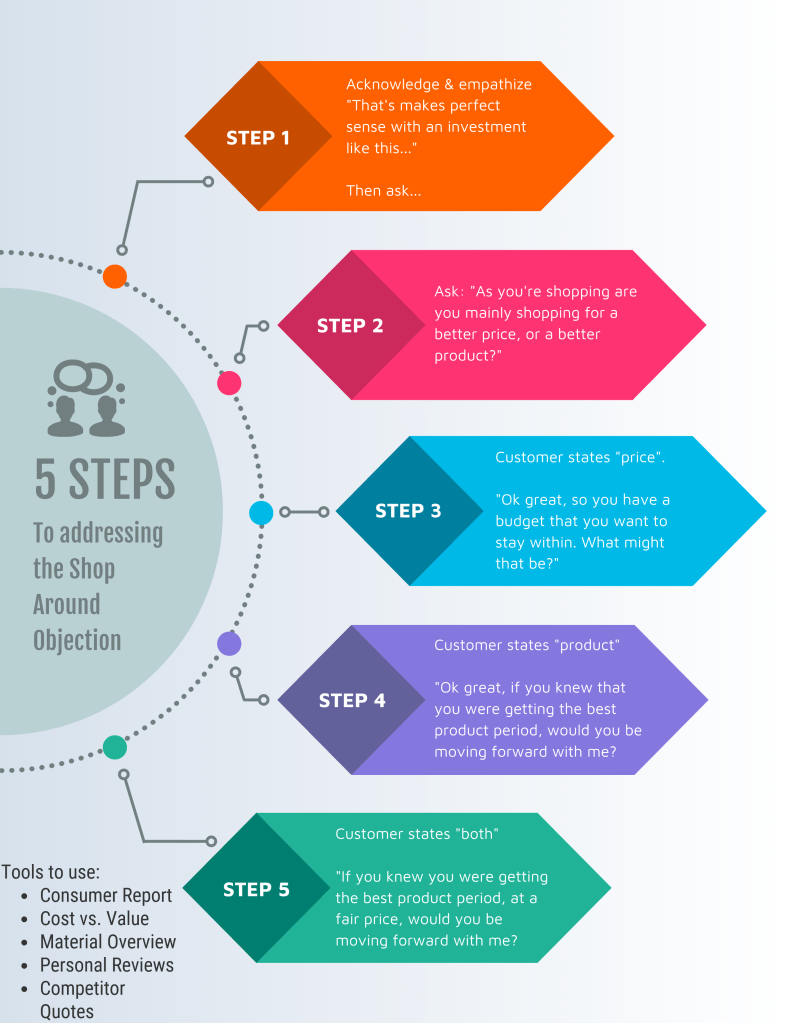
5 Steps To Addressing the Shop Around Objection

The closing stage of a sales presentation is one of the toughest- it’s fraught with emotions on both sides of the table. Customers begin to feel the tension of making a decision, and salespeople begin to battle the anticipated emotions of rejection, uncertainty, and stress.

Legendary sales trainer Brian Tracy states that whenever a customer experiences the emotions of the close “they retreat and begin to say things like, ‘let me think it over, ‘or can you email me the quote’, or ‘we need to get other quotes’, ‘I need to talk it over with someone else’, and so on.

It’s this sales resistance that necessitates a closing process. Otherwise as salespeople we begin to push for a result. The result is the process!

What’s the point of eating a bowl of ice cream: to get to the end, or savor every bite? My bet is that if you are a results driven person- you want to get to the end of that bowl as fast as possible. How about a goal of an exercise program? Unless you’re a professional athlete, the goal is to maintain a level of personal satisfaction.

Sales Coach and author of “Selling for Dummies”, Keith Rosen shares that “you don’t do a result; you execute a process, which produces the result as a natural by-product of your efforts.” To get better results you must focus on the process.

A well practiced closing process allows you to convey confidence. To address the shop around objection devote your attention to following the process and you’ll find that more of your customers will choose you rather than shop around.

When you don’t have an objection process

10 Strategies to prevent:”I lost the customer to price”

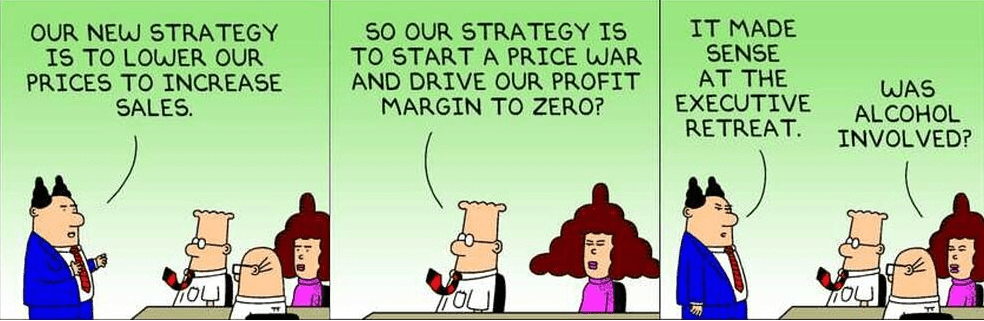
Dilbert on Price

Nothing happens until a sale is made. There are a lot of things that have to happen before a customer signs on the dotted line, but lastly, a sales rep and customer must agree on a price. At one time or another, we’ve all had our prices challenged. I’ve heard many sales people proselytize their closing abilities and tactics. The question becomes of these great closer’s is, have they protected price and margins? It doesn’t take an expert sales person to seal the deal when they’ve simply folded on price once the customer posed a pricing concern.

Avoid Price Driven Conversations

To persevere through pricing objections, your self-assurance is critical. Being confident in what you say is paramount in presenting price (Want a 1:45 second course on CONFIDENCE ?) When the customer requests a discount, respond by asking, “before we get into that, what value do you see in what I’ve presented thus far?” In reality if a customer can’t, or refuses to, answer that question, then the decision is made solely on price and I bet there are other cheaper options for your customer.

The worst thing sales people can do when a customer is looking for a price break is to give in. Jeb Blount, author and sales expert, states that customers may not have gone to sales university, but they’ve definitely gone to buyers university. Many customers know that if they give the least bit of price resistance a sales person will immediately offer price concessions. To overcome this problem, sales people need to understand, in real terms, how their prospect can benefit from your product or service- from their perspective.

A great example that I learned from Keith Rosen. If I’m taking a trip and my destination is 1,000 miles away, I have several options. I could hitchhike, which would cost me virtually nothing, but wouldn’t guarantee when I’d arrive. I could drive my car, limiting my immediate costs to the necessary gasoline, but my trip could take several days. Or, I could fly, which would probably be my highest-priced option, but would be the fastest.

You can see from my travel example that the cheapest option is not reliable, nor would it save time. In addition, most people wouldn’t want to take several days to drive to and from their destinations. Therefore, because of the time it will save, the best option is to fly, even though it’s probably the most expensive choice. Since time is of the essence for many folks, its value is worth the extra money. Cutting the price is clearly not beneficial or efficient for the customer.

Confidence Is key Everything

To hold firm on price you need to have a high level of confidence. One of the best ways to feel confident is by maintaining a full sales pipeline. When a sales person doesn’t have a full-pipeline, or lacks the ability to generate more customers, or doesn’t fully nurture past customers, they rely on each potential sale that a customer may propose. Sales people become needy, overzealous, and those emotions lead to the inability to overcome price objections.

Jeffrey Gitomer Sales Training

Sales Bit: 8 Closing Guidelines to get sales this week!

8 Closing Guidelines to get sales this week!


Closing  is one aspect in sales that separates those who will enjoy a long prosperous career and those who end up making excuses for lack of results. My experience in complex selling situations and face to face consumer sales have taught  me that regardless of what type of selling you are doing there are closing guidelines that are universal. Closing doesn’t have to be difficult for you or your customers, but often that’s exactly how we make it. Here are 8 guidelines to getting agreement…

Closing isn’t slick, it’s not something that you do TO someone, but rather WITH someone.

Closing starts from the minute that you say hello with making a connection with the customer..not when you begin your service or product presentation. Some would argue it even starts before hello in pre-call planning.

If you’re not a product expert or an expert on your competitors you’ll never have the success you really want in closing. (what does your competition offer in service, reputation, product quality, how are you better?)

It’s always been helpful for me to view objections as questions.  Rephrase them in your mind and they are much easier to handle. For example: “Your price is too high”..I hear it as “Help me understand the value for me? You can go through many of the common objections that you hear and rephrase them. Write them down and train your brain!

Always position your response to the best interest of the customer. If you can’t, you’re selling for you not the customer. Customers pick up on this.  Put yourself in a position to make a professional recommendation, “Based on what you’ve shared to be important, here is what I recommend.”

Ask questions! You will not know what is important to the customer if you’re not asking. (be more creative than just asking, “what’s important to you?”, too obvious!)  I’ve seen sales professionals present too early and way too often in areas the customer has no interest. In these situations solutions are rarely built around needs, but rather just thrown out to see what sticks.

Ask for the sale! Sales professionals who aren’t confident closers rely on their product knowledge and presentation expecting customers to just say “yes”.


Get comfortable with being uncomfortable in closing situations. That means being prepared to ask tough questions to know exactly where you and your customer are in the process. Challenge a stall by asking “What hesitations do you have?”, or “What risks do you foresee with moving forward?”

There are volumes of material that has been written on closing techniques. I encourage you to continually study and improve on this area of your sales game. Send me an email for a list of books that have helped me gain the right closing mindset

Click on the Subscribe button to get updates on new post. I look forward to connecting with you on Twitter or LinkedIn. Please share your selling experiences.  I appreciate any and all feedback on post.