“We are not as rational as we think we are, but we are rational enough to think we are rational.” -Dan Ariely
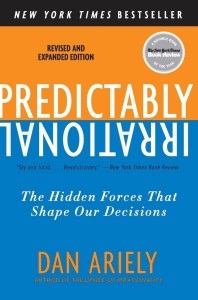
Predictably Irrational by Dan Ariely is a thought-provoking book that delves into the realm of behavioral economics and the irrationality of human decision-making. Ariely, a professor of psychology and behavioral economics, provides an engaging and informative book that explores the various ways in which people make decisions, often in ways that are not rational or logical.
The chapters are divided into different aspects of human behavior. Ariely uses a combination of personal anecdotes, experiments, and studies to illustrate his points, making the book an easy and thought-provoking read.
One of the key themes of Predictably Irrational is the idea that people often act against their own best interests. Ariely argues that people make decisions based on emotions and biases rather than rational thought, resulting in poor decision-making and negative outcomes. For example, he highlights the concept of “anchoring,” where people rely too heavily on the first piece of information they receive when making a decision, even if it’s irrelevant or inaccurate.
Another important theme of the book is the idea that people are highly influenced by social norms and peer pressure. Ariely explains how our desire to fit in and be accepted can lead us to make irrational decisions, such as conforming to group norms even when they go against our own beliefs.
The style of the book is informative and engaging, with Ariely’s examples making complex concepts easy to understand. However, it’s worth noting that Predictably Irrational is not a book that provides easy answers or quick fixes. Instead, it challenged me to rethink my assumptions about human behavior and the decision-making process.
As a sales professional, I found the insights in Predictably Irrational to be incredibly applicable. The book helped me understand the ways in which customers make decisions, and how I can use this knowledge to deliver a more customer centric sales approach. For example, by understanding the concept of anchoring, I can present my products and services in a way that sets a positive first impression and reduces resistance.
Dan Ariely provides several insights around pricing and purchasing behavior. One key insight is that people’s perception of value is often influenced by the price of a product or service. For example, Ariely found that people are more likely to perceive a wine as tasting better if they are told that it is more expensive, even if the wine is actually the same as a cheaper option.
Another insight is that people are often willing to pay more for a product or service if they feel that they are getting a “deal”. Ariely found that people are more likely to buy a product that has a higher price with a discount than a lower-priced product with no discount, even if the actual price paid is the same.
Ariely also argues that people are more likely to make a purchase if they have an emotional connection with the product or service. For example, people are more likely to buy a product if it is presented in a way that appeals to their emotions or personal values.
Ariely’s insights around pricing and purchasing behavior suggest that people’s decision-making when it comes to buying products and services is often influenced by emotions, biases, and perceptions of value. Understanding these factors can help businesses and sales professionals to develop more effective pricing and marketing strategies.
Overall, Predictably Irrational is a must-read for anyone interested in behavioral economics, psychology, or human decision-making. While it’s not a book that provides easy answers or guarantees success, it’s a fascinating exploration of the science behind our choices and a valuable tool for anyone looking to improve their sales results. My only criticism of the book is that it occasionally feels repetitive, with some of the concepts being revisited multiple times. However, this is a minor quibble in an otherwise excellent read.
Here are 10 reflection questions to use while reading “Predictably Irrational” by Dan Ariely:
- What are some examples from your own life where you’ve made irrational decisions based on emotions or biases?
- How can understanding the concept of anchoring help you make better decisions in your personal or professional life?
- In what ways do social norms and peer pressure influence your decision-making?
- How can you apply the insights from the book to improve your sales approach or marketing strategies?
- What impact does the concept of “fairness” have on your decision-making?
- How can you use the insights from the book to make better financial decisions, such as saving money or investing?
- Have you ever been influenced by the perceived value of a product or service? How can you avoid being swayed by this in the future?
- In what situations do you find yourself making decisions based on incomplete or inaccurate information? How can you improve this?
- How can you use the insights from the book to improve your personal relationships or communication with others?
- What are some practical steps you can take to overcome your own biases and make more rational decisions in the future?


 Catalyst Consulting