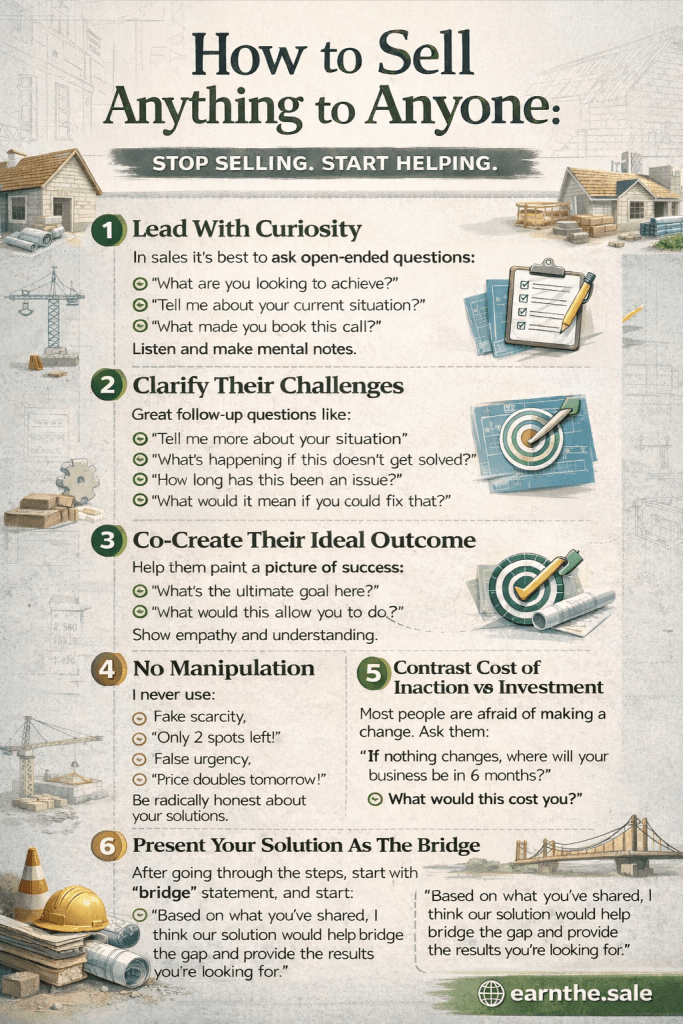
6-Step Consultative Process

“While most salespeople cringe at the sound of objections, top performers see objections as a roadmap to close deals. They embrace objections, knowing that the path to success is paved with them.”
Jeb Blount
In Jeb Blount’s “Objections: The Ultimate Guide for Mastering the Art and Science of Getting Past No,” you’ll be taken on a journey through the challenging yet essential world of sales objections. Blount, a popular sales expert, delves into the art and science of handling objections, equipping sales professionals with the tools they need to overcome obstacles and achieve greater success.
One of the most striking aspects of this book is its emphasis on the importance of mindset and attitude in the face of objections. Blount highlights that objections are not roadblocks but rather opportunities for growth and understanding. By shifting our perspective, objections can be seen as gateways to building stronger relationships and closing more deals. This theme resonates throughout the book, reminding readers to approach objections with curiosity, empathy, and a determination to find common ground.
Blount’s writing style is conversational and accessible, making it easy for both seasoned sales professionals and newcomers to grasp the concepts presented. He combines real-life anecdotes, practical tips, and psychological insights, creating a comprehensive guide that covers a wide range of objection scenarios. From common objections like price and competition to more complex ones involving trust and credibility, Blount leaves no stone unturned.
One of the crucial takeaways from “Objections” is the concept of active listening. Blount emphasizes the significance of truly understanding the objections raised by prospects instead of merely reacting to them. By actively listening, paraphrasing, and asking clarifying questions, salespeople can uncover the underlying concerns behind objections and address them effectively. This approach not only builds trust but also enables sales professionals to tailor their responses to meet the specific needs of their prospects.
I can attest to the impact “Objections” has had on me as a sales professional, sales trainer, and sales manager. Many, who I’ve shared these insights with, have developed an enhanced ability to navigate objections, resulting in increased closing rates and improved customer relationships. By applying the techniques outlined in the book, my sales teams have been able to build stronger connections with their prospects, understand their pain points, and find mutually beneficial solutions.
Jebs work is a valuable resource for sales professionals seeking to refine their objection handling skills. Blount’s emphasis on mindset, active listening, and empathy sets this book apart, offering a fresh perspective on how to approach objections in the sales process. By internalizing and deploying the concepts presented, sales professionals can expect to see positive results in their interactions with prospects.
Here are ten reflection questions based on the main concepts of the book:
These reflection questions can help you deepen your understanding of the book’s concepts and prompt you to consider how you can apply them to your own sales practice.

Selling home improvements can be a lucrative business, but it can also be challenging, especially during times of economic uncertainty. With many homeowners tightening their belts and cutting back on expenses, it can be difficult to convince some to invest in home renovations. However, with the right sales techniques, you can still close deals and grow your business even during a recession.
Here, I’ll share some of the top recession-proof sales techniques for selling home improvements to homeowners. From building trust to offering financing options, we’ll cover everything you need to know to close more deals and thrive in a challenging market.
One of the most important things you can do as a salesperson is to build trust with your potential customers. Homeowners want to work with someone they can trust to do a good job and not take advantage of them. In a recession many businesses will be cutting costs in an effort to lower prices and in doing so quality can suffer. In a race to the lowest price, homeowners are willing to pay more for companies they can trust. Here are some ways to build trust with your customers:
By building trust with your customers, you’ll be more likely to close deals and earn repeat business.
During a recession, many homeowners may be hesitant to spend money on home improvements, even if they’re necessary. Offering financing options can help make your services more accessible and affordable. This is another area where some business will see financing as an expense and look for cost-savings by either limiting financing options or eliminating them. Here are some financing options you can offer:
By offering financing options, you can make your services more accessible to a wider range of customers and increase your chances of closing deals.
Creating a sense of urgency can be a powerful sales technique, especially during a recession when customers may be more hesitant to spend money. Here are some ways to create a sense of urgency:
By creating a sense of urgency, you can encourage your customers to act quickly and increase your chances of closing deals.
Homeowners may have objections to investing in home improvements, especially during a recession. Here are some common objections and how to overcome them:
“It’s too expensive”: Offer financing options or emphasize the long-term benefits of the investment. For products or services that have a strong return on investment, whether through greater resale value or energy-savings, long-term financing options let these homeowners offset the initial costs through a low cost of ownership.
“I don’t have time”: Emphasize the convenience and time-saving benefits of your services. You can also work with the customer to create a timeline that works for them.
“I’m not sure it’s necessary”: Emphasize the potential cost savings and energy efficiency that come with home improvements. You can also provide references or testimonials from previous customers who have seen the benefits of your services.
By addressing objections and providing solutions, you can help your customers overcome their reservations and close more deals.
Upselling and cross-selling can be effective sales techniques for increasing the value of each sale. Here are some tips for upselling and cross-selling:
Offer complementary services: If a customer is interested in one service, offer a related service that complements it. For example, if they’re interested in a window replacement, offer to also update their entry door as well.
Suggest upgrades: If a customer is considering a certain product or service, suggest an upgraded version that offers more features or benefits.
Large project discounts: Offer discounts for jobs that keep crews busy and reduces downtime to encourage customers to invest in larger projects.
By upselling and cross-selling, you can increase the value of each sale and grow your business.
Selling home improvements during a recession can be challenging, but it’s not impossible. By building trust, offering financing options, creating a sense of urgency, overcoming objections, and upselling and cross-selling, you can increase your chances of closing deals and growing your business. Remember to be honest, transparent, and customer-focused throughout the sales process, and you’ll be well on your way to recession-proof success.
“We are not as rational as we think we are, but we are rational enough to think we are rational.” -Dan Ariely

Predictably Irrational by Dan Ariely is a thought-provoking book that delves into the realm of behavioral economics and the irrationality of human decision-making. Ariely, a professor of psychology and behavioral economics, provides an engaging and informative book that explores the various ways in which people make decisions, often in ways that are not rational or logical.
The chapters are divided into different aspects of human behavior. Ariely uses a combination of personal anecdotes, experiments, and studies to illustrate his points, making the book an easy and thought-provoking read.
One of the key themes of Predictably Irrational is the idea that people often act against their own best interests. Ariely argues that people make decisions based on emotions and biases rather than rational thought, resulting in poor decision-making and negative outcomes. For example, he highlights the concept of “anchoring,” where people rely too heavily on the first piece of information they receive when making a decision, even if it’s irrelevant or inaccurate.
Another important theme of the book is the idea that people are highly influenced by social norms and peer pressure. Ariely explains how our desire to fit in and be accepted can lead us to make irrational decisions, such as conforming to group norms even when they go against our own beliefs.
The style of the book is informative and engaging, with Ariely’s examples making complex concepts easy to understand. However, it’s worth noting that Predictably Irrational is not a book that provides easy answers or quick fixes. Instead, it challenged me to rethink my assumptions about human behavior and the decision-making process.
As a sales professional, I found the insights in Predictably Irrational to be incredibly applicable. The book helped me understand the ways in which customers make decisions, and how I can use this knowledge to deliver a more customer centric sales approach. For example, by understanding the concept of anchoring, I can present my products and services in a way that sets a positive first impression and reduces resistance.
Dan Ariely provides several insights around pricing and purchasing behavior. One key insight is that people’s perception of value is often influenced by the price of a product or service. For example, Ariely found that people are more likely to perceive a wine as tasting better if they are told that it is more expensive, even if the wine is actually the same as a cheaper option.
Another insight is that people are often willing to pay more for a product or service if they feel that they are getting a “deal”. Ariely found that people are more likely to buy a product that has a higher price with a discount than a lower-priced product with no discount, even if the actual price paid is the same.
Ariely also argues that people are more likely to make a purchase if they have an emotional connection with the product or service. For example, people are more likely to buy a product if it is presented in a way that appeals to their emotions or personal values.
Ariely’s insights around pricing and purchasing behavior suggest that people’s decision-making when it comes to buying products and services is often influenced by emotions, biases, and perceptions of value. Understanding these factors can help businesses and sales professionals to develop more effective pricing and marketing strategies.
Overall, Predictably Irrational is a must-read for anyone interested in behavioral economics, psychology, or human decision-making. While it’s not a book that provides easy answers or guarantees success, it’s a fascinating exploration of the science behind our choices and a valuable tool for anyone looking to improve their sales results. My only criticism of the book is that it occasionally feels repetitive, with some of the concepts being revisited multiple times. However, this is a minor quibble in an otherwise excellent read.
Here are 10 reflection questions to use while reading “Predictably Irrational” by Dan Ariely:
If you want to get paid what you’re worth here are eight ways to sell value – not price
1. Be Unique. If there is nothing that differentiates you from your competition you become common. Webster defines the word common as, “ordinary or not special” and the only way buyers select one common service over another is price. Take inventory of your skills, experience and knowledge. Are you a specialist in some area? Are you an expert in certain facets of your business? These and other differentiators can make you unique and valuable to a select group of clients.
2. Choose Your Clients Carefully: Don’t ever let your clients choose you or you will be at their mercy. If a deal is going to close successfully, the true professional should be in control, not the client. To begin controlling your business, write down the attributes of the people you want as clients and then go out and get them with targeted marketing. I hope the first item on your list of attributes is that they are people you enjoy spending time with. Being a business owner is far too difficult to work with people you don’t like just to earn a living. Turn away people who don’t meet your criteria. When you reject or refer clients it tells the world that you don’t just work with anyone, you are selective which raises your perceived value. It also makes you unique from other businesses who will work with anyone who can bring them a paycheck.
3. Set High Standards: If you work with anyone and everyone your value drops. If people have to qualify to work with you your value increases. Of course you know that there are prospects who will ask you to give them a bid with no intention of ever buying from you. They’re planning to use your bid to leverage a discount with their current vendor or any one of a dozen other reasons that they want your knowledge but not your services. Then there are buyers who will use your time and then purchase through another vendor. Don’t ever meet with a potential client until you ask a logical list of questions to determine their seriousness and loyalty. You need to know their motivation and if they are interviewing other vendors. You also need to know if they’re financially qualified. If you don’t have serious, financially solvent, and loyal clients, your valuable time may be better spent somewhere else.
4. Compete On Value, Not Price: No disrespect intended to other business models, but it doesn’t take any special skill, experience or knowledge to compete on price. All you have to do is be the cheapest, but this is a losing game. History reminds us of the housing price wars of the mid 2000’s when there were more houses that people in the market. To gain market share, one would cleverly lower its price, but then all the others quickly followed suit and the only result was that everyone’s profit margin was reduced.
The way to get paid what you’re worth is to visibly demonstrate your value to your clients. If you find that difficult to do make sure you work with vendors that can help you in that conversation to your end customer. Competing on price does not create value.
5. Create Value In The Eyes Of Clients: Frankly, most people throughout the country believe that people in sales do little to earn their commissions. This is our fault because we should be educating them about how hard we work before ever accepting them as clients. Keeping prices firm is a problem for many business’s until you start tracking all the different duties required to earn your pay. I suggest you developed lists of activities that you do for customers. This amazes clients because most have no idea how complicated their orders sometimes can be (whether it’s manufacturing, servicing, fulfillment, etc.) Since sales reps and business owners began creating these lists they’ve rarely, if ever, have had to cut prices. If a prospect asks for a discount simply show them the list and say, “Here are just some of the activities I must complete to earn my money. Why don’t you point out the things that you’d be willing to do instead of me. If you save me time then we can talk about saving you money because I earn every penny I get.” When confronted with a list that runs nearly ten pages long their eyes glaze over and they usually respond with something like, “You’re the expert, I expect you to do this work!” To which you simply say, “If you want me to do all of these activities on your behalf then I need to paid what I’m worth. If you want to pay less, I’ll see if I can find someone who will do less and maybe they can save you some money.”
6. Educate Your Clients About How Much You Make. After speaking to thousands of sales reps, customers and business owners all over the country for the past 20 years it’s clear to me that the average prospect is clueless about how your prices are determined, factoring in overhead and other expenses you have to run your businesses. Customers often get caught up in comparing product specs while not taking into account the business model. For many business owners they have chosen a business model that either adds more value to the customer experience, thus increases overhead, or have chosen a business model that reflects a pricing strategy. The latter typically involves reducing overhead; service reps, technicians, all benefits that lead to customer retention, and these decisions affect the customer experience as well. When agents are trained to speak to these differences a customer can evaluate if the additional costs equates to adding value to meet their expectations.
7. Provide value that no one else offers. When prospects do business with you, do they get a complete outline that explains your process from start to finish? Does it include samples, a list of service providers that could be involved in the process? Other competing business may not offer any of these benefits, so if a client wants to work with you they must pay what you ask.
8. Reject price shoppers. Studies show that only 15-18% of people make their decision to purchase a product or service primarily based on price. This means that the majority of clients appreciate value and are willing to pay for it – if they see it.
Don’t forget that real professionals earn their money by helping clients maximize value, minimize costs, save time, and much more. If potential clients don’t appreciate this then feel free to refer them to your competition.
Sales Bit on Confidence
In my experience coaching sales reps, building confidence is a topic that comes up time and time again. Sales can be tough and with the amount of rejection sales professionals hear confidence often dips. The ability to maintain confidence will make or break any sales professional. You develop confidence in yourself by taking risk and pushing through. Build confidence in your product by becoming a product or service knowledge expert. Talk to past customers and ask them about their experiences. Build a list of testimonials to cement the confidence you build in your product. Surround yourself with confident people.
By developing a process of maintaining and building your level of confidence you will have a much greater influence on your customers and the people surrounding you. People like and gravitate towards a confident decisive person.
Success breeds confidence, but which comes first? That is the trick. We’ve all heard the “fake it till you make it” cliche. Sometimes confidence can be faked, but more often than not you can see right through it in selling situations. Focus on building lasting confidence.
Here are some tips to conveying confidence :
Look for situations around you to practice building confidence in your presentation and conversations. The reel tape that you play in your head should revolve around successful scenarios not potential failures. Often times sales professionals lose the sale in their heads long before they arrive at the customer. Starting off I’ve found that it’s helpful to focus on being process oriented rather than goal oriented. For example, in building rapport use a simple process that has worked for me:
F.O.R.M.
F. amily (the customer, where they are from, etc)
O. ccupation (how long in position, etc)
R. ecreation (similar hobbies, do for fun)
M. e (transition to you or your message)
To build good rapport you must have good FORM. It’s easy to remember..
Confidence will come with practice, but don’t let any lack of confidence prevent you from starting. Jump right in and begin your process to confidence.
Make sure you subscribe or follow me on twitter to receive updates on new post!
 Catalyst Consulting