Fueling Sales Leadership Success: Unleashing the Power of ‘Leaders Eat Last’ by Simon Sinek” ๐Ÿ“š

Leadership protects an organization from the internal rivalries that can shatter a culture. When we have to protect ourselves from each other, the whole organization suffers. But when trust and cooperation thrive internally, we pull together and the organization grows stronger as a result.

Simon Sinek

In sales leadership and management, Simon Sinek’s “Leaders Eat Last” stands as a thought-provoking and insightful guide that challenges conventional notions of leadership and offers a fresh perspective on how it can impact a sales teams results. Through a blend of real-life stories, research-backed insights, and practical advice, Sinek took me on a journey to understand the true essence of leadership and its profound implications for success in the sales management profession.

One of the book’s central themes revolves around the idea that great leaders prioritize the well-being and success of their team members above all else. Sinek draws inspiration from the military, where leaders are taught to put the needs of their soldiers before their own. By exploring the concept of “leaders eating last,” Sinek emphasizes the importance of creating a supportive and nurturing environment within sales teams, where individuals feel valued, safe, and motivated to give their best.

Sinekโ€™s writing is both informative and engaging, making it accessible to a wide range of aspiring and tenured leaders, including those outside the sales field. Sinek’s storytelling shines through as he weaves together anecdotes and research to drive home his message. From exploring the culture of trust and cooperation in the Marines to delving into the neurochemical basis of human behavior, Sinek combines personal narratives with scientific evidence, making the book a captivating and enlightening read.

For sales leaders and managers, “Leaders Eat Last” offers several important takeaways. Firstly, it underscores the significance of building a strong team culture based on trust, collaboration, and shared values. Sinek argues that when individuals feel a sense of belonging and safety within their team, they are more likely to take risks, innovate, and go the extra mile to achieve sales targets. By fostering a supportive environment, leaders can inspire their teams to reach new heights of performance and drive outstanding results.

Moreover, the book highlights the importance of servant leadership in the sales profession. Sinek emphasizes that leaders who prioritize the needs of their team members, providing the necessary resources, guidance, and support, create a sense of loyalty and commitment that directly impacts sales outcomes. By empowering their sales teams and removing obstacles, leaders can unleash their full potential and foster a culture of excellence.

While “Leaders Eat Last” offers valuable insights and practical applications for the sales profession, it is not without its limitations. Some may find the book overly idealistic, with Sinek painting a somewhat utopian picture of leadership. This where a readers experience with real-world challenges can provided concrete strategies for overcoming them. Additionally, the book’s focus on the military as a primary source of inspiration may not resonate with all readers, particularly those who are unfamiliar with or have reservations about military leadership models.

In conclusion, “Leaders Eat Last” is a compelling and thought-provoking book that has the potential to impact sales leadership and management results. By challenging traditional notions of leadership and emphasizing the importance of creating a supportive and nurturing environment, Simon Sinek offers practical insights and strategies that can transform sales teams and drive exceptional performance. While the book may have its idealistic moments and could benefit from a more diverse range of examples, it remains a valuable resource for sales professionals seeking to enhance their leadership skills and achieve outstanding results.


Here are 10 key leadership principles from “Leaders Eat Last” by Simon Sinek:

  1. Prioritize the needs of your team members above your own.
  2. Create a culture of trust, cooperation, and shared values within your team.
  3. Serve as a role model by embodying the qualities and behaviors you expect from your team.
  4. Empower your team members by providing them with the necessary resources, guidance, and support.
  5. Foster a sense of belonging and safety within your team to encourage risk-taking and innovation.
  6. Communicate openly and honestly, keeping your team informed and engaged.
  7. Practice active listening and show genuine interest in the ideas and concerns of your team members.
  8. Encourage collaboration and teamwork to leverage the collective intelligence and capabilities of your team.
  9. Recognize and appreciate the contributions and achievements of your team members.
  10. Continuously develop your own leadership skills and seek feedback to grow and improve.

Here are 10 reflection questions that readers can use as a complement to the book “Leaders Eat Last” by Simon Sinek:

  1. How can I prioritize the needs of my team members above my own in my current leadership role?
  2. What steps can I take to create a culture of trust, cooperation, and shared values within my team?
  3. In what ways can I serve as a role model for my team and embody the qualities and behaviors I expect from them?
  4. How can I empower my team members by providing them with the necessary resources, guidance, and support?
  5. What actions can I take to foster a sense of belonging and safety within my team, encouraging risk-taking and innovation?
  6. How can I improve my communication skills to ensure open and honest dialogue with my team members?
  7. What steps can I take to actively listen to and show genuine interest in the ideas and concerns of my team members?
  8. How can I promote collaboration and teamwork to leverage the collective intelligence and capabilities of my team?
  9. How can I better recognize and appreciate the contributions and achievements of my team members?
  10. What strategies can I implement to continuously develop my own leadership skills and seek feedback for personal growth and improvement?

By reflecting on these questions, you can deepen your understanding of the book’s concepts and apply them to their own leadership practices, ultimately enhancing their impact as sales leaders and managers.


Ready to take your sales game to the next level? ๐Ÿš€

Don’t miss out on exclusive tips, insights, and strategies to boost your sales and sales leadership skills! Hit the subscribe button and join a community of sales enthusiasts like yourself!

๐Ÿ“ฉ Stay up-to-date with the latest blog posts, packed with practical advice and real-world examples that will help you close more deals and inspire your sales team.

๐Ÿ”— Want more valuable content? Check out the library of articles for a treasure trove of sales wisdom just waiting to be discovered. From prospecting techniques to negotiation tactics, I’ve got you covered!

๐Ÿ‘ If you found this article helpful, give a thumbs up and share it with your network. Help spread the word and empower others to achieve sales excellence!

Remember, success in sales starts with knowledge and continuous learning. Don’t miss out-subscribe, explore, and share today!
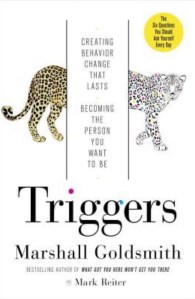
Book Review ๐Ÿ“š Triggers: Creating Behaviors that Last, by Marshal Goldsmith

Triggers: Creating Behaviors That Last – Becoming the Person You Want to Be by Marshall Goldsmith is a powerful book that delves deeply into the psychology of behavior change. Goldsmith, a renowned executive coach, shares his insights on how to create lasting change in our lives and become the person we want to be.

One of the key themes of the book is that behavior change requires a conscious effort on our part. Goldsmith explains that our environment and the people around us can trigger certain behaviors, both positive and negative. He uses the term “triggers” to describe these environmental cues that can influence our behavior. By becoming aware of our triggers and taking action to modify them, we can create new habits and behaviors that will serve us better.

Outside of our environment, our internal beliefs that can stop change. An awareness of these beliefs, along with self-reflection, can turn these beliefs into positive triggers for success. These beliefs include:

  1. “I have willpower and won’t give in to my triggers.” This belief can be problematic because it assumes that willpower alone is enough to overcome triggers and change behavior, when in reality willpower is a limited resource that can be depleted quickly.
  2. “I’m right and others are wrong.” This belief can prevent us from being open to feedback and new ideas, and can make it difficult to make changes in our behavior.
  3. “I’m a victim of my environment.” This belief can make us feel powerless to change our circumstances, and can prevent us from taking action to modify our environment and our behavior.
  4. “I’m too busy and don’t have time to change.” This belief can be a convenient excuse for avoiding the hard work of behavior change, and can prevent us from making progress toward our goals.
  5. “I’ve tried before and failed, so why bother trying again?” This belief can be a self-fulfilling prophecy that prevents us from making new attempts at behavior change and can keep us stuck in unhelpful patterns.

Goldsmith suggests that these beliefs can be overcome by adopting a growth mindset, being open to feedback and new ideas, and developing a sense of accountability to ourselves and to others. By doing so, we can create lasting change and become the person we want to be.

The writing style of the book is direct and practical, with Goldsmith offering a wealth of actionable advice and exercises that help to implement his ideas. He also emphasizes the importance of accountability, both to ourselves and to others, in order to stay on track and achieve our goals.

A tip that Goldsmith suggests to drive personal accountability is to ask the five questions below at the end of each day. He offers some interesting research data (although anecdotal at best) conveying the efficacy of these questions and goal achievement.

  1. Did I do my best to set clear goals today?
  2. Did I do my best to make progress toward my goals today?
  3. Did I do my best to find meaning and purpose in my work today?
  4. Did I do my best to be happy today?
  5. Did I do my best to be fully engaged in my interactions with others today?

As a sales professional, I found this book to be incredibly valuable. Sales is a highly competitive field, and success often requires a combination of skill, discipline, and perseverance. Goldsmith’s insights on behavior change are directly applicable to the sales profession, as we constantly face challenges and opportunities that can trigger positive or negative behaviors. By developing greater awareness of our triggers and consciously modifying our behavior, we can become more effective salespeople and achieve greater success.

One important takeaway from the book is the importance of setting achievable goals. Goldsmith emphasizes that small, incremental changes can lead to significant improvements over time. By setting specific, measurable goals and tracking our progress, we can build momentum and create lasting change in our behavior.

Another key lesson from the book is the importance of humility and openness to feedback. Goldsmith encourages readers to seek out constructive feedback from others and to be open to criticism. By doing so, we can identify areas for improvement and make the necessary changes to become better versions of ourselves.

Overall, I highly recommend Triggers: Creating Behaviors That Last – Becoming the Person You Want to Be to anyone looking to create positive change in their lives. While the book is not without its flaws, particularly in its somewhat repetitive structure, the insights and advice it offers are invaluable. As a sales professional, I have found the concepts and strategies outlined in the book to be directly applicable to my work, and have seen tangible improvements in my sales results as a result of implementing Goldsmith’s advice.


Following are ten reflection questions based on my reading. These questions are designed to facilitate reflection on the key concepts and strategies outlined in the book, and to help you apply them to your own professional development and career goals.

  1. What triggers have I identified in my own life that influence my behavior, both positively and negatively?
  2. How can I modify my environment to support positive behavior change and eliminate triggers that lead to negative behavior?
  3. What specific, measurable goals can I set for myself to create lasting change in my behavior?
  4. How can I hold myself accountable to these goals and monitor my progress?
  5. What is my mindset toward feedback, and how can I become more open to constructive criticism and suggestions for improvement?
  6. How can I develop a sense of humility and acknowledge that I don’t have all the answers?
  7. How can I cultivate a growth mindset and approach behavior change as an opportunity for learning and development?
  8. How can I build stronger connections with others and seek out support and guidance in my behavior change efforts?
  9. What role does urgency play in my behavior, and how can I manage it more effectively?
  10. How can I find meaning and purpose in my work, and use it as a source of motivation and inspiration for behavior change?

Want to join me on Goodreads?

Book Review: The War of Art, by Steven Pressfield

“Resistance is the most toxic force on the planet. It is the root of more unhappiness than poverty, and disease. To yield to Resistance deforms our spirit. It stunts us and makes us less than we are and were born to be.”

“The War of Art”, by Steven Pressfield, is a book that every artist, writer, musician, or creative person should read. It is a compelling manifesto that explores the nature of creativity and the resistance that often hinders us from achieving our full potential.

Pressfield’s book is divided into three parts, each with its own set of insights and wisdom.

Part one, “Resistance: Defining the Enemy”, is a powerful call to action that forces readers to confront the obstacles that prevent us from creating, such as procrastination, self-doubt, and fear.

Part two, “Combating Resistance: Turning Pro”, is a guide to overcoming these obstacles and becoming a professional in our chosen field.

Finally, part three, “Beyond Resistance: The Higher Realm”, explores the spiritual dimension of creativity and the connection between art and the divine.

The book’s tone is straightforward and no-nonsense, with Pressfield’s voice serving as a firm but supportive guide. I found his writing style to be engaging and accessible, with anecdotes and examples that illustrate his points and make the book feel like a conversation with a wise mentor.

One of the main themes of the book is the importance of discipline and perseverance in the creative process. Pressfield argues that to achieve greatness, we must show up every day and do the work, regardless of how we feel or what obstacles we face. He also stresses the importance of taking risks and embracing failure as a necessary part of the creative journey.

Another key theme is the idea that creativity is a spiritual endeavor, and that by tapping into our innermost selves, we can create work that is not only meaningful but transformative. Pressfield encourages readers to trust their intuition and to view their work as a calling rather than a job.

Overall, “The War of Art” is a book that has inspired me to take my own creative work more seriously and to confront the resistance that arises when pushing beyond the status-quo. It has given me actionable ideas and tools that I can use to overcome self-doubt and fear, and it has reminded me that creativity is not just a hobby but a vital part of who I am and who I can continue to become as new challenges come.

“The War of Art” is a must-read for anyone who has ever struggled to create or who has felt that their creative work is not living up to its full potential. It is a book that will inspire, challenge, and ultimately transform.

Here are my five main takeaways from the book:

  1. Resistance is the enemy of creativity, and we must learn to recognize and overcome it.
  2. Discipline and perseverance are essential to achieving greatness in our creative work.
  3. Taking risks and embracing failure are necessary parts of the creative journey.
  4. Creativity is a spiritual endeavor, and by tapping into our innermost selves, we can create work that is transformative.
  5. Trusting our intuition and viewing our work as a calling rather than a job can help us find meaning and purpose in our creative endeavors.

While “The War of Art” is primarily focused on the creative process, its principles can be applied to sales professionals and sales managers as well. Here are some ways the book is very relevant to sales:

  1. Resistance in sales: Just like in the creative process, sales professionals also face resistance in their work. This can manifest as fear of rejection, procrastination, or self-doubt. By understanding the nature of resistance and learning to overcome it, sales professionals can become more effective and successful in their work.
  2. Discipline and perseverance: Sales is a competitive field, and achieving success requires discipline and perseverance. Sales professionals must be willing to put in the hard work and show up every day, even when faced with rejection or setbacks.
  3. Taking risks: Sales professionals are often required to take risks, whether it’s trying out a new sales technique or reaching out to a potential client who may seem out of reach. By embracing the possibility of failure and taking calculated risks, sales professionals can expand their reach and achieve greater success.
  4. Resourcefulness in sales: While sales may not seem like a creative field at first glance, creativity can be an important asset for sales professionals. By thinking outside the box and coming up with innovative solutions to clients’ problems, sales professionals can differentiate themselves from their competitors and build lasting relationships with clients.
  5. Trusting intuition: Sales professionals often rely on their intuition to make quick decisions and build rapport with clients. “The War of Art” emphasizes the importance of trusting our inner voice and intuition, which can be a valuable tool for sales professionals.

Overall, “The War of Art” can provide valuable insights and strategies for sales professionals looking to improve their performance and achieve greater success in their work.

New Year-New You from Tony Robbins

One of my favorite videos to watch from time to time. A great message with important reminders about the habits & rituals that we create daily that lead to success.

We often overlook the importance of daily habits in managing ourselves and our lives. But, it’s often the small changes we make to our daily routines that enable the BIG changes in our lives and careers.

For more insights or to get my 5-Steps to identifying your daily success habits, comment below with “HABITS” and I’ll send to you for download.